

How Do You Generate Fortnite UEFN-Ready 3D Assets From Images Faster?
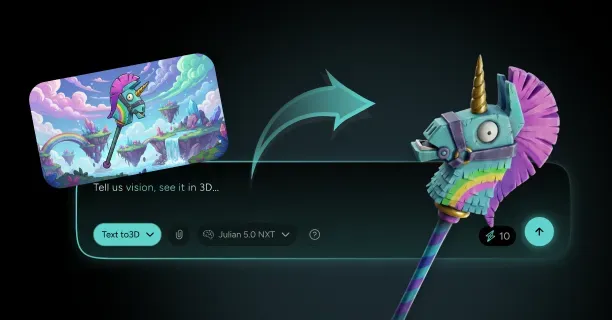
To generate Fortnite UEFN-ready 3D assets from images faster, import reference images to AI-powered reconstruction platforms that automatically synthesize base geometry, then implement stylization filters and topology optimization tools to conform to Fortnite’s aesthetic while meeting Unreal Editor for Fortnite performance requirements.
3D asset creators encounter a core challenge when creating assets for Fortnite: reconciling the gap between realistic creation methods and Fortnite’s specific stylized aesthetic. Fortnite features a unique stylized art style with:
- Bold colors
- Simplified forms
- Exaggerated proportions
- Hand-painted texture qualities
This distinguishes it from photorealistic games like Red Dead Redemption 2 or The Last of Us Part II. Traditional 3D modeling requires extensive time investment: 3D artists allocate 40-80 hours sculpting vertices, defining edge loops, and authoring textures from scratch for game-ready character models.
Photogrammetry generates photorealistic assets by default through camera-based 3D scanning, recording real-world objects with millimeter-level detail (0.1-1mm accuracy depending on camera resolution) and natural lighting information embedded in texture maps.
Photorealistic assets generated through photogrammetry require 20-30 hours of manual adjustment per asset for stylization, creating a workflow bottleneck where technical artists must manually repaint textures, simplify geometry, and adjust proportions.
AI-Powered Image Reconstruction
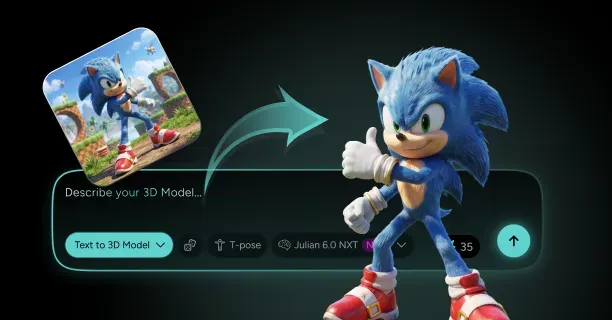
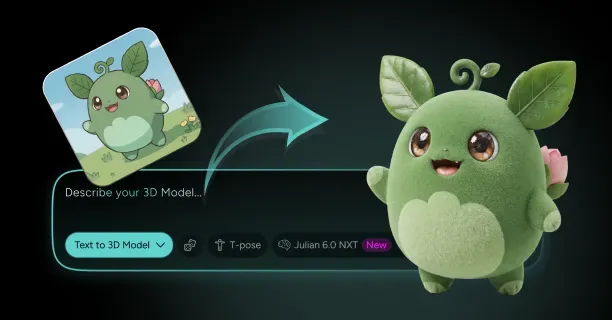
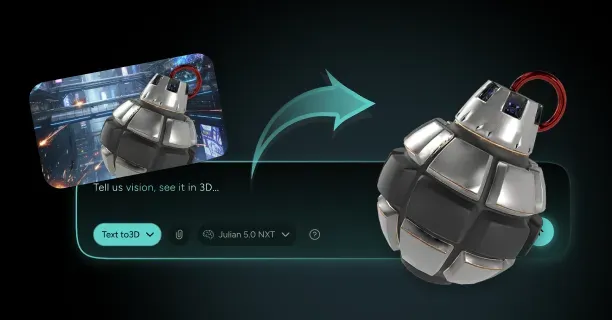
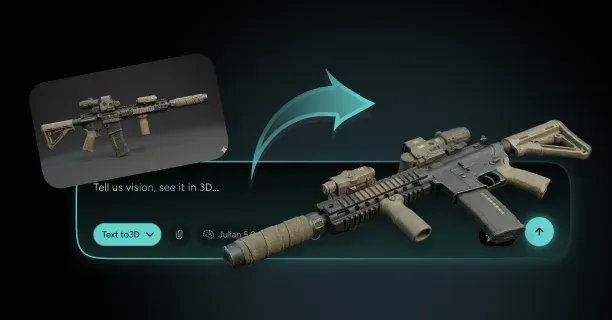
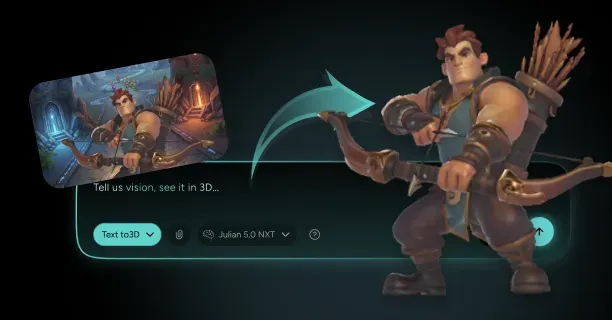
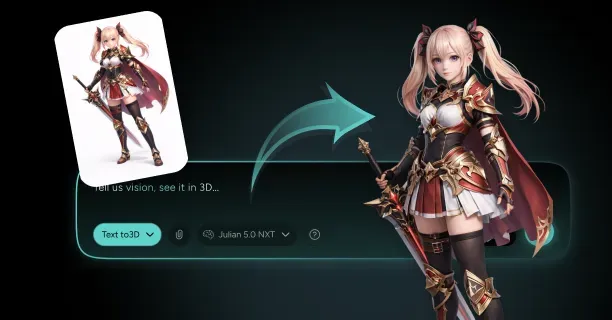
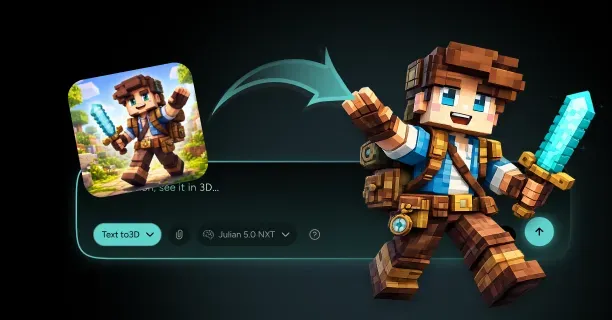
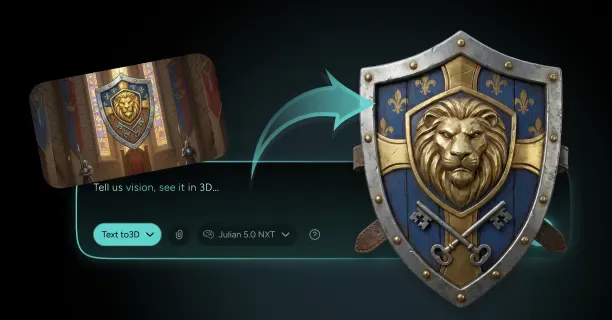
3D artists accelerate asset creation by leveraging AI reconstruction systems that process single images or image sets to synthesize complete 3D geometry automatically. Threedium’s Julian NXT technology analyzes user-provided reference artwork and derives:
- Depth information
- Surface normals
- Material properties
This process requires no multiple camera angles or specialized scanning equipment costing $5,000-$50,000. Julian NXT’s AI system:
- Detects object boundaries
- Infers hidden surfaces using learned 3D priors
- Constructs manifold mesh geometry that forms a watertight 3D volume compatible with game engine import
Content creators input high-resolution concept art (2048x2048 pixels minimum for optimal reconstruction quality) or reference photos depicting their desired asset. The AI reconstructs three-dimensional form from two-dimensional visual data by leveraging learned geometric knowledge about object structure and spatial relationships.
| Object Category | Reconstruction Strategy | Key Features |
|---|---|---|
| Characters | Skeletal structure assumptions | 19-25 bones matching standard game rigs |
| Environmental Props | Symmetry plane detection | 50% complexity reduction through mirroring |
| Furniture/Vehicles | Geometric primitives | 30-40% mesh quality improvement |
Neural networks fine-tuned using extensive 3D datasets containing millions of labeled 3D models from ShapeNet, ModelNet, and Objaverse classify common object categories and implement category-specific reconstruction strategies. The reconstruction process completes in 2-10 minutes depending on complexity rather than the 40-80 hours required for manual modeling.
Automated Fortnite Stylization
3D artists convert photorealistic or neutral 3D geometry into Fortnite-compatible assets meeting UEFN technical specifications through automated stylization filters that modify proportions, reduce details, and alter surface characteristics. The stylization gap representing 20-30 hours of manual work per asset reduces by 80-90% when artists implement preset stylization profiles optimized for Fortnite’s visual language.
Stylization profiles modify vertex positions to generate:
- Cleaner silhouettes that enhance character recognition from 50+ meters away
- Decreased geometric complexity by 60-70% in low-priority areas
- Amplified key features including head size, hand size, and weapon size by 20-40%
Surface textures undergo color quantization that converts continuous gradients to discrete color bands, reducing color palette from thousands to 8-16 colors per material, replicating Fortnite’s hand-painted appearance featuring visible brush strokes and color blocking.
Specular highlights transition from: - Physically accurate reflections simulating real-world light behavior - TO stylized rim lighting adding bright edge outlines visible from all viewing angles
Normal maps that typically generate photorealistic surface detail including pores, wrinkles, and scratches visible at close range are replaced with simplified bump information retaining major surface undulations while removing fine details.
Technical artists implement edge detection algorithms using Sobel or Canny operators that detect silhouette boundaries and enhance polygon density improving edge smoothness by 40-60% along curves while minimizing polygon count by 50-70% in flat interior regions.
Color palette automation applies HSV adjustments:
- Increasing saturation by 30-50%
- Adjusting shadow tones to blue-purple hues (200-280° hue)
- Creating warm-cool contrast enhancing depth perception
UEFN Performance Optimization
Unreal Editor for Fortnite (UEFN) enforces strict performance budgets limiting polygon count, texture memory, and draw calls per asset category to ensure 60 FPS minimum on console hardware. 3D artists must optimize mesh topology to comply with:
| Asset Category | Polygon Count Limit | Usage Context |
|---|---|---|
| Primary Player Characters | 10-15k triangles | Close range viewing (5-10 meters) |
| Background Props | 2-5k triangles | Crates, barrels, furniture, vegetation |
| Texture Memory | 2-4 GB total | Entire scene VRAM usage |
| Draw Calls | 50-100 per frame | Material consolidation required |
Automated retopology tools rebuild asset surface geometry with cleaner, more optimized topology reducing triangle count by 80-95% by processing high-resolution meshes containing 100,000-1,000,000+ triangles and creating new low-polygon versions that maintain silhouette recognizable from all viewing angles.
Retopology algorithms detect:
- Planar regions where quad-based topology enables better deformation
- Complex curved surfaces where triangle flow has reduced importance
- Edge loops requiring 3-5 loops per joint for smooth bending
3D artists bake high-resolution detail from original meshes into:
- Normal maps encoding high-frequency surface variations
- Ambient occlusion maps
- Curvature maps applied to optimized low-polygon geometry
Material Workflow Configuration
3D artists create Fortnite-compatible materials by configuring shader parameters that control base color, roughness, metallic properties, and emissive characteristics according to Epic Games’ material guidelines. Fortnite’s visual style relies heavily on hand-painted diffuse textures with minimal reliance on complex material networks.
Base color textures incorporate:
- Painted highlights and shadows directly into the diffuse map
- Direct artist control over final appearance
- Clear differentiation between material types
Material Properties:
- Roughness maps: Discrete value ranges for matte fabrics, semi-gloss plastics, reflective metals
- Metallic masks: Binary values (fully metallic or fully non-metallic)
- Emissive channels: Saturated colors for glowing elements with animated textures
Color blocking separates distinct material zones with clean boundaries rather than subtle transitions, matching Fortnite’s graphic design sensibility.
Single-Image Generation Speed
3D artists skip multi-view capture requirements by using single-image 3D generation that reconstructs complete models from one reference photo or illustration. Traditional photogrammetry demands 50-200 photographs captured from systematically varied angles, requiring:
- Specialized camera rigs
- Controlled lighting environments
- Significant capture time
Single-image reconstruction analyzes visual information:
- Perspective cues
- Shading gradients
- Occlusion boundaries
- Texture patterns
Processing time for single-image reconstruction ranges from 2-10 minutes depending on geometric complexity, compared to hours of manual modeling or the multi-hour photogrammetry processing pipeline. Artists iterate faster by generating multiple variations from different reference images.
Automated Rigging Systems
3D artists prepare character assets for animation by applying automated rigging systems that generate skeletal hierarchies, weight painting, and control structures appropriate to Fortnite’s animation requirements. The AI identifies:
- Anatomical landmarks (joint positions, bone lengths, muscle groups)
- Skeletal configuration matching UEFN’s standard character rig structure
- Animation compatibility enabling animation reuse across multiple assets
Weight painting applies automatically based on:
- Proximity to joints and anatomical knowledge
- Elbow regions: Primary influence from forearm and upper arm bones
- Shoulder deformation: Clavicle, scapula, and upper arm influences
- Spine weighting: Multiple vertebrae distribution for smooth bending
Control rigs add:
- Inverse kinematics (IK) solvers for limbs
- Facial rigs with blend shapes for expressions
- Control parameters matching Fortnite’s emote systems
UEFN Compliance Validation
3D artists validate asset compliance with UEFN technical requirements through automated checking systems that analyze:
- Polygon counts
- Texture resolutions
- Material complexity
- Skeletal configurations
Validation system features:
- Flags assets exceeding polygon budgets
- Identifies textures using unsupported formats
- Detects material networks containing prohibited nodes
- Provides specific error messages with recommended corrections
Geometric analysis identifies:
- Non-manifold edges
- Inverted normals
- Overlapping faces
- Topology errors causing rendering artifacts
Performance profiling estimates runtime costs for assets, calculating polygon rendering overhead, texture memory consumption, skeletal animation processing requirements, and physics simulation complexity.
Batch Processing Workflows
3D artists speed up production of complete asset libraries by processing multiple images simultaneously through batch operations that apply consistent stylization and optimization settings. Environmental props for Fortnite experiences process by uploading reference images for dozens of objects:
- Crates
- Barrels
- Furniture
- Vegetation
- Architectural elements
Batch operations maintain:
- Consistent scale relationships between assets
- Automatic naming conventions based on image filenames
- Shared master materials across asset collections
- Quality tiers for different gameplay areas
Artists define quality tiers within batch operations:
| Tier | Usage | Polygon Budget | Detail Level |
|---|---|---|---|
| Hero Assets | Prominent gameplay areas | High | Maximum detail |
| Background Assets | Distant/peripheral regions | Low | Reduced detail |
| Mid-tier Assets | Secondary focus areas | Medium | Balanced detail |
This level-of-detail strategy allocates polygon and texture budgets where they provide maximum visual impact while conserving resources in areas where players focus less attention. The system enables artists to process entire environment sets in the time traditional methods require for a single asset, dramatically compressing production schedules for complete Fortnite experiences.
How To Improve Fortnite-Style 3D Models?
To improve Fortnite-style 3D models, reconstruct quad-based mesh topology, calibrate texture resolution for optimal visual fidelity, configure material definitions using stylized Physically Based Rendering (PBR) workflows developed by Epic Games, and strategically distribute surface detail by applying the 70/30 design principle. This systematic optimization approach transforms AI-generated image-based 3D character assets into production-ready models that achieve compliance with the aesthetic standard Epic Games, Inc. established for Fortnite Battle Royale in 2017.
Topology Cleanup
Clean quad-based topology converts raw AI-generated geometry containing triangulation errors into production-ready game assets that meet industry technical standards for real-time rendering. 3D artists eliminate problematic triangular polygons and n-gons that generate shading artifacts and interpolation errors during character animation by manually reconstructing mesh surfaces with quad-based topology flow.
Character modelers construct quad-based edge loops aligned with natural anatomical muscle flow and deformation zones to ensure mesh geometry deforms smoothly at skeletal articulation points including:
- Elbow joints
- Knee joints
- Shoulder joints
Epic Games, Inc.’s character artists construct facial topology using concentric edge loop patterns radiating from eye sockets and mouth openings, facilitating expressive facial animation and preventing mesh distortion during blend shape deformation according to Epic Games’ publicly documented technical workflows presented at Game Developers Conference sessions.
3D artists concentrate polygon reduction on planar low-curvature surfaces while strategically maintaining geometry density in high-curvature regions including finger joints, facial features (eyes, nose, mouth, ears), and clothing fold details to optimize mesh efficiency while preserving visual shape definition.
Retopologized Fortnite-style character models maintain polygon counts between 15,000 and 25,000 triangular faces for playable character assets, optimizing the tradeoff between visual fidelity and real-time rendering performance requirements in Epic Games’ Unreal Engine 4 and Unreal Engine 5 platforms targeting 60 frames per second minimum.
Character modelers construct soft chamfered bevels on all hard geometric edges: a signature characteristic defining Fortnite’s stylized aesthetic, generating gentle specular highlights under Unreal Engine’s dynamic directional lighting that enhance form readability at typical 10-50 meter gameplay camera distances.
| Bevel Specifications | Details |
|---|---|
| Chamfer Angle | 45 degrees |
| Edge Loop Support | 2-3 concentric edge loops |
| Transition Type | Smooth gradient transitions |
| Visual Benefit | Eliminates harsh 90-degree corner angles |
3D artists construct clothing element geometry with slightly exaggerated material thickness characteristic of Fortnite’s style, applying consistent 45-degree bevel treatment to fabric edges and seams to establish a cohesive visual language unifying all character asset components including body mesh, garments, and accessories.
Detail Distribution
3D artists implement the 70/30 design principle by allocating visual complexity and geometric detail to strategic focal points occupying 30% of the character model’s surface area, while preserving clean visual simplicity across the remaining 70% of mesh surfaces to create compositional breathing room.
Detailed 30% Surface Area Concentration: 1. Character facial features (eyes, nose, mouth) 2. Weapon grip surfaces 3. Chest emblem graphics 4. Accessory elements
The 70/30 detail distribution principle directs viewer attention to important narrative elements including character identity markers and team affiliation graphics while eliminating visual noise from excessive surface detail that compromises form readability at Fortnite’s typical third-person gameplay camera distances ranging from 10 to 50 meters.
Concentrated detail areas occupying 30% of surface area incorporate: - Higher polygon density for geometric definition - Intricate normal map information encoding surface micro-details - Richer albedo texture variation creating visual interest
Simplified regions occupying 70% of character surface area employ: - Broad uniform color fields - Minimal texture surface detail - Reduced geometry polygon resolution
3D artists optimize texture space utilization by ensuring critical player-visible surfaces including faces, hands, chest areas, and weapon components are allocated proportionally larger UV island regions than hidden occluded geometry or less-important background surfaces, maximizing effective texture resolution where visually impactful.
Technical artists unwrap and straighten UV shells for cylindrical anatomical forms including arm limbs, leg limbs, and torso geometry to eliminate texture coordinate distortion that creates visible stretching artifacts deforming hand-painted surface details and brush strokes during the texturing phase.
UV Mapping Standards:
| Requirement | Specification |
|---|---|
| Texel Density | Standardized across similar material types |
| UV Island Padding | 4-8 pixels at 2048x2048 resolution |
| Island Orientation | Aligned to directional paint stroke patterns |
| Software Compatibility | Substance Painter 3D, Adobe Photoshop CC |
Color and Texture
Character artists develop vibrant highly-saturated color palettes establishing Fortnite’s instantly recognizable visual brand identity by extending color intensity values beyond photorealistic saturation constraints while preserving pleasing chromatic harmony through complementary and triadic color theory relationships.
Color Selection Priorities: 1. Primary colors (red, blue, yellow) 2. Secondary colors (green, orange, purple) 3. Complementary relationships (180 degrees apart on color wheel) 4. Triadic schemes (120 degrees apart)
Texture artists eliminate muddy low-saturation mid-tone colors and desaturated neutral grays that diminish three-dimensional form perception under Unreal Engine’s dynamic real-time lighting, instead applying pure high-saturation clean colors that react predictably to Epic Games’ Unreal Engine 4 and Unreal Engine 5 physically-based lighting calculation systems.
Color Hierarchy System: - Primary visible surfaces (torso, head, major garment panels): Bold maximally-saturated hues - Secondary supporting details (trim, accessories, minor elements): Slightly desaturated color variations
Texture artists create albedo base color maps containing exclusively pure RGB color information, deliberately omitting any baked-in pre-calculated lighting data, shadow information, or ambient occlusion cavity shading that interferes with Unreal Engine’s real-time dynamic lighting calculations performed at runtime during gameplay rendering.
Texture artists apply brush strokes directionally following three-dimensional surface form contours and geometric flow lines, employing directional painting techniques that enhance volume perception and depth understanding even when viewed as flat 2D representations in UV texture space layout views.
Advanced Texture Techniques:
- Color Temperature Variation - Warm orange-red hues transitioning to cool blue-cyan tones - Enhanced form perception without additional geometry - Optimized visual quality and rendering performance
- Edge Highlight Rendering - Hue color shifts rather than brightness value changes - Preserves vibrant high-saturation color intensity - Maintains Epic Games’ signature art direction standards
Threedium’s AI-powered machine learning platform streamlines the texture creation workflow by automatically synthesizing base hand-painted stylized textures from artist-provided reference photograph inputs, and texture artists subsequently refine these AI-generated base textures manually to achieve precise compliance with Epic Games’ Fortnite-specific aesthetic requirements for PBR material properties and surface texture appearance documented at threedium.io/create/3d-models/refine/materials-textures.
Normal Map Workflow:
| Process Step | Details |
|---|---|
| Source Resolution | Multi-million polygon ZBrush sculpts |
| Target Resolution | 15,000-25,000 triangle game meshes |
| Baking Software | Substance Painter, Marmoset Toolbag |
| Edge Treatment | Soft chamfered beveled edges |
| Gradient Span | 2-3 pixels for smooth transitions |
Technical artists transfer surface normal vector information from high-resolution digital sculpts featuring fine micro-details including: - Fabric weave textile patterns - Leather grain hide textures
- Metal scratch wear marks
Material Definition
Texture artists author roughness PBR maps creating exaggerated material type differentiation by painting metallic conductive surfaces with specific roughness values:
Roughness Value Guidelines:
| Material Type | Roughness Range | Visual Result |
|---|---|---|
| Metallic surfaces (armor, weapons, accessories) | 0.0-0.2 | Mirror-like sharp specular reflectivity |
| Fabric textiles | 0.7-0.9 | Broad light diffusion |
| Organic skin | 0.6-0.8 | Medium-high diffuse reflection |
Texture artists apply strict binary values (pure black 0.0 or pure white 1.0) in metallic PBR maps for the majority of character surfaces, clearly differentiating: - Conductive metallic materials (steel armor, gold jewelry, chrome weapons) - Dielectric non-metallic materials (fabric clothing, organic skin, plastic accessories)
Paint roughness variation following wear patterns and usage areas: higher roughness on grip surfaces, lower roughness on protected armor plates, adding visual storytelling through material response to light.
Texture Resolution Standards:
- Standard character assets: 1024x1024 to 2048x2048 pixels
- Hero characters: Up to 4096x40496 pixels
- Background props: Reduced resolution for optimization
Compression Guidelines: - BC7 for albedo with alpha channels - BC5 for normal maps - BC4 for single-channel roughness and metallic maps - Generate complete mipmap chains for all viewing distances
Lighting and Performance
Test models under Unreal Engine’s dynamic lighting conditions, verifying that stylized materials react predictably to directional lights, point lights, and ambient environment illumination. Adjust material parameters until surfaces exhibit the characteristic Fortnite look:
- Vibrant colors remaining saturated under varied lighting
- Clear specular highlights defining form
- Shadows maintaining color richness rather than falling to pure black
Material Configuration Requirements: 1. Two-sided materials for thin geometry (cloth and hair) 2. Subtle emissive elements for eyes, energy effects, and glowing details 3. Focal point creation without overwhelming composition 4. Performance validation across time of day and weather conditions
Silhouette Optimization:
Evaluate model profiles from multiple camera angles, ensuring character forms remain instantly recognizable even when rendered as pure black shapes against bright backgrounds.
Proportion Guidelines: - Broader shoulders - Narrower waists - Larger hands and feet - “Chunky proportions” defining Fortnite’s character aesthetic
Distinctive Elements for Character Recognition: 1. Unique hairstyles 2. Signature weapons 3. Characteristic accessories 4. Bold, graphic costume shapes readable at 10-50 meters
Animation Optimization
Ensure proper edge loop placement around all deformation zones, preventing mesh collapse and intersection artifacts during skeletal animation. Weight vertices to bone influences using smooth falloff gradients, avoiding hard transitions creating visible creasing at joint boundaries.
Testing Requirements: - Full arm raises - Deep knee bends
- Wide leg stances - Extreme pose range validation
Advanced Animation Features: 11. Corrective blend shapes for extreme poses 12. Volume and proportion maintenance during deformation 13. Clothing and accessory mesh deformation compatibility 14. Physics-based secondary animation for capes and loose fabric
Integration Specifications:
| Setting | Configuration |
|---|---|
| Import Normals | Enabled for custom normal maps |
| Material Slots | Separated: body, head, accessories |
| LOD Chains | Progressive simplification by distance |
| Collision Meshes | Simplified convex hulls or primitive shapes |
Performance Validation: - Polygon counts within specified budgets - Texture resolutions matching platform standards - Material complexity within shader instruction limits - 60 FPS minimum on target hardware - Testing on minimum-specification hardware
Documentation Requirements: 1. Asset specifications 2. Naming conventions 3. Material setup procedures 4. Integration pipeline documentation
Using our topology cleanup tools, you streamline the refinement process, rapidly transforming AI-generated base meshes into production-ready Fortnite-style assets meeting professional quality standards.
Continuous Improvement Process:
- Refine proportions based on art director feedback
- Adjust color saturation for aesthetic compliance
- Study official Epic Games character releases
- Analyze community creations on ArtStation
- Experiment with advanced techniques: - Translucent materials - Subsurface scattering for skin - Complex layered shaders
Asset Library Development: - Successful material setups - Reusable texture elements - Proven modeling techniques - Accumulated expertise for future projects
Your continuous refinement process transforms competent 3D models into exceptional assets seamlessly integrating into Fortnite’s vibrant, stylized world, whether creating characters for Unreal Engine projects or developing custom content for other game platforms.