How Do You Create A 3D Character Model From A Single Image Or Concept?
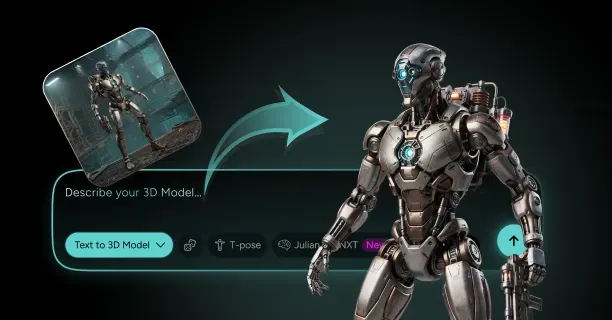
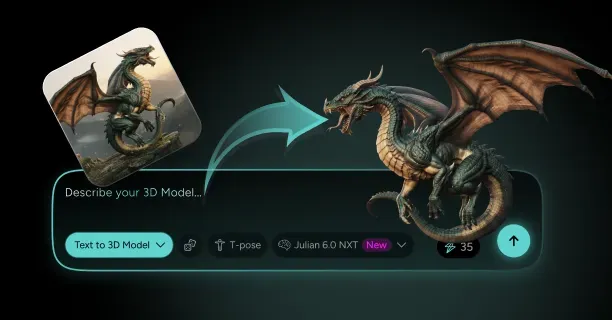
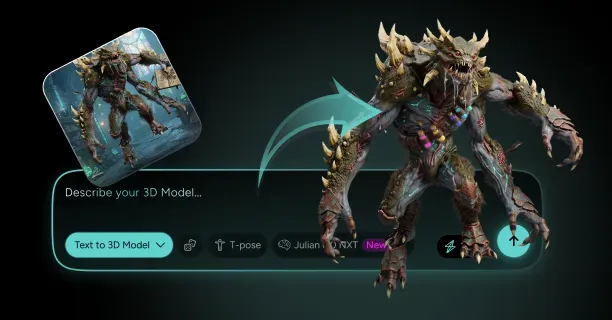
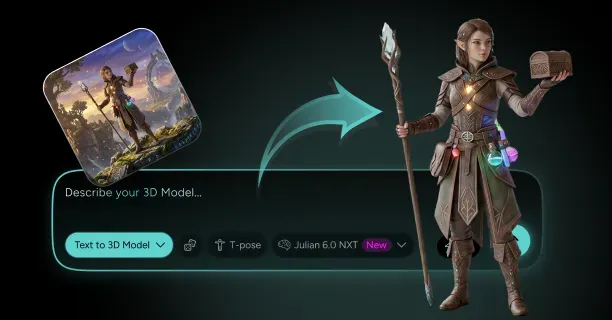
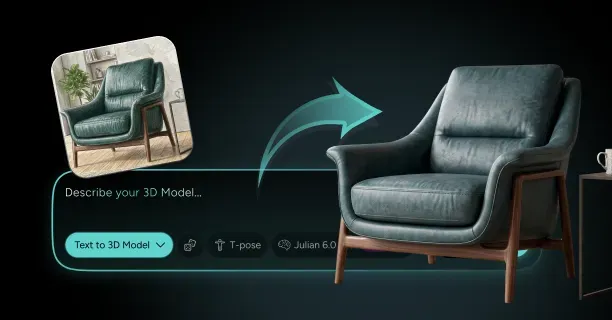
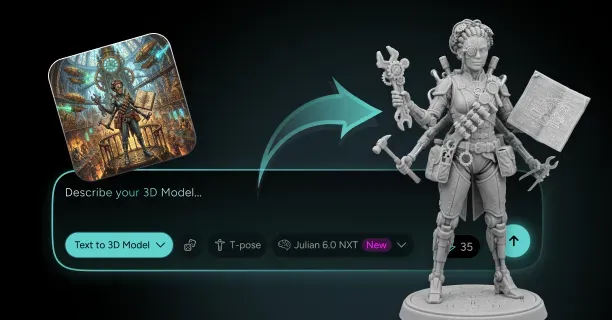
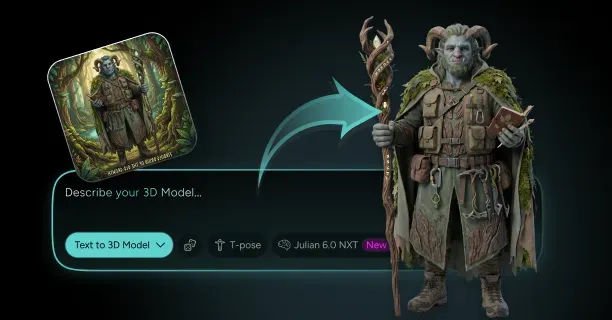
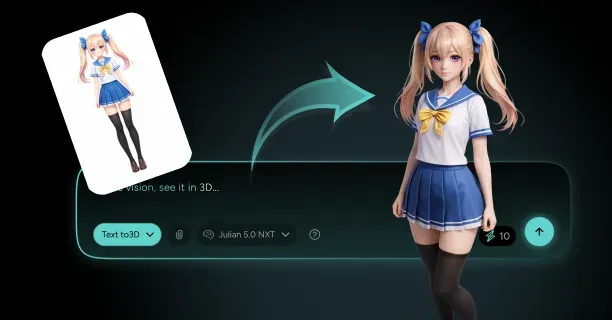
You create a 3D character model from a single image or concept by importing your reference artwork to an AI-powered platform, specifying character parameters like style and topology requirements, and generating a production-ready 3D model with automated rigging and textures. This workflow integrates photogrammetry principles, deep learning reconstruction, and manual modeling techniques to convert 2D visual references into fully realized three-dimensional characters.
AI-Powered Generation
AI-powered 3D generation leverages deep learning models to generate comprehensive three-dimensional character models from a single image. Neural Radiance Fields (NeRFs), a volumetric scene representation technique using neural networks, and Generative Adversarial Networks (GANs), dual-network systems for generative modeling, process your input photograph or concept art to predict missing geometric information including:
- Depth values
- Surface normals
- Occluded geometry using patterns extracted from curated training datasets
The following platforms demonstrate this technology:
| Platform | Type | Specialization |
|---|---|---|
| Luma AI | Commercial neural radiance field-based 3D capture platform | Real-time 3D reconstruction |
| PIFuHD | Academic research tool | High-resolution 3D human digitization |
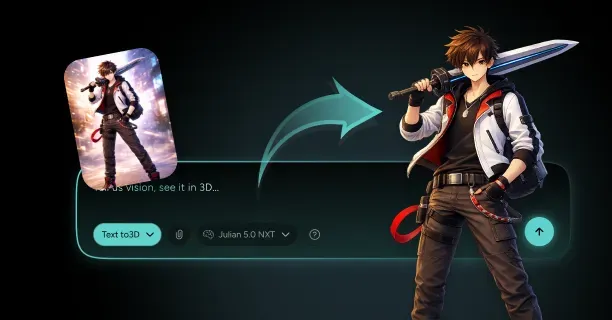
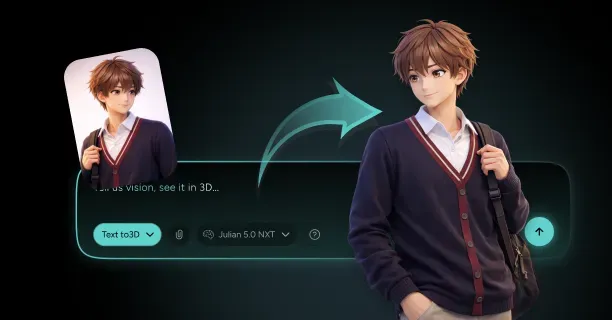
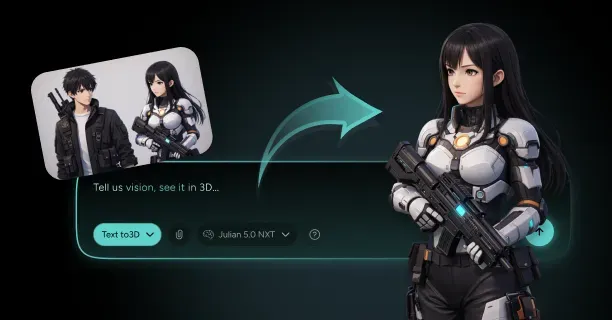
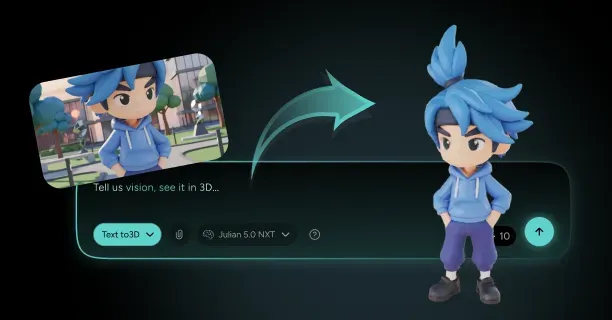
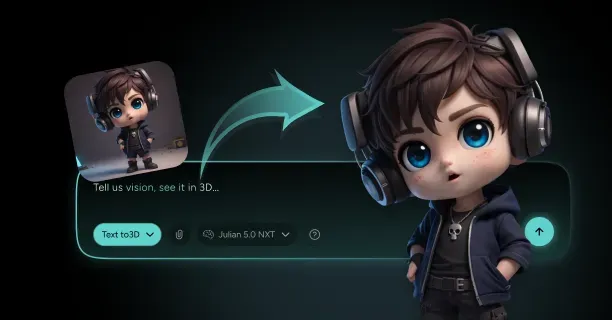
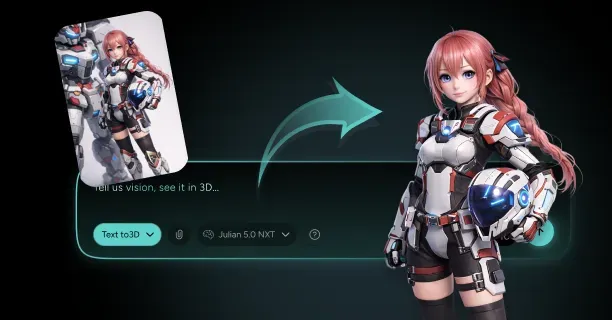
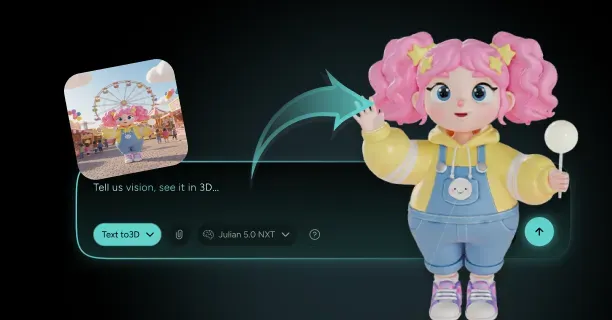
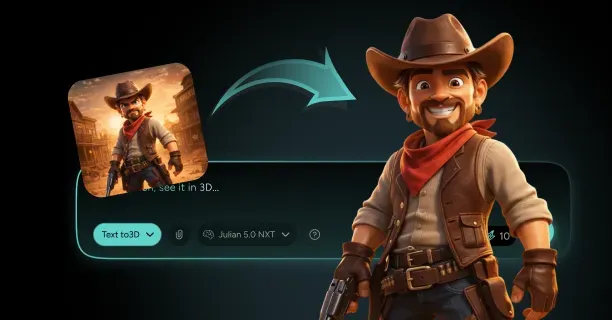
| Threedium’s Julian NXT | Proprietary AI-powered system | Character generation for anime, cartoon, and comic styles |
Convolutional neural networks, deep learning architectures specialized in image processing and pattern recognition, perform these key functions:
- Isolate primary subject figures from backgrounds
- Calculate body proportions based on key skeletal and muscular reference points
- Construct quad-based polygon mesh structure with edge loops following muscle groups
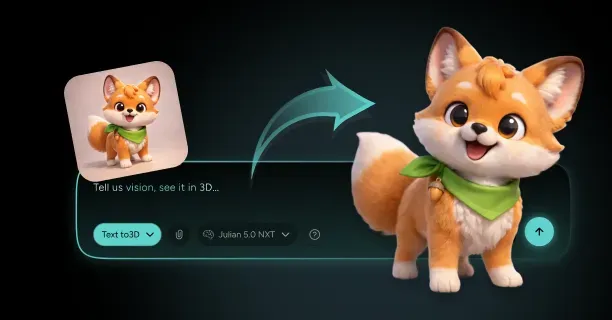
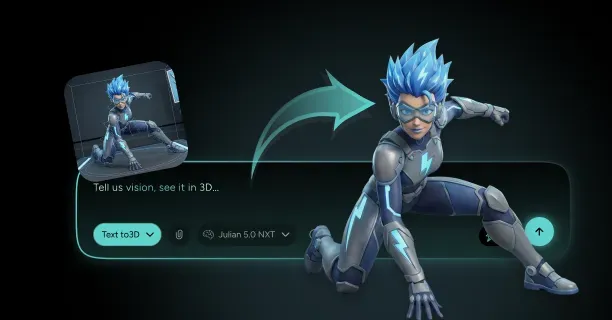
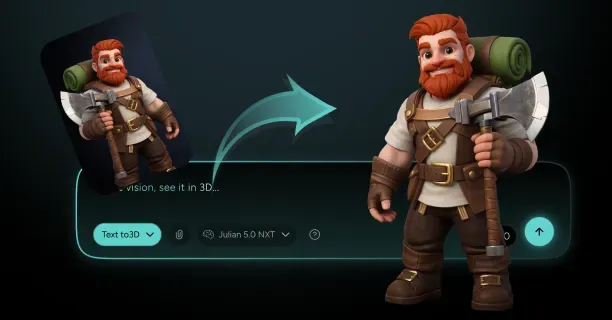
Threedium’s Julian NXT analyzes reference artwork through custom-trained deep learning models using our private training datasets specialized in creating 3D models in anime character models, cartoon character styles, and comic book aesthetics, creating foundational polygon geometry requiring further refinement and detailing in 5-15 minutes compared to 40-120 hours of traditional manual modeling.
You refine this AI-generated preliminary 3D mesh with basic proportions and silhouette through iterative digital sculpting sessions using tools like ZBrush or Blender to add surface detail, preserving your ability to make subjective aesthetic decisions about character design while accelerating initial modeling phase in production pipeline.
Photogrammetry Reconstruction
Photogrammetry, a computational photography technique for extracting three-dimensional measurements from two-dimensional images, derives accurate XYZ coordinate data and surface geometry measurements from photographic images to generate models with millimeter-level precision.
Image Requirements:
- 50-200 overlapping images capturing the subject from various viewpoints
- Minimum 2048×2048 pixel dimensions
- Studio environment with diffused lighting sources
- Fixed camera settings and reduced shadow areas
Professional Software Options:
| Software | Developer | Specialization |
|---|---|---|
| RealityCapture | Capturing Reality (Epic Games) | High-speed 3D reconstruction |
| Agisoft Metashape | Agisoft | Professional photogrammetry for spatial data |
Processing Pipeline:
- Pattern Detection: Software analyzes images by detecting distinctive visual patterns (corners, edges, textures)
- Camera Calibration: Determining camera parameters through optimization algorithms
- 3D Point Computation: Computing 3D positions by intersecting viewing rays from multiple calibrated cameras
- Mesh Generation: Transforming unstructured 3D coordinate points into connected polygon networks
Raw mesh density typically ranges from 500,000-2,000,000 triangles before retopology, achieving photorealistic quality suitable for film, VFX, and high-fidelity visualization.
Texture Extraction Process: - Generates high-resolution 2D images containing color, detail, and material information - Preserves fine surface features including pores, fine lines, and skin texture variations visible at 1mm scale - Captures textile structure details including thread crossings, material texture, and weave density - Records light penetration and diffusion properties of translucent materials
Manual Modeling Workflow
Manual modeling, a traditional artist-driven 3D modeling technique requiring individual polygon placement, employs 2D front, side, and top view drawings used as alignment guides in 3D viewport.
Primary Software Tools:
- Blender: Open-source 3D creation suite for modeling, animation, and rendering
- ZBrush by Pixologic: Industry-standard digital sculpting software for high-resolution organic modeling
Modeling Techniques:
Box Modeling: - Starts from basic geometric primitives (cubes, spheres, cylinders) - Uses subdivision-based technique starting from primitive cube - Develops through continuous rings of connected edges
Edge Modeling: - Point-to-point modeling technique building geometry incrementally - Commences from an individual face serving as foundation - Expands to form outer contour and profile shape
Digital Sculpting Features:
- High-frequency geometric features adding realism and texture to base mesh
- Anatomical surface forms representing underlying musculature structure
- Skin folds and creases from expressions, aging, or fabric compression
- Microscopic skin surface features typically 0.05-0.1mm in scale
Time Investment:
Manual polygon modeling and digital sculpting workflow requires 40-120 hours (typical time investment ranging from 5-15 working days for experienced artists) for 3D models meeting professional standards.
Technical Requirements: - Understanding of strategic arrangement of edge loops following anatomical structure - Strategic allocation of polygon density across the model surface - Mesh topology characteristics enabling proper skeletal rigging and blend shape deformation
Hybrid Production Methods
Hybrid 3D creation methods integrate photogrammetry, AI generation, and manual modeling to leverage each technique’s strengths while minimizing weaknesses.
Workflow Steps:
- AI-powered generation to establish basic proportions and silhouette geometry in 5-15 minutes
- Manual sculpting to refine facial features and achieve specific aesthetic goals
- Photographic texture projection onto finalized geometry for realistic surface detail with 4096×4096 pixel resolution
AI Automation Features:
- Symmetry operations (mirroring geometry across the centerline)
- Automatic UV unwrapping (flattening 3D surfaces into 2D texture coordinates)
- Technical process acceleration while preserving artistic control
Our platform implements this hybrid workflow by combining Julian NXT AI scaffolding with manual refinement tools, reducing total production time from 80 hours to 12 hours for game-ready characters while preserving artistic control over final aesthetics.
Image Quality Requirements
The resolution and composition of your source image significantly affect geometric fidelity and texture detail in the reconstructed 3D model.
Recommended Specifications:
| Image Type | Minimum Resolution | Recommended Resolution | Purpose |
|---|---|---|---|
| Standard Characters | 2048×2048 pixels | 4096×4096 pixels | Facial feature extraction |
| Close-up Shots | 4096×4096 pixels | 8192×8192 pixels | High-fidelity skin textures |
Composition Guidelines:
- Position character centrally in the frame
- Character should occupy 60% to 80% of the image area
- Avoid lens distortion from wide-angle lenses (focal lengths below 35mm equivalent)
- Eliminate harsh shadows that hide surface details
- Provide multiple orthographic views (front, side, back) for comprehensive geometric information
Topology Optimization
The polygon mesh structure must accommodate the character’s intended use, whether for real-time game rendering at 60 frames per second, film-quality animation requiring subdivision surfaces, or static visualization in marketing materials.
Polygon Count Targets by Platform:
| Platform Type | Triangle Count | Use Case |
|---|---|---|
| Mobile Games | 5,000-15,000 | Real-time rendering on mobile devices |
| PC Games | 20,000-50,000 | Desktop gaming applications |
| Cinematic Renders | 100,000-500,000 | Film and high-quality visualization |
Technical Requirements:
- Maintain quad-based topology around deformation zones (shoulders, elbows, knees, hips)
- Edge loops follow anatomical muscle groups to support realistic deformation
- Higher polygon density in facial regions (2,000-8,000 triangles) for detailed facial rigging
Our auto-rig humanoid system generates AI-optimized topology suitable for immediate skeletal binding, eliminating 8-16 hours of manual retopology work that traditional workflows require.
Material Extraction
Physically-based rendering (PBR) material properties derive from reference images through AI-powered extraction that separates diffuse color information from lighting effects baked into photographs.
PBR Map Types:
- Albedo maps: Contain pure surface color without shadows or highlights
- Roughness maps: Define surface microsurface detail controlling specular reflection sharpness
- Metallic maps: Distinguish conductive materials (metals) from dielectric materials (plastics, skin, fabric)
Workflow Options:
Photogrammetry Approach: - Generates material properties automatically by analyzing light reflection across multiple photographs - Achieves photorealistic rendering under varied lighting conditions
Stylized Character Approach: - Paint custom textures in Substance Painter using reference images as guides - Apply cel-shading techniques for anime models - Use flat color blocking for cartoon characters
Our topology cleanup tools optimize UV layouts to minimize texture seams and maximize texel density, ensuring consistent visual quality across the character’s surface.
Pose Estimation
Pose and expression capture from static images involves skeletal rigging and blend shape modeling to recreate the character’s configuration visible in reference photographs.
AI Pose Estimation Process:
- Keypoint Detection: AI algorithms like OpenPose predict 3D joint locations by analyzing 2D keypoints
- Skeleton Generation: Automatic skeleton creation with bone lengths proportional to character anatomy
- Skinning Weight Calculation: Bind skeleton to mesh through calculations determining bone influence on vertices
- Blend Shape Creation: Model facial expressions through morph targets derived from multiple reference images
Standard Output:
Our system generates 52 standard facial blend shapes compatible with ARKit and VTuber applications, enabling real-time facial animation driven by webcam tracking or manual keyframe animation.
Export Formats
Export the completed 3D model in industry-standard formats to ensure compatibility across multiple platforms and software applications.
Primary Export Formats:
| Format | Full Name | Optimization | Use Case |
|---|---|---|---|
| FBX | Filmbox | Comprehensive data | Game engines, 3D software |
| glTF | GL Transmission Format | Web-optimized | Web platforms, Three.js, WebGL |
FBX File Contents:
- Geometry data (vertex positions, polygon faces)
- Material definitions (shader assignments, texture file paths)
- Rigging information (skeleton hierarchy, skinning weights)
- Animation data (keyframe transformations, blend shape values)
glTF Advantages:
- Compact JSON-based format optimized for web delivery
- 40% to 60% smaller file sizes compared to FBX through efficient binary encoding
- Ideal for web-based 3D applications
Platform-Specific Exports:
We provide both high-resolution master files for archival and further editing, and game-ready optimized versions pre-configured for specific platforms like Roblox, creating 3D models for Fortnite, and VRChat, with polygon counts, texture resolutions, and material complexity adjusted to meet each platform’s technical requirements.
Lighting Adaptation
Lighting conditions in reference photographs influence material setup and shading network configuration to achieve visual consistency between the source image and the 3D model.
Analysis Process:
- Identify highlight positions and shadow edges in reference photograph
- Replicate lighting setup in 3D viewport to verify material accuracy
- Replace baked shadows with dynamic lighting that responds to scene illumination in real-time
PBR Conversion Benefits:
- Enables character to appear correctly lit in any environment
- Separates lighting information from albedo color
- Generates PBR-compliant maps for consistent rendering
Technical Processes: - Tone mapping: Convert high-dynamic-range lighting data into standard color spaces - Normal map baking: Capture fine surface details as geometric information rather than diffuse texture patterns
Our conversion tools analyze photographic textures to separate lighting information from albedo color, generating PBR-compliant maps (base color, normal, roughness, metallic, ambient occlusion) that render consistently under varying lighting conditions.
Which Character Style Do You Need: Anime, Cartoon, Or Comic?
Which character style you need: anime, cartoon, or comic depends on evaluating your project’s target platform (Unity, Unreal Engine, VRChat, Roblox), assessing audience expectations based on demographic preferences and cultural context, and defining the visual storytelling approach before uploading the reference image to the conversion system. The character style selection (anime, cartoon, or comic) directly influences topology density (polygon count ranging from 15,000 to 100,000+ triangles), rigging complexity (including bone hierarchies, blend shapes, and deformation systems), and rendering pipeline configuration (cel-shading, PBR, or NPR techniques) during the conversion process that transforms 2D source artwork into production-ready 3D character assets.
Anime Style Characteristics
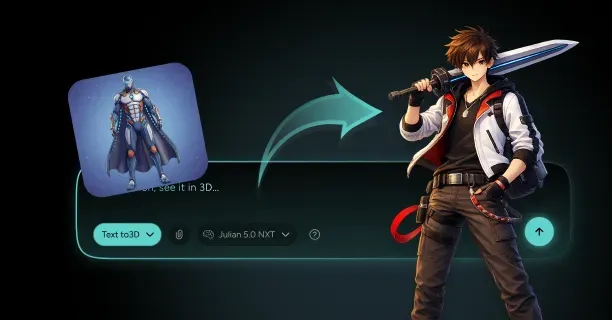
Anime style is characterized by large expressive eyes that occupy 30-40% of the facial area, gravity-defying hair structures that ignore realistic physics simulations, and cel-shading rendering techniques that preserve the hand-drawn aesthetic of traditional Japanese animation (anime). To create anime 3D characters from reference images using Threedium’s AI conversion system, the user should focus on facial expressiveness achieved through oversized eyes (occupying 30-40% of the total face area), sharp angular hair volumes that deliberately ignore realistic physics simulations, and flat color regions separated by clean edge lines characteristic of cel-shaded rendering.
Anime 3D characters require specialized UV mapping configurations to achieve compatibility with cel-shading rendering techniques, which render 3D models using separate discrete color bands (typically 2-4 brightness levels) rather than smooth photorealistic gradients, thereby replicating the visual appearance of traditional 2D animation cels used in Japanese anime production. This non-photorealistic rendering (NPR) approach requires that the 3D character model maintains clean topology flow with optimized edge loops around critical facial features, particularly the eyes and mouth regions, where expression changes and deformation occur most frequently during facial animation.
Threedium’s AI-powered conversion system automatically detects anime-specific proportions (including oversized eyes and reduced nose definition) within uploaded reference images and intelligently adjusts vertex distribution to support exaggerated eye geometry and simplified nose structures that are characteristic of manga-derived character designs.
Shonen Anime Characters
Shonen anime 3D characters are designed to appeal to young male audiences (typically ages 12-18) and emphasize:
- Dynamic action poses
- Pronounced muscular definition even in teenage character models
- Distinctive spiky hair silhouettes that maintain visual clarity and readability during fast-paced movement sequences in animation
Configure shonen character models with:
- Broader shoulders (approximately 3 head-widths)
- Narrower waists creating an inverted triangle torso silhouette
- Elongated limbs (arms and legs extended 10-15% beyond realistic proportions) that enhance perceived athleticism and convey visual power
Key Insight: Shonen style requires simpler clothing designs with reduced ornamental details compared to other anime sub-genres (shojo, seinen, josei), which decreases texture resolution requirements (typically 2K textures suffice) while maintaining strong visual impact through bold, clearly readable silhouettes.
Shojo Anime Characters
Shojo anime characters are designed to appeal to young female demographics (typically ages 10-18) through:
- Softer, more delicate facial features
- Larger eyes containing multiple highlight reflections (3-5 highlights compared to shonen’s 1-2)
- Flowing hair with individual strand separation that requires higher polygon counts (25,000-35,000 triangles) to achieve convincing movement during animation
| Feature | Shojo Style | Shonen Style |
|---|---|---|
| Eye Highlights | 3-5 reflections | 1-2 reflections |
| Hair Complexity | Individual strand separation | Simple spiky volumes |
| Polygon Count | 25,000-35,000 triangles | 15,000-25,000 triangles |
| Target Audience | Young females (ages 10-18) | Young males (ages 12-18) |
Eyes in shojo character designs contain 3-5 highlight reflections (specular highlights created through texture mapping and shader configuration) compared to shonen style’s simpler 1-2 reflections, which adds visual depth and enhances emotional connection with viewers through more expressive character facial expressions.
Seinen Anime Characters
Seinen anime character models target adult male audiences (ages 18-40) with:
- More realistic anatomical proportions (approximately 7.5 head-heights)
- Subdued eye sizes closer to anatomical accuracy (15-20% of face area vs. 30-40% in younger-demographic styles)
- Detailed facial features including visible cheekbones, defined jawlines, and mature facial structure
Seinen character models incorporate:
- Realistic weathering effects (skin texture variation, age lines)
- Facial scars
- Deliberate asymmetrical features (uneven facial structure, unique imperfections) that intentionally deviate from the idealized perfect symmetry characteristic of younger-demographic anime styles (shonen and shojo)
When to Choose Seinen: Select seinen style when the project requires mature thematic content (violence, philosophy, moral ambiguity), psychological depth in character development, or gritty realism (weathered appearances, realistic consequences) while maintaining anime aesthetic frameworks and visual conventions.
Josei Anime Characters
Josei anime characters are designed to appeal to adult female viewers (ages 18-45) through:
- Mature facial structures (defined cheekbones, realistic lip shape, subtle makeup details)
- Realistic body proportions (anatomically accurate 7-7.5 head-heights)
- Sophisticated fashion elements (contemporary clothing, complex fabric patterns) that require advanced cloth simulation systems for realistic draping, wrinkles, and movement
When selecting josei style, configure character models with:
- Narrower, more realistically proportioned eyes
- Defined lips with natural color gradients
- Subtle makeup details (eyeshadow, eyeliner, blush) that require higher texture fidelity (4K resolution textures) compared to teen-oriented anime styles (shonen and shojo)
Josei character designs prioritize emotional subtlety and restrained expressions over the dramatic, exaggerated expressions typical of younger-demographic styles, requiring nuanced blend shapes (50-80 facial morphs) for precise, realistic facial animation that conveys complex adult emotions.
Chibi Characters
Chibi characters represent a specialized anime sub-style featuring super-deformed (SD) proportions where the head size equals or exceeds total body height, creating:
- Extreme 1:1 or 2:1 head-to-body ratios (head:body)
- Compared to standard anime character proportions of 1:6 or 1:7 ratios
Technical Challenge: Chibi character models require completely different skeletal rig configurations and bone hierarchies because limb proportions become extremely compressed (arms and legs reduced to 20-30% of standard length), causing standard humanoid bone hierarchies to fail in deforming the geometry correctly, resulting in joint collapse and unnatural bending artifacts.
Use chibi style for: - Mascot characters - Comedic relief - Mobile game assets where screen space limitations favor compact, instantly readable silhouettes
Mecha Pilot Characters
Mecha pilot anime characters combine human figures with mechanical suit elements, requiring:
- Hybrid topology that transitions between organic facial features and hard-surface armor plating
- Panel lines, rivets, and technical details inherited from mecha design conventions
- Dual-material workflows that handle both skin shaders and metallic surface treatments within single character assets
Cartoon Style Characteristics
Cartoon style emphasizes:
- Strong character silhouettes
- Exaggerated proportions based on the twelve principles of animation
- Squash-and-stretch deformation capabilities that enable extreme pose flexibility
To generate cartoon 3D models from images, prioritize silhouette readability: the character’s outline must communicate personality, emotion, and action even when rendered as a solid black shape against white background.
Cartoon topology requires additional edge loops around joints and facial features to support the squash-and-stretch principle, where characters compress and extend beyond realistic limits to convey weight, impact, and momentum. Your reference image guides the base proportions, but cartoon conversion automatically adds deformation zones that maintain volume during extreme poses, preventing geometric collapse that occurs when standard models bend beyond their designed range.
Western Cartoon Characters
Western cartoon characters follow design philosophies established by studios like Disney and Pixar, emphasizing:
- Appeal through rounded forms
- Asymmetrical features that suggest personality
- Construction from simple geometric primitives: spheres for heads, cylinders for limbs, and ovoids for torsos
Western style demands clean silhouettes where every appendage, accessory, and costume element reads clearly without overlapping into visual confusion. Build western cartoon models with:
- Larger hands and feet than anatomical proportion dictates
- Typically scaling extremities 1.3 to 1.8 times realistic size to enhance gesture communication and ground the character visually
- Eye placement following the “rule of thirds” where pupils sit one-third down from the top of the head rather than the anatomically correct halfway point
Kids’ Cartoon Characters
Kids’ cartoon characters push proportional exaggeration further with:
| Feature | Kids’ Cartoon | Standard Cartoon |
|---|---|---|
| Head-to-body ratio | 1:3 or 1:4 | 1:5 or 1:6 |
| Eye size | 40-50% of face area | 25-35% of face area |
| Anatomy | Simplified, rounded volumes | More defined muscle structure |
| Color palette | Pastel colors | Varied color schemes |
Safety Priority: Kids’ style prioritizes safety in design with no sharp angles, pointed elements, or threatening features that might frighten young viewers.
Work with pastel color palettes, high-contrast outlines, and minimal detail density that renders clearly on small screens and maintains visual appeal during rapid movement when creating kids’ cartoon characters. Threedium’s AI detects rounded shape language in your reference images and automatically smooths sharp vertices, bevels hard edges, and inflates volumes to achieve the soft, huggable aesthetic kids’ content demands.
Comic Style Characteristics
Comic style is defined by:
- Dynamic line work
- Cross-hatching for shadows
- Heroic poses that emphasize action and drama through perspective distortion and anatomical exaggeration
Comic book 3D characters translate inked artwork into volumetric forms while preserving the bold line weight variations and dramatic shading that define printed comic aesthetics. Comic style varies greatly by artist and publisher:
- Mike Mignola’s work: Heavy shadows and gothic atmosphere in the Mignola-verse
- Alex Ross’s approach: Hyper-realistic painted style that renders superheroes with photographic detail and classical painting techniques
Important Note: Specify which comic sub-genre your reference image represents because topology requirements differ dramatically between styles.
Superhero Comic Characters
Superhero comic characters demand heroic proportions where:
- Male figures stand 8 to 9 heads tall (compared to realistic 7.5 heads)
- Shoulder width expands to three head-widths
- Chest depth exaggerated to suggest power and invulnerability
Female superhero proportions emphasize: - Hourglass figures with narrow waists - Wide hips - Athletic muscle definition that maintains feminine curves while suggesting physical capability
Superhero models require pronounced muscle definition even through skintight costumes, demanding detailed normal maps that capture the stippling and cross-hatching comic artists use to render anatomical form. Upload superhero reference art and the system analyzes line weight distribution to determine shadow placement and automatically generates geometry that supports dramatic uplighting and rim lighting setups common in comic book rendering.
Comic Line Work and Shading
Comic style incorporates dynamic line work where outline thickness varies based on:
- Proximity to light sources
- Object overlap
- Dramatic emphasis
Lines thicken in shadows and at silhouette edges while thinning on illuminated surfaces and interior details. Replicate this effect in 3D through:
- Freestyle rendering
- Inverted hull outlines
- Post-process edge detection that modulates line weight based on surface normal angles and depth discontinuities
Cross-hatching for shadows translates into custom shader networks that replace smooth gradients with parallel line patterns, adjusting density and angle to match traditional comic inking techniques. Stippling effects require texture maps where shadow regions contain dot patterns of varying density rather than continuous tone, mimicking the mechanical printing processes that originally reproduced comic artwork.
Style-Specific Rigging Requirements
Your style choice determines rigging requirements and animation capabilities:
Anime Character Rigs
- Facial rigs with independent eye scaling controls
- Hair physics systems that maintain rigid strand clumps rather than realistic flow
- Blend shapes for extreme expression changes: closed-eye smiles, sweat drops, anger veins that communicate emotion through visual shorthand
Cartoon Character Rigs
- Squash-and-stretch deformers
- Bendy-bone systems that allow limbs to curve smoothly without joint breaks
- Volume-preserving constraints that maintain character mass during compression and extension
Comic Character Rigs
- Muscle systems for dynamic flexing during heroic poses
- Advanced bone hierarchies for dramatic pose capabilities
- Detailed facial controls for realistic expressions
Auto-Rig System: The auto-rig humanoid system detects style from your reference image and configures appropriate control schemes: anime receives morph-target-based facial animation, cartoons get lattice deformers for body squash, and comic characters receive muscle systems for dynamic flexing during heroic poses.
Platform Compatibility
Platform compatibility influences style selection because different engines and frameworks handle non-photorealistic rendering with varying efficiency:
| Platform | Preferred Style | Key Features |
|---|---|---|
| Unity 3D | Cartoon/Anime | Shader Graph for custom cel-shading and outline effects |
| Unreal Engine | Comic | Advanced material systems for comic book rendering with dynamic ink lines |
| VRChat | Anime | User base expects manga-inspired aesthetics, large expressive eyes |
| Roblox | Cartoon | Simplified proportions matching platform’s blocky aesthetic |
| Fortnite | Western Cartoon | Exaggerated proportions, clear silhouettes, PBR texturing |
VRChat avatars predominantly use anime style because the platform’s user base expects manga-inspired aesthetics, large expressive eyes that communicate emotion in social VR, and optimized topology that maintains visual appeal within strict polygon budgets.
Roblox 3D models require simplified cartoon proportions that match the platform’s blocky aesthetic and technical constraints, while Fortnite characters demand western cartoon style with exaggerated proportions, clear silhouettes, and PBR texturing that integrates with the game’s established visual language.
Audience Demographics
Audience demographics and cultural context guide style appropriateness:
Anime Style Appeals To:
- Audiences familiar with Japanese media conventions
- Viewers who consume manga, watch seasonal anime releases
- Participants in otaku subcultures where character archetypes carry specific meanings
- Target: Asian markets, younger demographics aged 13-35
- Best for: Projects requiring emotional intensity and dramatic presentation
Cartoon Style Appeals To:
- Broader Western audiences
- Family-friendly content
- Projects prioritizing humor, accessibility, and universal appeal
- Target: All-ages content, Western markets
- Best for: Universal appeal over demographic specificity
Comic Style Appeals To:
- Audiences interested in superhero narratives
- Graphic novel aesthetics enthusiasts
- Mature content consumers
- Target: Action and suspense projects
- Best for: Dramatic visual language and mature themes
Technical Execution Differences
Technical execution differs substantially across styles:
Anime Models
- Clean quad topology with minimal triangulation
- Polygon count: 15,000-30,000 triangles for real-time characters
- Focus areas: Faces and hair (detailed), body geometry (simplified)
- Challenge: Cel-shading exposes geometric artifacts that hide in photorealistic rendering
Cartoon Models
- Higher triangle tolerance: 25,000-50,000 range
- Dense vertex distribution required for squash-and-stretch deformation
- Rounded forms need sufficient resolution to appear smooth rather than faceted
- Deformation zones prevent geometric tearing during extreme poses
Comic Characters
- Widest polygon range depending on sub-style
- Stylized comic: ~30,000 triangles (similar to cartoon)
- Hyper-realistic painted style: 100,000+ triangles for photographic detail
- Analysis-based optimization: System analyzes rendering style to recommend topology density
Texture Resolution Requirements
| Style | Resolution | Reasoning |
|---|---|---|
| Anime | 2K (2048x2048) | Large flat color regions, minimal surface detail |
| Cartoon | 2K-4K | Simple designs use 2K, complex costumes may need 4K |
| Comic (Stylized) | 4K | Cross-hatching and stippling require higher pixel density |
| Comic (Realistic) | 8K (8192x8192) | Match detail levels of traditional comic art |
Anime texture allocation: - 25-30% for facial features (particularly eyes) - Maintains sharpness at close viewing distances - Large flat color regions reduce information density
Comic texture requirements: - 4K minimum for cross-hatching without aliasing - 8K for hyper-realistic painted comic style - Fine line work demands sufficient pixel density
Material Complexity
Anime Materials
- Simple materials with flat diffuse colors
- Sharp shadow termination
- Rim lighting creating characteristic backlight glow around silhouettes
- Custom shadow ramps quantizing smooth lighting into 2-4 discrete brightness levels
Cartoon Materials
- Subsurface scattering for translucent elements (ears)
- Specular highlights positioned for visual appeal rather than physical accuracy
- Ambient occlusion baked into texture maps for shadow detail in flat-lit environments
Comic Materials
- Ink density replication through custom shaders
- Surface normals converted to line patterns
- Line thickness adjustment based on viewing distance
- Halftone pattern overlays in shadow regions simulating mechanical printing processes
Automated Configuration: The materials and textures system automatically configures style-appropriate shader networks based on your selected character type.
Workflow Efficiency
Your workflow efficiency improves when you match style to your skill level and available production time:
Anime Style (Fastest)
- Simplified geometry reduces modeling complexity
- Flat shading minimizes texture painting requirements
- Standardized proportion systems enable quick iteration
- Best for: Moderate 3D skills and compressed timelines
Cartoon Style (Intermediate)
- Requires understanding of appeal and silhouette design
- Twelve principles of animation knowledge beneficial
- More iteration needed for seemingly simple designs
- Best for: Intermediate skills with design understanding
Comic Style (Most Complex)
- Steepest learning curve
- Requires mastery of both 3D modeling and traditional illustration
- Understanding needed of ink lines, cross-hatching, and anatomy cheats
- Best for: Advanced users with illustration background
Platform-Specific Requirements
Different platforms have established style expectations:
VTuber Avatars
- Universally anime style
- Streaming audiences expect manga aesthetics
- Facial tracking systems map accurately to anime’s exaggerated expressions
- Large eye movements translate well to tracking software
Metaverse Avatars
- Decentraland/Sandbox: Stylized cartoon aesthetics
- VRChat: Heavy anime preference
- Comic metaverse projects: Superhero comic style for DC/Marvel virtual spaces
Game-Specific Styles
- Genshin Impact: Anime style with cel-shaded rendering, elaborate costumes, large eyes, colorful hair
- Valorant: Western cartoon with exaggerated proportions
- Roblox: Simplified cartoon matching platform constraints