How Do You Create An Anime 3D Character Model From A Single Image (Style + Proportions)?
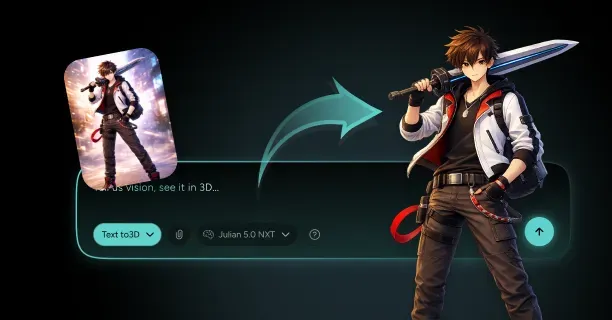
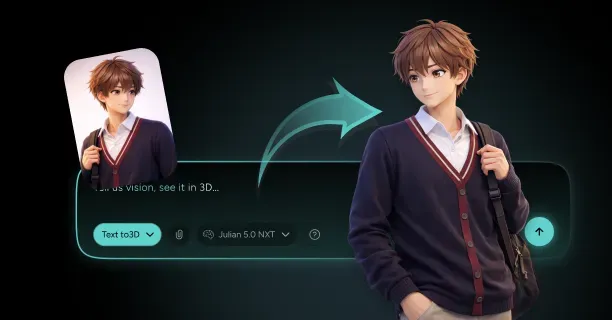
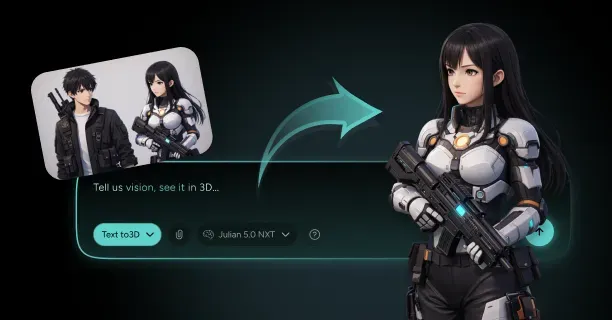
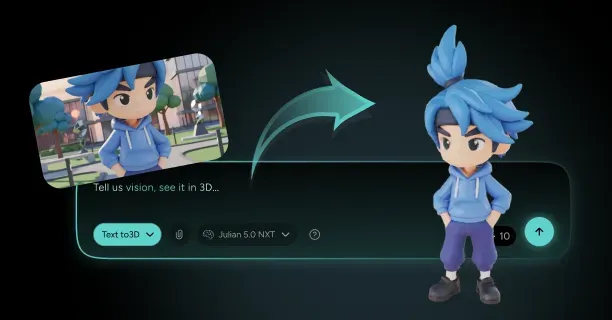
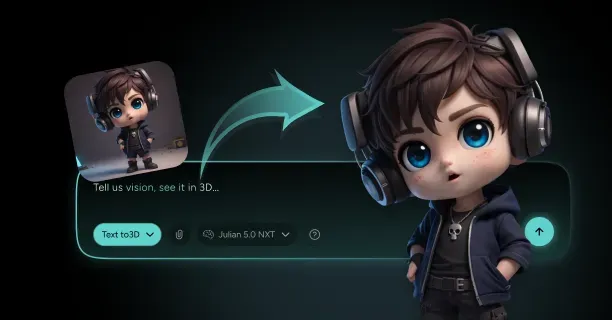
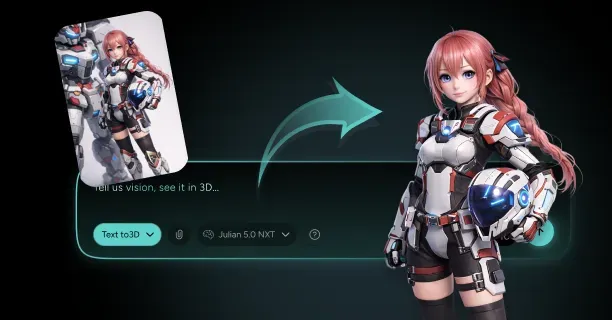
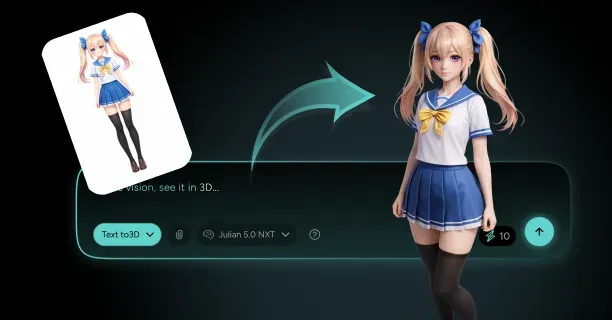
To create an anime 3D character model from a single image, you upload your reference artwork, configure character parameters based on anime proportions, and generate a production-ready 3D mesh that preserves the original 2D style.
Upload your reference image to define dimensional authority for your entire modeling workflow. This reference specifies head-to-body ratios, limb proportions, and facial feature placement that characterize anime aesthetics:
- 1:6 for shonen characters
- 1:7 for seinen characters
- 1:5 for chibi characters
The image functions as your geometric blueprint, governing every geometric decision throughout mesh construction, topology refinement, and texture application.
AI-Powered Depth Reconstruction
AI algorithms process your reference image by detecting edge contours, shading gradients, and anatomical landmarks to extrapolate 3D geometry from flat 2D data. Neural networks trained on anime character datasets identify stylistic conventions to generate depth maps that preserve anime visual language rather than photorealistic anatomy:
Key Anime Conventions: - Oversized eyes occupying 30-40% of facial height - Sharp hair edges that defy gravity - Simplified nose structures
Threedium’s proprietary Julian NXT technology employs convolutional neural networks to extract geometric features from your uploaded image, transforming line art and cel-shaded illustrations into volumetric 3D forms within seconds.
| Process Stage | Function | Output |
|---|---|---|
| Edge Detection | Identifies contours and boundaries | Line art geometry |
| Depth Analysis | Determines z-axis positioning | Volumetric forms |
| Feature Recognition | Locates facial landmarks | Anatomical structure |
The depth reconstruction process determines z-axis positioning for facial features, hair volume, and body contours by analyzing visual cues like overlapping elements, line weight variation, and shading intensity. You receive a base mesh with primary forms established without manual vertex placement.
Base Mesh Generation and Refinement
Create a low-polygon foundation mesh that represents primary anatomical forms through automated AI processing. This base mesh typically comprises 5,000-15,000 polygons, providing sufficient geometric detail for major body segments while maintaining real-time viewport performance during refinement.
The automated system generates edge loops around critical areas:
- Eyes
- Mouth
- Joint areas
These define topology flow that supports facial expressions and body deformation.
Enhance this base mesh using subdivision surface modeling, which softens angular geometry by computing interpolated vertices between existing edges. Implement subdivision levels strategically:
- Level 2 (quadrupling polygon count) for body segments requiring smooth curvature
- Level 0 for hair sections demanding sharp angular edges characteristic of anime styling
Manual Sculpting for Style-Specific Details
Create high-resolution details using brush-based tools that adjust vertex positions with pressure-sensitive control. Digital sculpting software offers specialized brushes:
- Clay buildup brushes for building volume to cheeks and hair strands
- Smooth brushes for blending surface transitions
- Pinch brushes for defining sharp edges along eyelid creases and clothing folds
You achieve granular control over stylistic nuances including eye shapes demanding precise almond curves, nose bridges reduced to single vertical planes, and mouth corners angled upward for characteristic anime expressions.
Critical Focus: Concentrate your sculpting effort on facial features, which possess 70-80% of character recognition value in anime art.
Eyes require exact replication of your reference’s specifications:
- Pupil size: Often 60-70% of iris diameter
- Highlight placement: Typically upper-right quadrant
- Eyelash geometry: Individual strands versus solid masses
Hybrid Workflow: AI Speed with Artistic Precision
Integrate AI-generated structures with manual refinement to expedite initial proportion blocking while safeguarding creative control over style-defining elements.
| Workflow Component | Method | Time Investment |
|---|---|---|
| Body Framework | AI Generation | 15-20 minutes |
| Style Details | Manual Sculpting | Variable |
| Traditional Method | Full Manual | 2-3 hours |
This hybrid approach decreases production time by 60-75% compared to full manual modeling, as validated in production pipelines for anime game assets. You invest minimal time on AI-assisted base generation instead of hours on manual blocking, redirecting saved time to detail sculpting that distinguishes your character from generic templates.
Topology Optimization for Animation
Construct edge loops adhering to natural deformation patterns to ensure smooth bending during skeletal animation. Position horizontal loops around critical joints:
- Shoulders
- Elbows
- Wrists
- Hips
- Knees
- Ankles
Place loops at 10-15 degree intervals, establishing sufficient geometry density for realistic joint rotation without mesh collapse.
Facial topology necessitates radial edge flows around eyes and mouth, facilitating blend shape deformations for expressions:
- Smiles: Requiring 8-12 edge loops in cheek area
- Blinks: Requiring 6-8 loops in eyelid region
Preserve quad-based topology (four-sided polygons) throughout the mesh to enable subdivision algorithms and eliminate shading artifacts. Triangles and n-gons introduce termination points in edge flows, resulting in uneven subdivision and visible creasing during animation.
Parameter-Based Character Creation
Modify anatomical features through slider-based controls that alter underlying skeletal proportions and mesh deformations. Parameter systems provide predefined anime proportion presets:
- Shonen hero builds: Broad shoulders (shoulder width 2.5× head width)
- Shojo characters: Elongated legs (leg length 55-60% of total height)
- Chibi proportions: Enlarged heads (head height 33-40% of body height)
You can personalize these presets by modifying individual parameters for:
- Eye size
- Nose prominence
- Chin sharpness
- Body mass distribution
This approach ensures consistency across multiple characters sharing design lineage, as parameter values can be saved as templates and applied to new base meshes.
Style-Fidelity Preservation
Maintain anime-specific visual elements that separate stylized characters from realistic human models:
- Sharp edges on hair geometry rather than applying smoothing
- Enlarged eye dimensions to 2-3× anatomically realistic proportions
- Eye placement lower on face (eye center at 45-50% of head height instead of anatomical 50%)
- Minimize nose geometry to minimal bridge lines or small triangular protrusions
Cel-shading preparation demands clean topology with minimal surface variation, as toon shaders compute lighting based on surface normal angles.
You establish hard edges at clothing seams and hair part lines by splitting vertices, inducing normal discontinuities that generate sharp shadow boundaries characteristic of anime rendering.
Reference Overlay Validation
Superimpose orthographic renders of your 3D model onto the original reference image at matching scales to confirm proportion accuracy throughout modeling stages.
Validation Process:
- Generate front, side, and three-quarter view renders with flat lighting
- Output them as semi-transparent overlays in image editing software
- Quantify critical dimensions with target accuracy within 2-3% deviation
Critical Measurements:
- Head height
- Shoulder width
- Torso length
- Leg proportions
This validation process detects proportion drift before detail sculpting, eliminating costly revisions after investing hours in high-resolution features. Conduct validation repeatedly after major modeling phases:
- Base mesh completion
- Detail sculpting
- Final topology
This ensures cumulative changes remain aligned with reference fidelity.
Which Anime Character Type Do You Need: Shonen, Shojo, Seinen, Josei, Chibi, Or Mecha-Pilot?
Which anime character type you need depends on your target audience demographics:
- Shonen for action-oriented content targeting males ages 12-18
- Shojo for romance-focused content targeting females ages 10-18
- Seinen for mature content targeting adult males ages 18-40
- Josei for mature content targeting adult females ages 18-40
- Chibi for comedic super-deformed art style
- Mecha-Pilot for robot combat narratives
Content creators should analyze the target audience demographics, evaluate the narrative tone being established, and assess which visual style aligns with the project goals. Each anime character archetype requires distinct visual proportions, specialized facial feature construction, genre-appropriate costume designs, and tailored 3D modeling methodologies that fundamentally determine the technical workflow 3D character artists must implement during asset creation.
Shonen Characters
The Shonen anime genre primarily serves young male audiences within the 12-18 age demographic, requiring 3D character modelers to create 3D models of shonen characters that emphasize:
- Dynamic action poses
- Exaggerated muscular definition
- Heroic silhouettes
Key Design Requirements:
| Element | Specification |
|---|---|
| Shoulder Width | 1.5-2 times head width |
| Body Proportions | Elongated limbs for dramatic action |
| Facial Structure | Angular jawline, sharp eye designs |
Iconic Shonen protagonists including Son Goku from the Dragon Ball franchise, Monkey D. Luffy from One Piece, Naruto Uzumaki from Naruto, and Izuku Midoriya from My Hero Academia exemplify these design principles through visual construction that maintains silhouette readability during fast-paced combat sequences.
3D Modeling Workflow Requirements:
- Mesh topology architecture supporting extreme pose deformations
- Edge loops configuration around major joint areas (8-12 edge loops per major joint)
- Joint positioning for shoulders, elbows, hips, and knees with elevated topology densities
- Deformation capabilities for 180-degree kicks, overhead punches, acrobatic movements
Character progression in Shonen narratives correlates with escalating physical power levels, requiring the base 3D model to:
- Accommodate multiple costume variations
- Support power-up transformation states
- Integrate attachment points for visual effects including energy blast emissions and elemental ability manifestations
Facial Rigging Systems:
Facial rigging systems for Shonen character models emphasize intense emotional expression capabilities including:
- Gritted teeth configurations during combat sequences
- Wide-eyed shock reaction states
- Confident smirk expressions conveying heroic determination
Configure blend shape systems incorporating: - 15-20 distinct mouth position morphs - 8-10 eye variation morphs
Hair simulation presents unique technical challenges for Shonen character models because protagonists within this genre typically feature gravity-defying hairstyle designs (including spiky upward-projecting styles and asymmetrical bang configurations) that require rigid body physics simulation rather than soft-body cloth dynamics.
The Threedium AI system analyzes uploaded reference images depicting Shonen characters and automatically generates anatomically appropriate muscle definition geometry, ensuring the resulting 3D model embodies the power fantasy aesthetic central to the young male demographic this genre targets.
Shojo Characters
The Shojo anime genre targets young female audiences within the 10-18 age demographic, requiring 3D character modelers to create 3D models of shojo characters featuring:
- Delicate facial feature construction
- Elongated limb proportions establishing elegant silhouettes
- Expressive eyes occupying 25-35% of total facial height
Design Priorities:
Shojo character construction prioritizes graceful movement mechanics over combat functionality, requiring:
- Skeletal rig systems optimized for gentle gesture animations
- Emotional embrace interactions
- Flowing hair dynamics responding to subtle head movement inputs
Eye Asset Construction:
Construct eye assets incorporating: - Multi-layered iris texture systems (3-5 gradient layers) - Prominent highlight reflection elements (2-4 specular points per eye) - Detailed eyelash geometry (individual strand modeling or alpha-mapped card techniques)
Body Proportions:
| Measurement | Specification |
|---|---|
| Waist | 0.6-0.7 times shoulder width |
| Leg Length | 55-60% of total character height |
| Hands/Feet | Proportionally smaller than anatomically accurate |
Model finger joint topology with additional subdivision levels to support close-up camera shots featuring hand-holding interactions, gift-exchanging moments, and other intimate gesture animations that characterize Shojo narrative storytelling.
Hair Simulation Systems:
Hair simulation systems for Shojo character models require sophisticated strand dynamics technology:
- Hair card geometry containing 200-400 individual strand elements per major hair section
- Physics simulation for realistic swaying motion during emotional narrative scenes
- Gradient blending techniques (pink-to-blonde and purple-to-blue color transitions)
- Multi-channel texture map systems with 4K minimum resolution
Facial Construction Guidelines:
Configure facial bone structure geometry to create the soft, rounded feature aesthetic:
- Reduced cheekbone prominence
- Smaller nose bridge construction (frequently simplified to single edge loop topology)
- Lip geometry featuring gentle curves rather than sharp angular definition
- Eye geometry positioned at 45-48% of total head height
Seinen Characters
The Seinen anime genre targets adult male audiences within the 18-40 age demographic, requiring 3D character modelers to create 3D models of seinen characters featuring:
- Realistic body proportions
- Detailed facial weathering textures
- Subdued color palette schemes
Modeling Methodology:
Seinen character modeling methodology abandons the exaggerated anatomical features characteristic of younger audience demographics and instead implements:
- Anatomically accurate muscle insertion point placement
- Realistic joint mechanical systems
- Facial topology architecture supporting subtle micro-expression animation
Body Proportions (Anatomically Accurate):
| Measurement | Specification |
|---|---|
| Total Body Length | 7.5-8 head-heights |
| Shoulder Width | 2-2.2 head widths |
| Facial Features | Classical portraiture composition guidelines |
Texture Development Workflows:
Texture development workflows for Seinen character assets demand photorealistic skin rendering techniques:
- Subsurface scattering shader systems with accurate light penetration depth parameters (1.5-3mm for facial skin tissue)
- Normal map textures capturing pore-level surface detail (8K resolution for primary hero characters)
- Specular map configurations differentiating between oily T-zone facial regions and matte cheek surface areas
Advanced Rigging Systems:
Seinen character rigging systems implement advanced muscle simulation architecture positioned beneath the skin mesh geometry:
- Generate corrective blend shape systems for 40-60 distinct pose combinations
- Achieve realistic muscle bulging deformations
- Skin sliding over bone structure mechanics
- Fat tissue jiggle dynamics in anatomically appropriate body regions
Seinen narrative structures explore complex psychological themes, requiring facial rig systems capable of expressing nuanced emotional states: skepticism through subtle eyebrow asymmetry configurations, weariness via slight eyelid droop animations (2-3mm lowered upper lid position), and determination without the exaggerated expression intensity characteristic of Shonen genre works.
Josei Characters
The Josei anime genre serves adult female audiences within the 18-40 age demographic, requiring 3D character modelers to create 3D models of josei characters that balance aesthetic visual appeal with mature realism representation.
Character Construction Methodology:
Josei character construction methodology maintains aesthetically attractive body proportions while incorporating realistic body diversity representation:
- Character designs range from athletic muscular builds to fuller curvier figures
- Breast topology geometry supporting natural movement physics simulation
- Waist-to-hip measurement ratios varying between 0.7-0.9
Facial Geometry Requirements:
| Feature | Specification |
|---|---|
| Cheekbone Positioning | Higher than Shojo character standards |
| Jawline Structure | More defined |
| Eye Dimensions | 20-25% of total face height |
Facial Aging Detail Incorporation:
Facial aging detail incorporation distinguishes Josei character designs from younger audience demographic genres:
- Nasolabial fold geometry (1-2mm surface depth)
- Slight crow’s feet wrinkle details around eye areas (visible during smile expression states)
- Varied skin texture map systems reflecting different age representations within the 18-40 adult demographic range
Makeup Application Rendering:
Makeup application rendering requires separate texture layer systems:
- Foundation layers providing subtle color correction adjustments
- Eyeshadow layers featuring metallic shader material properties
- Lip gloss layers with appropriate specular intensity parameters: - 0.6-0.8 roughness values for natural matte finishes - 0.2-0.4 roughness values for glossy reflective products
Hair Modeling Systems:
Hair modeling systems for Josei character assets emphasize sophisticated, professionally practical hairstyle designs:
- Layered cut styles featuring realistic volume distribution patterns
- Updo configurations requiring accurate hair strand flow topology
- Colored highlight integration blended naturally throughout the hair mass structure
Configure hair shader systems supporting multiple reflection pattern types including sharp specular highlight reflections indicating healthy hair condition combined with diffuse light scattering from internal hair fiber structure to achieve the polished, well-maintained appearance characteristic of adult Josei character designs.
Chibi Characters
The Chibi art style represents super-deformed character design methodology featuring exaggerated body proportions:
| Measurement | Specification |
|---|---|
| Total Body Length | 2-3 head-heights |
| Head Dimensions | 40-50% of total character height |
| Facial Features | Radically simplified construction |
Modeling Workflow:
The Chibi character modeling workflow radically departs from realistic anatomical construction principles, creating stylized character assets optimized for:
- Maximizing cute aesthetic appeal
- Comedic expression potential
Body Construction Guidelines:
Construct bodies with minimal joint articulation:
- Simple ball-and-socket shoulders and hips suffice
- Chibi animation emphasizes bouncy, springy movements over realistic biomechanics
Facial Construction:
Facial construction for Chibi characters maximizes expressiveness through extreme simplification:
- Eyes: Large, circular shapes (35-45% of face width each)
- Internal detail: Single-color irises, prominent white highlights, optional simple pupil shapes
- Mouths: Flexible rigging supporting transitions between: 1. Tiny dot shapes (neutral expression) 2. Wide circular openings (surprise)
3. Exaggerated cat-smile curves (happiness) - Noses: Eliminate geometry entirely or represent as single-vertex points, small triangular protrusions, or simple texture details
Body Proportions:
Body proportions follow specific Chibi conventions:
- Arms and legs as simple cylindrical shapes with minimal tapering
- Hands as mittens with suggested finger divisions rather than individual digits
- Feet as rounded nubs or simple shoe shapes
- Torso construction simplifies to egg or bean shapes
Your topology remains minimal (500-2000 polygons total for full characters) because Chibi designs prioritize silhouette readability over surface detail.
Threedium Platform Integration:
Threedium’s platform automatically converts standard character proportions to Chibi variants:
- Upload your full-scale character reference
- Select Chibi conversion
- Our AI redistributes proportions according to super-deformed ratios maintaining recognizable costume elements and color schemes
Animation Rigging:
Animation rigging for Chibi characters implements squash-and-stretch deformers:
- Create bone scaling controls allowing the entire character to compress vertically by 30-50% during landings
- Expand horizontally during surprise reactions
- Physics simulation applies exaggerated properties:
- Gravity at 1.5-2x normal strength for bouncy movements
- Hair with high stiffness values creating antenna-like protrusions
- Clothing with minimal draping (treated as rigid shells rather than flexible fabric)
Mecha-Pilot Characters
Mecha-Pilot characters require dual-scale 3D modeling:
- Detailed pilot figures for cockpit scenes
- Simplified versions visible through mecha canopy windows
Your primary pilot model follows Seinen or Shonen proportions depending on narrative tone, but you add specific design elements:
- Flight suit costumes with functional helmet connections
- Seated pose optimization (pre-bent knees and hips reducing deformation stress)
- Reduced lower-body detail since pilots appear primarily from waist-up during mecha operation
Helmet Design Requirements:
Helmet design presents unique technical challenges:
| Component | Specification |
|---|---|
| Visors | 0.15-0.25 roughness for clean acrylic |
| Interior Padding | 8-12mm foam representation |
| Communication Equipment | Integration points for oxygen hoses or communication cables |
Helmet Mesh Structure:
Your helmet mesh separates into multiple parts:
- Outer shell
- Visor (with separate geometry for open/closed states)
- Interior lining
- Attachment hardpoints for oxygen hoses or communication cables
Cockpit Interaction Rigging:
Cockpit interaction rigging requires precise hand-controller alignment:
- Create IK (inverse kinematics) chains for arms that automatically position hands on joystick controls, button panels, and throttle levers
- Finger rigging implements detailed individual digit control for: 1. Switch-flipping animations 2. Button-pressing animations 3. Lever-pulling animations
Secondary Pilot Model Optimization:
Your secondary pilot model (visible through mecha canopy) reduces polygon count by 70-85% maintaining silhouette recognition:
- Simplify facial features to basic shapes readable at distance
- Eliminate fine costume details like zippers or small patches
- Optimize texture resolution to 512x512 pixels
This optimization prevents rendering bottlenecks when scenes contain multiple mecha units, each with visible pilots.
Costume Design Requirements:
Costume design for Mecha-Pilots balances military functionality with character personality:
Flight Suit Construction: - Accurate seam placement following actual pressure suit construction - Torso seams avoiding pressure points - Limb seams positioned on inner surfaces
Material Shader Specifications:
| Material | Roughness Value |
|---|---|
| Technical Fabrics (Nomex) | 0.4-0.5 |
| Rubberized Seals | 0.8-0.9 |
| Metallic Hardware (Buckles, Zippers) | 0.2-0.3 |
Platform-Specific Optimization
Your character type selection affects marketability across platforms:
Platform Requirements by Character Type:
| Character Type | Target Platform | Optimization Requirements |
|---|---|---|
| Shonen | Action games | Robust rigging supporting 50-100 distinct animations |
| Shojo | Visual novel engines | Extensive facial expression libraries (30-50 expressions minimum) |
| Seinen | Mature gaming markets | Photorealistic rendering capabilities and motion-capture compatibility |
| Josei | Relationship simulation games | Nuanced emotional range and diverse body representation |
| Chibi | Mobile games/merchandising | Forms suitable for figurine production, emoji sets |
| Mecha-Pilot | Robot combat franchises | Balance pilot characterization with mechanical design integration |
Technical Specifications by Platform:
- Mobile games favor Chibi or simplified Shonen designs (under 10,000 polygons)
- Console and PC titles support detailed Seinen or Josei models (50,000-100,000 polygons)
- VR applications require optimized versions (15,000-25,000 polygons) maintaining 90fps minimum frame rates
- Web-based experiences use moderate-detail models (8,000-20,000 polygons)
Evaluate target platform specifications before finalizing character type. Mobile games favor Chibi or simplified Shonen designs for performance optimization. Console and PC titles support detailed Seinen or Josei models with advanced shader systems.
Threedium Analysis System:
We analyze your reference image and automatically classify character demographic based on visual markers:
- Eye size relative to face
- Body proportion ratios
- Costume complexity
- Color palette saturation
You receive demographic-appropriate base meshes, rigging templates, and texture guidelines matching your selected anime character type, ensuring your 3D model authentically represents its intended audience category maintaining technical compatibility with your target platform.