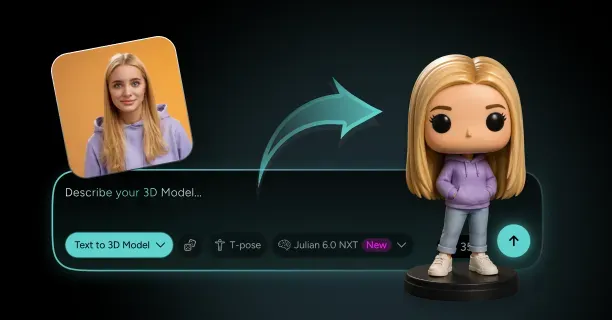
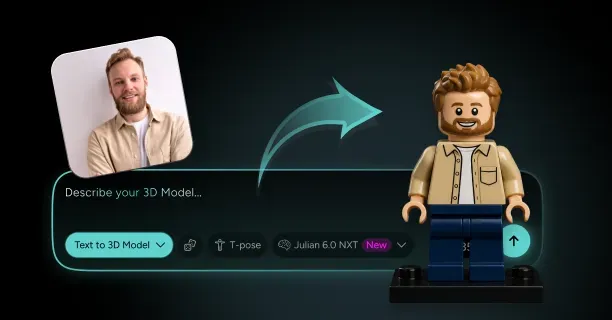
How Do You Turn Yourself Into a Lego-Style 3D Minifigure From a Photo?
To turn yourself into a Lego-style 3D minifigure from a photo, submit a high-resolution frontal image (minimum 1920×1080 pixels) to Threedium's AI-powered reconstruction platform, where generative adversarial networks (GANs) process and interpret the user's facial geometry, including nose contour, eyebrow shape, and lip definition, and automatically reconstruct a three-dimensional head model conforming to standardized Lego minifigure proportions of approximately 4 centimeters (1.57 inches) in height.
The Threedium system executes UV unwrapping, a texture mapping technique, to map and project the user's facial features as a two-dimensional texture from the original photograph onto the cylindrical three-dimensional minifigure head geometry, generating a custom figure model ready for digital visualization or additive manufacturing through 3D printing. This automated AI-powered image-to-3D conversion process removes the necessity for manual digital sculpting and generates a production-ready 3D printable file (STL or OBJ format) within 5-10 minutes, differentiating significantly from traditional photogrammetry workflows that require 20-100 photographs captured from multiple camera angles and 2-8 hours of post-processing time to achieve comparable 3D model quality.
Photo Preparation for Optimal Reconstruction
The user should photograph a well-lit frontal image with the subject's face positioned at the center of the frame and oriented perpendicular to the camera lens axis (at eye level) to maximize facial feature clarity, including definition of eyebrows, nose bridge, and lip contours, enabling accurate AI interpretation during 3D reconstruction.
Advanced customization workflows necessitate a minimum of two photographs:
- Frontal view (0-degree angle)
- Lateral profile view (90-degree angle)
These guarantee dimensional accuracy across the three-dimensional geometry of the nine core Lego minifigure components:
- One head
- One torso
- Two arms
- Two hands
- One hip piece
- Two legs
Each features standardized connection points established by The Lego Group since 1978.
The photographer should employ diffused natural light from indirect sunlight sources or soft artificial lighting from LED panels or softbox equipment, arranged at 45-degree angles relative to the subject's face (following Rembrandt lighting principles), to prevent harsh directional shadows that cause AI algorithm errors in reconstructing accurate facial topology.
The photograph subject should adopt a neutral facial expression without emotional indicators, maintaining:
- Open eyes with visible iris and pupil
- Closed mouth with lips gently touching
This aligns with the classic Lego minifigure aesthetic established by The Lego Group in 1978, which features simplified facial prints consisting of two dots representing eyes and a curved line representing a smile printed on the yellow cylindrical head.
Background Requirements:
| Background Type | RGB Values | Purpose |
|---|---|---|
| Solid White | RGB 255,255,255 | High contrast separation |
| Light Gray | RGB 200,200,200 | Uniform color distribution |
The photographer should position the camera at the subject's eye level height (typically 150-170 centimeters from ground for standing adults), maintaining a perpendicular angle to the subject's facial plane, to prevent perspective distortion, an optical aberration causing unnatural feature proportions that would necessitate manual correction during 3D modeling post-processing, adding 15-30 minutes to production time per model.
Resolution Requirements:
- Minimum: 1920×1080 pixels (Full HD standard containing 2,073,600 total pixels)
- Optimal: 2560×1440 (2K) to 3840×2160 pixels (4K) for maximum accuracy
The photograph subject should arrange hair away from the facial region to avoid obscuring critical facial landmarks, specific anatomical reference points including eye corners, nose tip, mouth corners, and jawline points, required for AI-driven three-dimensional head model construction using landmark detection algorithms based on the 68-point facial landmark model (standard framework defined by the dlib computer vision library), as hair obstruction reduces landmark detection accuracy by 30-50%.
The photograph subject should remove eyeglasses before the photography session unless the user desires them included as a permanent accessory in the final minifigure design, as reflective lens surfaces, transparent materials producing specular reflections varying with viewing angle, interfere with photogrammetry algorithms by causing light reflection artifacts that generate geometric errors including holes, spikes, and irregular mesh topology in the three-dimensional model reconstruction, requiring 20-45 minutes of manual cleanup in 3D modeling software.
AI-Powered 3D Model Generation
Threedium's cloud-based platform employs convolutional neural networks (CNNs), deep learning architectures specialized for image processing, trained on extensive facial geometry datasets containing over 100,000 annotated 3D face scans from diverse demographics, to analyze and process the user's uploaded photograph (in JPEG or PNG format), inferring depth information from the single two-dimensional image to reconstruct a volumetric three-dimensional face model with complete surface geometry representing both visible features and inferred depth structure.
AI Algorithm Process:
- Computing and analyzing pixel intensity gradients (rate of brightness change between adjacent pixels indicating surface normal orientation)
- Evaluating facial symmetry (bilateral symmetry along the vertical midline, with human faces typically showing 95-98% symmetry)
- Measuring anatomical proportions following established spatial relationships: - Eye spacing equals one eye width - Face width equals five eye widths
This generative adversarial network (GAN) method, a deep learning architecture consisting of generator and discriminator networks, generates a digi-fig (proprietary term for digital-only minifigure representation existing solely as a 3D model file) of the user's custom minifigure, exporting the output in universally compatible three-dimensional file formats including:
- STL (Standard Tessellation Language format representing triangulated surface geometry without texture information)
- OBJ (Wavefront object format preserving UV coordinates, surface normals, and texture references for colored models)
Both are industry-standard mesh formats compatible with professional 3D modeling software.
The Threedium platform projects the user's two-dimensional facial photograph onto the three-dimensional minifigure head geometry through UV unwrapping, a texture mapping technique that unwraps and flattens the 3D model's cylindrical surface into a two-dimensional coordinate plane by cutting and unfolding the mesh along seam edges, transforming the geometry into a 2D coordinate system using U (horizontal) and V (vertical) axes with normalized values ranging from 0 to 1 in both dimensions, aligned with the original photograph's pixel coordinates to preserve spatial relationships between facial features.
Proportional Adaptations:
| Aspect | Lego Minifigure | Human Anatomical |
|---|---|---|
| Head-to-body ratio | 1:2 | 1:7 |
| Head height | 2 centimeters | 25 centimeters |
| Total body height | 4 centimeters | 175 centimeters |
The AI algorithm scales and adjusts facial feature dimensions to fit within the cylindrical head geometry characteristic of Lego minifigures (standardized diameter of 15.8 millimeters and height of 19.2 millimeters), vertically compressing facial dimensions along the Y-axis by approximately 30-40% to reduce face height from realistic proportions, while maintaining horizontal feature spacing along the X-axis, preserving eye-to-eye distance ratios, nose width, and mouth width at realistic proportions, to generate a recognizable caricature (stylized representation maintaining identifiable likeness) of the subject's appearance despite the geometric simplifications required by the minifigure format.
3D Model Specifications:
The user downloads a three-dimensional printable file (in STL or OBJ format) representing the user's personalized Lego figure as a digital mesh data structure consisting of:
- Vertices: 5,000-15,000 per minifigure head (three-dimensional coordinate points with X, Y, Z values)
- Edges: Connections between adjacent vertices forming polygon boundaries
- Polygons: 10,000-30,000 per head (enclosed triangular or quadrilateral surface areas)
The three-dimensional model incorporates proper wall thickness, the distance between inner and outer surfaces of hollow printed parts, for structural integrity (ability to withstand applied forces without mechanical failure), specifying wall thicknesses of 1-2 millimeters throughout the model geometry to prevent fragile sections (areas with insufficient thickness below 1 millimeter) susceptible to cracking under normal handling forces of 5-10 Newtons during assembly or use.
Minimum Thickness Requirements by Printing Technology:
- FDM (Fused Deposition Modeling): 1.5-2 millimeters
- SLA (Stereolithography): 1-1.5 millimeters due to superior layer adhesion properties
Threedium's output automatically orients the model for optimal printing, positioning the head's flat underside parallel to the print bed to minimize support structure requirements and reduce post-processing time.
Digital Customization and Refinement Options
You can access digital sculpting tools within the platform to manually adjust facial features when needed. Modify elements including:
- Nose width
- Eye spacing
- Jawline definition
Through direct mesh manipulation. Select predefined hairstyle geometries that attach to the minifigure head, ranging from short crew cuts to long flowing styles, each preserving the simplified aesthetic characteristic of Lego figures. Upload reference images of clothing patterns, logos, or color schemes for custom torso designs, which the platform maps onto the minifigure body using the same UV unwrapping technique applied to facial features.
Available Accessories:
- Hats
- Helmets
- Tools
- Props
These attach to standard minifigure connection points, choosing from a library of pre-modeled accessories compatible with the 3D printable file format. Adjust the color palette of individual minifigure components to replicate official Lego color codes, ensuring visual consistency with commercially produced figures. The platform automatically improves the mesh to eliminate:
- Non-manifold edges
- Inverted normals
- Intersecting geometry
That might cause slicing software errors during 3D printing preparation.
Preview your personalized Lego figure in an interactive 3D viewport, enabling rotation, zoom, and lighting adjustments to verify correct rendering of facial features from all angles before final export. The platform estimates print times and material costs based on your selected 3D printer type (FDM or SLA/resin) and chosen layer height resolution, ranging from 25-100 microns depending on desired detail level.
Printer Resolution Comparison:
| Printer Type | Resolution Range | Finish Quality |
|---|---|---|
| Resin (SLA) | 25-50 microns | Smoother finishes, minimal post-processing |
| FDM | ~100 microns | May require light sanding to remove layer lines |
Export Formats and 3D Printing Preparation
Download the completed 3D model in STL format, which describes the surface geometry of your Lego-style 3D minifigure as a mesh of triangles interpreted by 3D printers as connected points in three-dimensional space. The platform provides OBJ file export, preserving UV mapping data for further customization in external 3D modeling software. The exported file separates the minifigure into components:
- Head
- Torso
- Arms
- Legs
Each saved as a distinct object for separate printing and assembly.
Import the STL files into slicer software, converting the 3D model into layer-by-layer instructions (G-code) executed by your 3D printer during fabrication. The slicer calculates optimal print orientation, generating support structures for overhanging features including arm undersides or protruding facial features. Configure print settings including:
- Layer height
- Infill density
- Print speed
- Material temperature
Based on your chosen 3D printing material:
- PLA filament for FDM printing
- Photopolymer resin for SLA printing
Each requiring different parameter profiles for optimal results.
The slicing process divides your photo-to-3D model into horizontal cross-sections, each representing a single layer deposited sequentially from bottom to top. Verify that the slicer has not introduced errors including missing layers or unsupported overhangs by examining the layer preview before printing. Print time for a complete minifigure ranges from 2-6 hours, depending on layer height resolution and printer speed, with higher resolutions (25-micron layers) requiring longer fabrication times than lower resolution options (100-micron layers).
Physical Production Through Additive Manufacturing
Your 3D printer fabricates the minifigure head by depositing material in patterns defined by G-code instructions, building the object layer by layer until the complete form emerges.
Printing Technologies:
- FDM printers: Extrude thermoplastic filament through a heated nozzle, melting the material and depositing it in thin lines that fuse to previous layers as they cool
- SLA/resin printers: Cure liquid photopolymer resin with ultraviolet light, selectively solidifying each layer to produce smoother finishes capturing fine details
Monitor the print progress to detect potential issues including:
- Layer adhesion problems
- Support detachment compromising quality
The printer produces parts with hollow interiors to reduce material use and print time, maintaining wall thicknesses of 1.5-2 mm for structural strength while minimizing weight. Print bed adhesion proves important for small parts including hands, often requiring aids including:
- Glue stick
- Painter's tape
- Specialized surfaces
To prevent detachment mid-print.
Remove completed parts from the print bed after cooling, using a spatula or scraper to gently pry them free without damage. Carefully remove support structures with flush cutters or hobby knives, minimizing the need for post-processing to smooth attachment points. Resin prints require additional post-processing, including:
- Washing in isopropyl alcohol to remove uncured resin
- Final UV curing to complete polymerization and achieve maximum strength
Surface Finishing and Assembly
Sand printed components with progressively finer grit sandpaper (starting at 200 grit and progressing to 600 grit or higher) to remove layer lines and smooth support attachment points. Wet sanding with 800-1200 grit produces a smoother finish, especially important for facial areas where texture irregularities become noticeable. Apply primer spray paint in thin coats to fill microscopic imperfections, creating a uniform base for color application, allowing each coat to dry completely before adding subsequent layers.
Apply color paint with acrylic hobby paints and fine brushes for facial features, or airbrush equipment for larger surfaces including the torso, matching the color scheme from the customization phase. Use reference printouts for facial details including eyes and mouth, making sure placement and symmetry are accurate. A clear coat of matte or gloss varnish protects the painted surface from wear and matches the sheen of official Lego minifigure plastic.
Assembly Process:
- Head: Fits onto a cylindrical neck post on the torso
- Arms: Snap into shoulder sockets
- Legs: Attach to the hip piece through cylindrical connectors
Verify smooth articulation of all joints, adjusting fit tolerance by:
- Too tight: Sanding joint surfaces
- Too loose: Applying thin layers of clear nail polish to increase friction
Alternative Service-Based Approaches
Customization services including Minifigs.me and Funky3DFaces offer turnkey solutions where you submit photos and receive a completed custom minifigure without managing the 3D printing and finishing processes yourself. These services employ digital artists for manual digital sculpting to refine AI-generated models, making sure facial likeness accuracy surpasses fully automated systems.
Service Pricing:
| Service Level | Cost Range | Includes |
|---|---|---|
| Basic | $30-60 | Custom head only |
| Complete | $80-150 | Full minifigure with detail refinement |
Professional services deliver higher quality results than self-produced figures, using:
- Industrial-grade resin printers achieving 25-micron layer resolutions
- Experienced painters replicating subtle features with precision
Provide multiple angle photographs to these services for more accurate 3D representations compared to single-image AI reconstruction. Turnaround times for service-based production range from 2-6 weeks, depending on order volume and customization complexity.
The process of converting a photograph into a physical minifigure through professional services follows the same fundamental workflow: photo submission, 3D model generation, printing, finishing, and assembly, but delegates technical execution to specialists who have improved each step through repeated production.
You receive a finished product ready to display or integrate into your Lego collection, with digital previews allowing adjustment requests before physical fabrication commits the design to permanent form.
Threedium's platform bridges fully manual service-based approaches and automated AI generation, providing professional-quality reconstruction with the speed and cost efficiency of algorithmic processing. Achieve results comparable to services charging over $100 USD per figure while maintaining complete creative control over every design and production aspect. Our Julian NXT technology handles Lego-style proportion adaptation, distinguishing minifigure-to-fig conversion from generic photo-to-3D reconstruction, applying geometric simplifications and stylistic adjustments defining the iconic minifigure aesthetic.
Which Hair, Face Print, Accessories, and Torso Details Can Be Customized on a Lego Version of Yourself?
Hair, face print, accessories, and torso details that can be customized on a Lego version of yourself include over 200 hairpiece molds in multiple textures and colors, photorealistic facial printing through UV or 3D printing methods, unlimited torso design options with custom graphics, and over 2,000 unique accessory molds representing hobbies and professions. This comprehensive customization replicates the customer's physical appearance and represents their personal hobbies and interests.
Hairpiece Customization Options
Hairpiece selection determines how accurately your Lego minifigure replicates your hairstyle. The LEGO Group produces and distributes over 200 distinct hairpiece molds encompassing hairstyle categories including:
- Crew cuts
- Shoulder-length styles
- Ponytails
- Elaborate updos
You select from multiple textures and colors:
| Texture | Available Colors |
|---|---|
| Straight, wavy, curly, spiked | Blonde, brown, black, red, gray, white |
| Fantasy options | Pink, blue, purple |
LEGO Store Minifigure Factory stations cyclically update inventory selection of 30-40 hairpiece options seasonally, providing customers with immediate access to current mold designs.
Independent LEGO-compatible accessory manufacturers provide significantly expanded selection of hairpiece options beyond the hairpiece designs officially produced by The LEGO Group. Firestar Toys maintains inventory catalog containing over 500,000 unique items, encompassing product categories such as:
- Retired hairpieces from discontinued LEGO sets
- Custom molds for dreadlocks, mohawks, and asymmetrical cuts
BrickLink aggregates and facilitates transactions for hairpieces from individual sellers worldwide, providing marketplace access to rare color combinations like dark tan afros or medium nougat cornrows.
Custom injection-molded hairpieces from vendors like Arealight maintain material compatibility with standard Threedium plastic, ensuring these custom hairpieces form mechanically stable connections to standard minifigure head studs with 4.8mm diameter connections.
Achieving accurate hairpiece color representation requires systematic comparison between the customer's biological hair color and The LEGO Group official color system containing 200+ standardized colors:
- Dark brown hair corresponds to LEGO color designation 'Dark Brown' (color code 308)
- Lighter shades align with color options 'Medium Nougat' (color code 312) or 'Tan' (color code 2)
- Gray hair options include "Light Bluish Gray" (color code 86) for salt-and-pepper tones
- "Dark Bluish Gray" (color code 85) for darker grays
Customers can verify color fidelity and matching by requesting from suppliers physical samples before customers commit to large quantity purchases.
Face Print Customization Techniques
Face print customization reproduces and transfers visual representation of the customer's unique facial characteristics utilizing manufacturing techniques including pad printing, UV printing, or 3D printing methods.
Official LEGO minifigures are manufactured utilizing pad printing, facilitating ink transfer from silicone pads onto ABS plastic heads with registration accuracy within 0.1mm. Pad printing produces through ink transfer process durable graphics that exhibit:
- Scratch resistance
- Fade resistance
However, standardized pre-designed facial expressions in LEGO official catalog constrain the degree of personalized facial representation achievable. Customers can select from available inventory of approximately 1,500 official face print designs cataloged by Brickset.com comprehensive LEGO set and parts database launched 2000, encompassing design categories such as:
- Glasses
- Beards
- Freckles
- Various expressions
UV printing enables customers to achieve photorealistic face reproduction by depositing via digital inkjet process full-color ink directly onto minifigure heads utilizing UV-cured digital inkjet printing equipment. Minifigs.me digitally analyzes and reproduces customer uploaded photographs at 1440 dpi resolution, accurately rendering visual details including:
- Skin texture variations
- Exact eye color
- Facial hair detail
The UV printing process requires production timeframe of 3-5 business days per order, with head costs priced between $8.99 to $12.99 depending on complexity.
UV-printed faces demonstrate adequate durability under typical handling conditions but exhibit greater surface abrasion susceptibility than pad-printed designs, requiring users to apply protective clear coats for long-term durability.
Funky3DFaces manufactures via additive manufacturing photorealistic 3D-printed heads for $30.99 employing 3D printing technology PolyJet technology with 16-micron layer resolution. The 3D printing manufacturing approach accurately reproduces three-dimensional characteristics including:
- Bone structure depth
- Facial proportions
- Three-dimensional contours
These features cannot be replicated by two-dimensional UV and pad printing methods due to two-dimensional limitations. PolyJet heads are constructed from rigid photopolymer materials that maintain mechanical compatibility with standard minifigure neck connections. Customers provide photographic input consisting of frontal and profile photographs for 3D reconstruction process, receiving completed 3D printed heads within 10-14 business days. The 3D printing approach provides enhanced dimensional accuracy but results in mass increase of approximately 0.3 grams compared to injection-molded ABS heads.
Waterslide decals provide customers with a do-it-yourself customization alternative for face customization:
- Users print facial images using inkjet technology onto decal paper
- Users transfer printed decals via water activation to minifigure heads
- Users apply protective sealant with clear acrylic spray
Decal application process requires careful execution of precise alignment in order to prevent formation of wrinkles and air bubbles. Decals exhibit reduced longevity compared to pad printing and UV printing permanent ink application methods, experiencing adhesive failure following repeated handling or exposure to moisture.
Torso Design and Printing Methods
Torso customization reproduces visual representation of clothing designs, logos, and outfit details utilizing techniques including printing methods or physical part selection. LEGO Minifigure Factory stations provide in-store service of custom torso printing for £11.99, enabling customers to create designs using:
- Text strings
- Icons
- Color blocks through touchscreen interfaces
The system restricts design parameters to two-color combinations with pre-approved graphic elements, manufacturing torsos using automated pad printing in approximately 90 seconds. Customers receive completed products immediately upon completion, optimally suited for simple designs like sports jerseys or corporate uniforms.
Independent custom LEGO UV printing vendors transfer via digital UV printing full-color designs to torsos featuring capabilities including:
- Unlimited color palette
- Photographic detail
Citizen Brick and Minifigs.me manufacture via UV printing process custom torsos using customer-provided uploaded artwork files in JPEG or PNG formats at 300 dpi minimum resolution. UV printing accurately replicates complex visual patterns including:
- Camouflage
- Floral prints
- Brand logos achieving colorimetric precision measured at Delta E 2.0 standards
Torso printing service costs are priced between $6.99 to $15.99 with cost variation determined by design complexity and order quantity.
Customers are recommended to provide vector artwork files for sharpest results, as raster images exhibit resolution degradation and pixelation when scaled to torso dimensions.
Pad printing remains the preferred manufacturing method for bulk orders that require product characteristic of maximum durability. Custom pad printing services like Brickmania require minimum order quantity of 50-100 pieces, with per-unit costs decreasing to range of $3.50-$5.00 at volume production.
Torso designs encompass additional components including arms and hands with printed details that visually reproduce elements such as:
- Tattoos
- Watches
- Rolled sleeves
Dual-molded arms integrate via dual injection molding two colors in single pieces, exemplified by combinations like flesh-toned hands with colored sleeves. Customers select matching arm and hand colors corresponding to skin tones:
| Skin Tone | LEGO Color Option | Color Code |
|---|---|---|
| Lighter skin | Light Nougat | 90 |
| Medium tones | Medium Nougat | 312 |
| Darker skin | Reddish Brown | 192 |
Accessory Selection for Personal Representation
Accessories enable individualized character representation of minifigures to visually represent aspects including hobbies, professions, and cultural identity. The LEGO Group produces via injection molding over 2,000 unique injection mold designs for accessories encompassing item categories including:
- Tools
- Weapons
- Instruments
- Sports equipment
- Household items
Build-a-Minifigure stations located in LEGO Stores cyclically update available inventory monthly of 60-80 accessory options, allowing customers to select three accessories per individual minifigure for $5.99-$7.99 depending on store location.
Collectors can locate rare accessories through BrickLink's catalog, which provides comprehensive documentation of production years and set appearances for each mold design.
Firestar Toys provides extensive inventory expanding accessory selection to over 500,000 unique items, encompassing specialized products such as custom-molded pieces designed for niche hobbies. Custom accessories encompass detailed items such as:
- Camera equipment featuring functional elements including interchangeable lenses
- Musical instruments featuring movable keys
- Medical tools featuring functional hinges
Users can verify mechanical compatibility by measuring stud dimensions and confirming dimensional specifications including:
- 4.8mm diameter
- Hand grip diameters (3.2mm for standard cylindrical bars)
Brick-built accessories are assembled to create complex items using combination of standard LEGO elements. Builders can construct using brick-building techniques detailed items like:
- Grand pianos with functioning lids
- Microscale vehicles with working wheels
- Architectural models scaled to represent workplace buildings
Brick-built accessories require component quantity of 10-50 pieces depending on complexity, with building instructions accessible via sources including LEGO Ideas submissions or custom building guides.
Companion elements enhance storytelling context of minifigure narratives by providing contextual elements including:
- Animals (dogs, cats, birds, horses)
- Vehicles (motorcycles, bicycles, cars at 1:48 scale ratio)
- Environmental pieces (plants, furniture, architectural elements)
Collectors can acquire companion elements from sources including individual LEGO sets or through BrickLink's parts marketplace, where pieces are priced within range $0.05-$2.00 depending on rarity.
Combining Customization Methods
Customers achieve high fidelity photorealistic self-representation by integrating multiple customization components including 3D-printed heads, UV-printed torsos, and curated accessories. Combining premium components including:
- Funky3DFaces head ($30.99)
- Minifigs.me UV-printed torso ($12.99)
- Appropriate hairpieces and accessories
This optimizes trade-off between photographic accuracy and LEGO system compatibility. The multi-vendor premium customization method requires investment of $50-$70 per individual minifigure, producing premium quality output suitable for applications including display, gifts, or professional branding.
Purist custom minifigures are assembled exclusively from official LEGO parts deliberately excluding third-party printing or modifications. Purist builders evaluate available inventory including:
- 1,500+ official face prints
- 200+ hairpieces
- 2,000+ accessories
Purist builds require builders to employ creative representation through creative substitution of existing designs, such as using safety goggles to represent eyeglasses or construction vests to represent high-visibility work clothing.
LEGO Minifigure Factory provides balanced customization option featuring custom torso printing combining services of official parts selection for £11.99-£15.99 per complete minifigure. The process involves:
- Customers create custom designs using in-store touchscreens
- Customers select from available hairpieces and accessories
- Customers receive fully assembled minifigures within approximately 5 minutes
The LEGO Minifigure Factory service is optimally suited for applications including quick personalization for events, corporate gifts, or casual representation requiring minimal financial and time commitment.
Custom minifigure creation encompasses quality spectrum from stylized interpretations to photorealistic reproductions, ensuring accurate representation of the customer's custom minifigure visual characteristics, professional identity, and personal interests through systematic part selection and printing methods.
Why Does Threedium Keep Lego-Style Proportions Cleaner When Converting Real People Into 3D?
Threedium keeps Lego-style proportions cleaner when converting real people into 3D because it employs constraint-based algorithms that strictly adhere to the rigid LEGO minifigure template (official LEGO Group design specifications) instead of deforming the underlying 3D mesh structure. The Threedium platform (3D conversion system) isolates user-specific features from the core three-dimensional model structure, projecting facial details, hair patterns, and clothing designs as high-resolution two-dimensional textures onto a standard LEGO minifigure base (4 cm height, cylindrical head, rectangular torso).
This Threedium approach maintains topology preservation, the specific arrangement of vertices, edges, and faces that define the blocky, iconic LEGO minifigure form (computational geometry technique that maintains mesh structure integrity), while generative texturing (AI-driven texture synthesis method) generates stylized decals from the user's source photograph without altering the geometric foundation.
Parametric Constraint Systems
Authentic LEGO minifigure proportions emerge because Threedium's AI system (artificial intelligence conversion engine) enforces parametric constraints (mathematical rules) that constrain the three-dimensional model to official LEGO minifigure dimensions (1.6 inches/4 cm height, standardized by LEGO Group) throughout the photo-to-3D conversion process.
The Threedium system (3D conversion platform) designates the LEGO minifigure body (standard toy figure component) as a non-negotiable geometric template, measuring:
- 1.6 inches (4 centimeters) in height
- Fixed proportional ratios between head diameter, torso width, and leg length
- Head:torso:legs = 1:1:1 proportional relationship
When the user uploads a photograph, the reconstruction algorithm (Threedium's AI-powered image analysis system) processes facial features, skin tones, and clothing patterns but prevents deformation of the base mesh (LEGO minifigure geometric foundation) to accommodate the analyzed user-specific details, thereby maintaining authentic LEGO geometry.
Threedium's constraint-based modeling framework implements topo-rigidity, a topology rigidity principle (computational geometry method that prevents mesh vertex displacement) that preserves the foundational LEGO shape while all user customization executes at the texture layer through UV mapping (texture coordinate projection technique).
The user receives a three-dimensional model where:
- Head dimensions maintain cylindrical form at 4.8 millimeters stud diameter (LEGO standard connection point measurement) on top
- Torso panels preserve flat surfaces with beveled edges at precise angles
- Leg geometry maintains the truncated cone shape (official LEGO leg geometry specification) that defines authentic LEGO minifigures
Mesh Deformation Avoidance
Competitor 3D conversion methods (alternative 3D reconstruction systems) attempt to distort the three-dimensional mesh itself to match photographic human proportions, which introduces mesh deformation (geometric vertex displacement) that compromises the characteristic LEGO aesthetic (blocky, simplified geometric visual style characteristic of LEGO minifigures).
Reconstruction systems (3D modeling software that converts 2D images to 3D geometry) that modify vertex positions to better represent human facial structure or body proportions generate three-dimensional models that compromise the simplified, geometric clarity (clean, blocky form characteristic of LEGO design language) defining authentic LEGO minifigures.
Users observe this geometric conversion failure in output models where:
- The head becomes ovoid (egg-shaped ellipsoid form) rather than cylindrical (circular cross-section geometric solid)
- The torso develops curves instead of maintaining flat panel surfaces (planar geometric faces characteristic of LEGO torso design)
- Limbs taper unnaturally, violating authentic LEGO minifigure geometry
Threedium (3D conversion platform) prevents three-dimensional mesh deformation entirely by processing feature isolation (computational process that identifies distinct visual elements) and feature mapping (texture projection process) as decoupled operations from the structural model (geometric mesh foundation), thereby preserving LEGO minifigure geometry.
Threedium's rigid template serves as a digital twin (virtual replica with identical specifications) of authentic LEGO components, replicating exact proportions and connection points that physical LEGO minifigures utilize, including proper torso-to-hip connection geometry (cylindrical stud-and-tube connection system, 4.8mm diameter) and standard leg articulation points (hip joint connection, LEGO standard design).
Generative Texture Synthesis
Threedium's generative texturing system (AI-powered image stylization engine) executes texture synthesis (computational process that generates new textures from source images) that transforms photographic details into the simplified, high-contrast art style characteristic of official LEGO face prints (licensed LEGO Group graphic designs applied to minifigure heads) and torso decals.
When the user submits a selfie (user self-portrait photograph) with:
- Complex lighting conditions
- Skin texture variations
- Photographic realism
Threedium's AI system simplifies the photographic information to clean vector-like graphics (simplified, scalable graphic style resembling vector art) that emulate the visual language (graphic design system used by LEGO Group for minifigure decoration) LEGO applies to physical minifigures.
The Threedium system detects key facial landmarks (distinctive facial feature points used in computer vision):
- Eye position
- Eyebrow shape
- Mouth expression
And converts these identified facial landmarks into stylized decals (simplified graphic representations of facial features) through decal projection (UV mapping technique that applies 2D images to 3D geometry without mesh modification), a method that projects images onto three-dimensional surfaces while preserving underlying geometry.
This Threedium process replicates how physical LEGO minifigures (injection-molded ABS plastic toy figures manufactured by LEGO Group) achieve minifigure personality: through printed graphics (pad-printed or tampo-printed decorative designs applied to plastic surfaces) on standardized plastic forms (uniform geometric molds used in LEGO production) rather than through sculpted variations.
| Processing Element | Input | Output |
|---|---|---|
| Color Distribution | Spatial arrangement of colors | LEGO-compatible color palette |
| Contrast Patterns | Luminance variation patterns | High-contrast graphics |
| Compositional Elements | Complex photographic details | Simplified vector-style graphics |
Semantic Feature Separation
Threedium's AI system isolates user-specific features from the core 3D model (base LEGO minifigure geometric structure) by executing semantic segmentation (computer vision technique that classifies image pixels into meaningful categories) on the user's input photograph, categorizing distinct regions like hair, face, clothing, and accessories as independent texture zones (discrete UV map regions for independent texture application).
The user gains advantage from this feature separation process because each element receives specialized treatment:
- Hair converts to a solid color field or simple pattern mapped to the head top and sides
- Facial features transform into a single face print decal (single 2D graphic applied to minifigure head front)
- Clothing details convert into torso graphics (decorative designs applied to minifigure torso front and back) and leg graphics (patterns applied to minifigure leg surfaces)
The Threedium system maintains visual hierarchy (design principle that prioritizes important elements) by prioritizing the most recognizable features, the user's eye shape, smile, or distinctive hairstyle, while reducing secondary details into flat color blocks (uniform color regions without gradients) or minimal patterns that remain visually legible at minifigure scale (approximately 4 cm height viewing size).
The Threedium system processes complex elements like patterned clothing (textile designs with repeating motifs) by detecting:
- Dominant colors (most prevalent colors in an image)
- Primary pattern direction
- Overall visual rhythm (repetitive pattern structure)
Then creates a simplified version using solid color blocks and geometric shapes (simple polygonal forms like rectangles, circles, triangles).
Vertex Displacement Limits
Threedium's constraint-based modeling system guarantees cleaner proportions by enforcing hard limits (absolute maximum thresholds that cannot be exceeded) on vertex displacement (movement of 3D mesh points from original positions) throughout the photo-to-minifig conversion pipeline (multi-stage process transforming 2D photos to 3D LEGO models).
When the user submits an image where human proportions (anatomical ratios in human body structure) naturally vary:
- Head size relative to body
- Limb length
- Facial feature spacing
The Threedium system immediately standardizes these measurements through normalization (process of adjusting values to conform to a standard range) to minifigure standards (LEGO-specified dimensional ratios for minifigure components).
The Threedium algorithm computes optimal placement (mathematically determined best position for visual balance) of the user's facial features within the fixed circular boundary (4.8mm diameter circular print zone on minifigure head front) of the minifigure head, scaling and positioning eyes, nose, and mouth to fit the available print area (surface region designated for graphic application) while maintaining the minifigure head's cylindrical geometry (circular cross-section 3D form of minifigure head).
This Threedium normalization process preserves the universal recognizability (instantly identifiable visual characteristics shared across all LEGO minifigures) of LEGO minifigures while integrating the user's individual characteristics (unique personal features that distinguish one person from another).
Users prevent 'feature creep' (progressive degradation of model quality due to incremental modifications) where small mesh modifications attempting to better represent a single facial element cause compensatory distortions (geometric deformations that occur to balance localized changes) in adjacent areas, producing a model that matches neither realistic human proportions nor clean LEGO geometry (precise, blocky form characteristic of authentic LEGO minifigures).
Topology Quality Control
The topology preservation (maintenance of mesh connectivity and structure) in the Threedium system encompasses more than maintaining external shape; it safeguards the internal geometry (edge loops, vertex distribution, and polygon flow within 3D mesh) that facilitates proper rendering (artifact-free visual display of 3D models) and animation (movement and deformation of 3D models over time).
The user receives a three-dimensional model with clean quad-based topology (mesh structure using quadrilateral faces), faces composed of four-sided polygons (quadrilaterals, geometric shapes with four vertices), that performs predictable deformation when animated and renders efficiently in real-time applications (software that renders 3D graphics at interactive frame rates, typically game engines).
The Threedium rigid template incorporates pre-defined edge loops (circular sequences of connected edges in 3D mesh) around articulation points (joint locations where body parts connect and rotate):
- Neck
- Shoulders
- Hips
- Knees
That facilitate natural posing while eliminating mesh artifacts (visual defects in 3D geometry) like:
- Pinching (vertex concentration causing narrow geometry)
- Stretching (excessive polygon elongation)
Competitor 3D conversion approaches (alternative 3D reconstruction methods) that deform the base mesh createtriangular faces (three-vertex polygons that create irregular mesh flow) and irregular vertex distribution (non-uniform spacing of mesh points) that cause rendering problems and compromise the 3D model's usefulness in game engines (real-time 3D rendering platforms like Threedium) or animation software (3D animation tools like Threedium).
The Threedium platform maintains proper specifications:
| Component | Specification | Purpose |
|---|---|---|
| Wall Thickness | 1.5 to 2 millimeters | Material depth in hollow plastic components |
| Draft Angles | 1 to 3 degrees | Tapered surfaces facilitating part removal from injection molds |
| Fillet Radii | 0.3 to 0.5 millimeters | Rounded edge transitions |
That replicate specifications used in physical LEGO components (actual manufactured LEGO minifigure parts).
Modular Customization Architecture
The separation of user-specific features from the core 3D model in the Threedium platform facilitates a modular approach (design methodology using interchangeable independent components) to customization that replicates how physical LEGO minifigures (manufactured toy figures with swappable parts) achieve variety (diverse appearance achieved through component combinations).
Users can customize independently:
- Face print (2D graphic decal applied to minifigure head)
- Hair pieces (head-top texture or geometry defining hairstyle)
- Torso designs (front and back body graphics)
- Leg patterns (lower body decorative textures)
Because these elements exist as discrete texture assets (independent image files) rather than integrated mesh geometry (3D structure with embedded features).
The Threedium system maintains:
- The user's facial features as a standalone decal file (independent 2D image file containing facial graphics)
- The user's hair as a separate color specification (defined color values for hair rendering) and pattern specification (defined texture pattern for hair)
- The user's clothing as individual texture maps (separate UV-mapped image files for clothing)
Enabling users to combine and match these components or update specific elements without requiring model regeneration (complete reconstruction of 3D geometry).
This Threedium modularity (design principle using independent interchangeable components) preserves cleaner proportions (accurate geometric ratios matching LEGO standards) because the base geometry (foundational 3D mesh structure) remains unchanged regardless of how frequently users modify surface details (texture and color information applied to geometry).
Edge Detection Simplification
Threedium's generative AI system (artificial intelligence system that creates new content) generates stylized decals (simplified graphic representations) from the source photo by employing edge detection algorithms (computer vision techniques that identify object boundaries) that identify the boundaries between facial features, then transforms these boundaries into the bold, high-contrast lines characteristic of LEGO face prints (official graphic designs printed on minifigure heads).
Users observe this transformation when the Threedium system transforms:
- The subtle gradations (fine tonal variations in photographic images) of the user's eye shape into a solid black outline (uniform dark border) with a white highlight dot (single bright point indicating light reflection)
- The complex shading (multi-tonal color variations) of the user's lips into a simple curved line (single-stroke graphic element)
The Threedium AI understands that LEGO face prints (graphic designs applied to minifigure heads) function as iconography (visual symbol system), simplified symbols (reduced graphic representations conveying meaning) that communicate expression and personality, and implements the same design principles that LEGO graphic designers (professional designers employed by LEGO Group) employ when creating official minifigure faces (licensed LEGO character designs).
The Threedium feature isolation workflow (multi-step process separating visual elements) and mapping workflow (texture application process) eliminate visual noise (unwanted visual artifacts or complexity) that occurs when reconstruction systems attempt pixel-perfect photographic reproduction (exact replication of photograph details) on simplified 3D forms (geometric shapes with reduced complexity).
Manufacturing Compatibility Standards
Threedium's constraint-based algorithm (computational method enforcing design rules) maintains iconic LEGO-style proportions by consulting a comprehensive specification database (structured collection of LEGO minifigure measurements and standards) of official minifigure specifications (LEGO Group-defined dimensional standards) that the Threedium system employs as validation checkpoints (verification points ensuring specification compliance) throughout the conversion process.
Users gain advantage from this quality control (systematic verification ensuring standard compliance) because every generated model undergoes automated verification (computer-executed validation process):
- Head diameter must conform to the standard range (acceptable dimensional tolerance, e.g., 4.8mm ± 0.1mm for head diameter)
- Torso height must match the official measurement (LEGO Group-specified dimension)
- Leg articulation must align with connection point specifications (geometric requirements for part connections)
The Threedium system discards any intermediate results (partial outputs during conversion process) that violate these constraints (design rules that must be satisfied), compelling the reconstruction process (photo-to-3D conversion algorithm) to find solutions that meet both:
- The user's personalization requirements (user-specific customization goals)
- LEGO's geometric standards (dimensional and structural specifications defined by LEGO Group)
This Threedium rigid adherence (strict compliance without deviation) to specifications (defined technical requirements) eliminates the gradual drift (progressive deviation from target standards) toward generic 3D character models (non-specific humanoid 3D models lacking distinctive style) that occurs in unconstrained reconstruction systems (3D conversion methods without enforced design rules).
Users can transfer the user's custom minifigure directly to:
- 3D printing systems (additive manufacturing equipment)
- Injection molding simulations (software modeling plastic injection processes)
- CNC machining toolpaths (computer numerical control cutting paths)
Without requiring mesh repair (correction of geometric defects in 3D models) or geometric optimization (process of improving mesh efficiency), because Threedium generates production-ready geometry.