How Do You Turn Yourself Into a Funko-Style 3D Figure From a Photo?
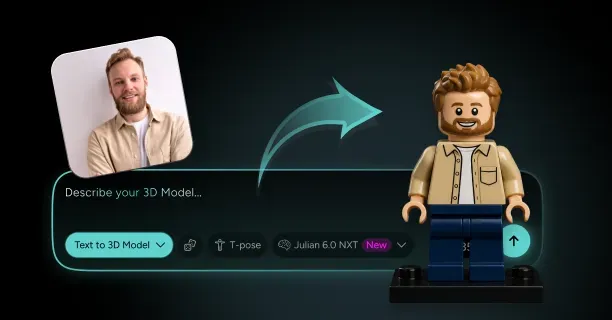
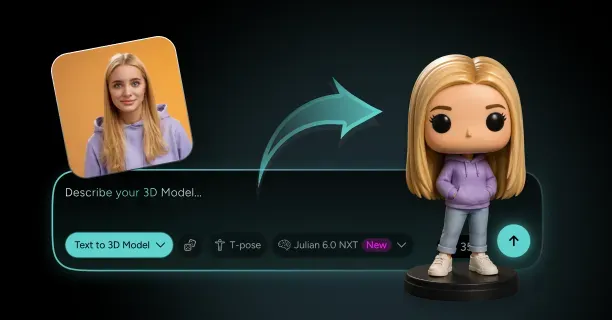
To turn yourself into a Funko-style 3D figure from a photo, upload high-resolution reference images to Threedium's AI-powered reconstruction platform or hire a professional 3D artist through platforms like Etsy or Fiverr. The platform processes the user's facial features: including eyes, nose, mouth, and jawline into the signature oversized head (measuring 1.5-2x standard human head-to-body ratio), simplified body proportions, and stylized aesthetic characteristic of Funko Pop collectible figures. The platform then exports a production-ready 3D model file optimized for digital rendering or physical 3D printing.
Professional Service vs DIY Workflow
Professional 3D reconstruction services manage the entire conversion workflow: from initial photograph analysis and facial feature detection to final 3D model export, eliminating the need for the customer to possess sculpting expertise or 3D modeling software skills. Customers can hire professional 3D artists through online marketplace platforms such as:
- Etsy (an e-commerce platform for handmade and custom goods)
- Fiverr (a freelance service marketplace)
Where independent 3D sculptors showcase their portfolio work and demonstrate their proven capability to create personalized collectible figures.
Professional 3D artists typically request 3-5 reference photographs displaying the subject's face from multiple angles:
- Front view (0-degree angle)
- Side profile view (90-degree angle)
- Three-quarter view (45-degree angle)
Freelance 3D artists state that this multi-angle photo set represents the minimum requirement needed to accurately capture facial likeness and proportional relationships for digital sculpting workflows.
Ensure that reference images maintain a minimum resolution of 1920×1080 pixels (Full HD quality) to enable reconstruction algorithms to accurately capture fine facial details including eyebrow shape, nose bridge structure, and jawline definition that establish the subject's unique facial characteristics and enable accurate likeness reproduction.
Individuals can pursue the DIY (do-it-yourself) approach if they possess proficiency in 3D modeling software such as:
Using these applications, users manually construct the figure model by starting with primitive geometric shapes including spheres (for head base geometry) and cylinders (for limb and body structures). The 3D artist creates the characteristic oversized head by starting with a UV sphere primitive (a spherical mesh with evenly distributed vertices in latitude-longitude pattern) scaled to occupy 60-70% of the total figure height.
The artist then adds facial features: eyes, nose, mouth, and ears using technical modeling methods including:
- Boolean operations (combining or subtracting geometric shapes)
- Displacement sculpting (deforming surface geometry based on texture maps)
- Manual polygon modeling (directly manipulating individual vertices, edges, and faces)
The artist constructs the body by modeling simplified anatomical components: torso (chest and abdomen), arms (upper arms and forearms), and legs (thighs and lower legs) with minimal or no joint articulation. The figure maintains a fixed static pose characteristic of display collectibles (non-articulated figurines designed for shelf presentation), rather than the ball-jointed articulation system found in poseable action figures.
| Approach | Time Required | Experience Level |
|---|---|---|
| Manual DIY modeling | 20-40 hours | Beginners (less than 100 hours prior experience) |
| AI-powered reconstruction | 3-5 minutes | No experience required |
Facial Feature Simplification Process
The "Funkofication" process: a stylization workflow specific to creating Funko Pop-style characters transforms realistic human facial anatomy (featuring complex organic curves, subtle contours, and detailed surface variations) into Funko's distinct simplified aesthetic by reducing anatomical complexity to clean geometric primitives (circles, triangles, rounded rectangles) and minimalist surface forms.
Realistic human eye sockets (elliptical orbital cavities with complex anatomical depth variations) transform into perfectly circular recessed areas measuring approximately 15-18 millimeters in diameter on standard 3.75-inch (9.5-centimeter) Funko Pop figures, representing a simplification ratio of approximately 1:1 circular geometry compared to natural 1.2:1 horizontal-to-vertical eye socket proportions.
Complex human nose structures: featuring nasal bridge, nostrils, columella, and alar cartilage with typical 15-20mm projection from the face simplify to minimalist geometric bumps (either triangular wedge shapes or hemispherical rounded forms) extending only 2-3 millimeters from the face surface, representing an 85-90% reduction in nasal projection.
Detailed human ear anatomy: including helix, antihelix, tragus, and lobule structures reduces to simplified C-shaped curved forms positioned at anatomically correct human ear height (horizontal alignment with eye-to-nose midpoint) but scaled down to 40-50% of natural ear size relative to head dimensions, creating the characteristic miniaturized ear appearance of Funko Pop figures.
Professional 3D artists analyze reference photographs to identify the subject's most distinctive facial characteristics: such as prominent eyebrows, distinctive nose shape, characteristic smile, or unique facial structure and selectively exaggerate these features within Funko's visual style constraints. This caricature-like approach ensures the figure maintains recognizable likeness to the subject while conforming to the collectible's signature simplified aesthetic (oversized head, minimal details, geometric features).
Threedium's AI-powered reconstruction platform (utilizing computer vision and deep learning algorithms) analyzes the user's uploaded reference photographs to extract:
- Three-dimensional depth information (z-axis distance data)
- 68 facial landmarks (eye corners, nose tip, mouth edges, jawline points)
- Proportional relationships between facial features
The system then algorithmically translates this extracted data into the characteristic Funko Pop aesthetic featuring an oversized head measuring 1.5 to 2 times standard human head-to-body proportions (compared to natural 1:7.5 head-to-body ratio), resulting in the signature 1:4 to 1:5 stylized ratio.
Threedium's computer vision AI identifies 68 standardized facial landmarks including:
- Inner and outer eye corners (4 points)
- Nose tip and alar base (5 points)
- Mouth edges and lip boundary (20 points)
- Jawline definition points (17 points)
Then maps these detected coordinates onto a pre-configured Funko-proportioned head template mesh while algorithmically preserving the subject's unique facial structure characteristics (relative feature spacing, facial width-to-height ratio, and distinctive feature shapes).
Photo Quality Requirements
Capture reference photographs using even, diffused lighting conditions (such as overcast daylight or softbox studio lighting) without harsh directional shadows that obscure facial contours and three-dimensional surface topology. Shadow-covered facial features prevent photogrammetry algorithms from accurately calculating depth reconstruction, as shadows create false depth cues and occlude true geometric surface information necessary for 3D mesh generation.
Position the subject against a neutral-colored background (white, gray, or light beige solid color without patterns or textures) with soft, diffused lighting originating from multiple angles (ideally 3-point lighting setup with key, fill, and back lights positioned at 45-90 degree intervals).
Avoid using direct on-camera flash, which creates specular highlights (shiny reflective spots) on skin surfaces due to concentrated point-source illumination, causing overexposed areas that obscure skin texture and facial detail in reference photographs.
Reference images should display the subject's face with a neutral, relaxed expression (no smiling, frowning, or exaggerated facial movements), eyes fully open, and mouth gently closed in natural resting position. Extreme facial expressions: such as wide smiles, raised eyebrows, or pursed lips create temporary muscular deformations and geometric shape changes that prevent reconstruction algorithms from accurately determining the subject's baseline facial proportions (resting-state measurements of feature spacing, facial width, and bone structure relationships).
Professional 3D reconstruction services reject reference photographs containing visual obstructions including:
- Sunglasses (which hide eye shape, eyelid structure, and periorbital features)
- Heavy makeup (which alters apparent skin texture, facial contours, and feature boundaries)
- Hair covering facial areas (which conceals forehead shape, temple structure, and ear positioning)
These obscuring elements prevent computer vision algorithms from accurately detecting facial features and force human artists to make speculative assumptions about the subject's underlying bone structure and soft tissue anatomy, compromising likeness accuracy in the final 3D model.
Remove eyeglasses before capturing reference photographs because eyeglass frames create physical obstructions that occlude critical facial landmarks including inner eye corners (medial canthi), eyebrow shape, nose bridge structure, and temple regions which interferes with computer vision facial landmark detection algorithms' ability to accurately identify the 68 standardized facial feature points required for 3D reconstruction.
Secure hair away from the face using hair ties, clips, or headbands to fully expose:
- The forehead (from hairline to eyebrows)
- Temporal regions (side areas between eyes and ears)
- Both ears (including helix, antihelix, and lobule structures)
This complete exposure enables photogrammetry reconstruction to accurately capture the subject's full cranial geometry including head width, forehead curvature, and temporal bone structure rather than requiring algorithmic interpolation to estimate obscured anatomical regions, which reduces reconstruction accuracy by 15-30%.
Digital Sculpt Creation and Approval
Digital sculpt creation occurs through specialized 3D modeling software: such as Threedium's sculpting mode, or Mudbox where 3D artists construct figures using virtual clay simulation tools that replicate traditional physical sculpting techniques. These digital sculpting tools simulate clay manipulation through brush-based interactions including:
- Clay buildup (adding volume)
- Clay removal (subtracting material)
- Smoothing (averaging surface topology)
- Detail refinement (enhancing surface features)
All performed through pressure-sensitive stylus input on graphics tablets.
Clients receive rendered preview images: computer-generated 2D visualizations created from the 3D model using ray tracing or rasterization rendering engines at multiple workflow stages (initial blocking, detailed sculpting, final refinement) for review and approval. These renders display the figure from multiple camera angles (front, side, three-quarter, back views) with proper lighting simulation to reveal form accuracy, surface details, and stylistic consistency before the finalized 3D model file progresses to 3D printing preparation or final file export.
Preview renders display the custom figure from multiple camera angles including:
- Front view (0°)
- Side profile (90°)
- Three-quarter view (45°)
- Rear view (180°)
With simulated studio lighting (typically three-point lighting setup) that reveals dimensional form accuracy, verifies correct Funko-style proportions (head-to-body ratio of 1:4 to 1:5), and demonstrates stylistic consistency with authentic Funko Pop products through comparison of geometric simplification, feature placement, and characteristic aesthetic elements.
Professional custom figure services typically include 3-5 revision iterations in their project workflow, during which clients can request modifications to specific elements including:
- Facial features (eye size, nose shape, mouth expression)
- Hairstyle details (hair texture, strand direction, overall volume)
- Body proportions (torso length, limb thickness, stance width)
Before approving the final digital sculpt for production. Each revision cycle typically requires 2-4 business days for the artist to implement requested changes and generate updated preview renders.
Clients should communicate design preferences through multiple reference methods:
- Detailed written descriptions specifying desired features, colors, and stylistic choices
- Supplementary reference photographs displaying clothing patterns, accessory details, or specific poses
- Examples of existing Funko Pop figures whose particular style elements: such as simplified clothing folds, accessory attachment methods, or pose dynamics the client wishes to incorporate into their custom figure
Clear, multi-modal reference communication reduces revision cycles by 40-60% compared to verbal-only descriptions.
Independent 3D artists maintain portfolio presence on social media platforms: particularly Instagram, ArtStation, and Behance where they showcase previous custom figure commissions through high-quality rendered images and client testimonials. Prospective clients can evaluate artist capabilities by reviewing portfolio work for:
- Accurate facial likeness capture (recognizability and feature precision)
- Proper Funko Pop proportion maintenance (1:4 to 1:5 head-to-body ratio adherence)
- Clean mesh topology delivery (watertight geometry without non-manifold edges, suitable for successful 3D printing without errors)
Automated Workflow with Threedium
Threedium's AI-powered platform streamlines the photo-to-3D-figure conversion workflow by automating computationally intensive processes:
- Facial landmark detection (identifying 68 facial feature points using convolutional neural networks)
- Proportional scaling (mathematically transforming natural human proportions to Funko's 1:4-1:5 head-to-body ratio)
- Style transfer operations (applying geometric simplification filters that convert organic curves to Funko's characteristic simplified aesthetic)
These automated processes eliminate 20-40 hours of manual modeling work typically required in traditional 3D software like.
Users upload reference photographs through Threedium's browser-based web interface (accessible via Chrome, Firefox, Safari, or Edge browsers without plugin installation), where the entire workflow including photo upload (drag-and-drop or file browser selection), style parameter selection (head size ratio, feature simplification level, body pose options), and 3D model generation (AI processing initiation) executes through intuitive button-click interactions rather than requiring complex multi-menu navigation typical of professional 3D modeling software.
Our platform generates the base Funko-style 3D model from your uploaded photos in under 5 minutes, giving you an immediately downloadable file ready for 3D printing or further customization. You can access this without installing software, learning 3D modeling, or going through lengthy artist communication cycles, transforming what traditionally took weeks of back-and-forth into instant digital asset creation.
File Format and Export Options
Choose your file format for the final 3D model based on how you plan to use it:
| Format | Best Use | Features |
|---|---|---|
| GLB/GLTF | Web-based display | Keeps materials and textures |
| STL | 3D printing | Geometry-only data |
| FBX | Dynamic applications | Maintains rigging and animation data |
Export Funko-style figures as STL files when preparing for resin or filament printing because this format contains only mesh geometry without texture data, reducing file size and ensuring compatibility with slicing software that converts 3D models into printer instructions.
Export GLB files with embedded PBR (Physically-Based Rendering) materials for digital display applications, defining surface properties like glossiness, roughness, and metallic reflectivity that make sure the figure renders correctly across different 3D viewers and platforms.
Mesh topology optimization ensures the 3D model contains clean quad-dominant geometry without non-manifold edges, overlapping faces, or inverted normals that cause printing failures or rendering problems. Verify topology cleanliness by checking that the model is watertight: meaning it has no holes or gaps in the surface mesh and that all face normals point outward consistently.
Scale and Dimension Calibration
Calibrate scale to set the figure's physical dimensions, with standard Funko Pop figures measuring 3.75 inches (9.5 centimeters) in height for the typical vinyl collectible format. Specify target dimensions during the commission process or set scale parameters in 3D modeling software to make sure the final printed figure matches expected size.
Larger figures need proportionally thicker wall geometry: typically 2-3mm minimum wall thickness to maintain structural integrity during printing, while miniature versions below 2 inches demand higher resolution settings and finer nozzle diameters (0.2mm or smaller) to capture facial feature details at reduced scale.
Physical Production Methods
Choose resin printing for figures that need sharp facial features, clean edges, and minimal layer lines, accepting longer print times (6-12 hours for standard 3.75-inch figures) and higher material costs ($15-$25 per figure) compared to PLA filament printing.
| Printing Method | Layer Height | Surface Quality | Cost |
|---|---|---|---|
| Resin printing | 0.025-0.05mm | Smoother surface | $15-$25 per figure |
| FDM printing | 0.1-0.2mm | Visible layer lines | Lower cost |
Professional printing services offer post-processing options including sanding, priming, and hand-painting that transform raw printed output into a polished collectible with accurate skin tones, clothing colors, and fine details like eye pupils or accessory embellishments.
Apply color through hand-painting for the most accurate color matching because it gives you precise control over hue, saturation, and value, letting artists replicate specific clothing patterns, logo details, or skin tone variations that automated color printing can't match. Full-color 3D printing services limit you to the printer's available material palette, typically 6-12 base colors that mix during printing to approximate your reference photo's color scheme but may not perfectly match specific brand colors or complex gradients.
Custom Packaging Design
Design custom window box packaging that displays the figure while mimicking the branded packaging of official Funko Pop products to complete the authentic collectible experience. Provide text for the box including:
- Custom name
- Series designation
- Collector number
That personalizes the presentation beyond the figure itself. Professional services offer template-based box designs where you select background colors, upload a custom backdrop image, and specify text fields that print onto cardstock material for assembly around the finished figure. This packaging transforms a custom 3D print into a complete personalized Pop collectible that replicates the unboxing experience of retail Funko products.
Timeline and Cost Structure
Professional custom Funko-style figure creation takes 2-6 weeks from initial photo submission to final delivery, depending on artist workload, revision requests, and whether you order only the digital file or a fully printed and painted physical figure. You'll receive the digital sculpt for approval within 5-10 business days, then printing and painting add another 1-2 weeks before shipping.
| Service Level | Price Range | Timeline |
|---|---|---|
| Digital sculpt file only | $150-$400 | 5-10 business days |
| Printed but unpainted figure | $300-$600 | 2-3 weeks |
| Fully painted and packaged collectible | $500-$1,200 | 3-6 weeks |
Commissioned work pricing depends on artist experience, figure complexity, and included accessories.
DIY costs include:
- Software subscriptions ($0-$50 monthly for Threedium vs. Threedium)
- 3D printer access ($20-$50 per print at maker spaces or $200-$500 for entry-level home printers)
- Materials ($10-$30 per figure for resin or filament)
Making the DIY route more economical only if you plan to create multiple figures or already own the necessary equipment. DIY projects extend the timeline to 4-8 weeks for first-time creators to complete a finished figure as you learn software interfaces, troubleshoot modeling errors, and iterate through multiple print tests to achieve satisfactory results.
Licensing and Personal Use
Create these figures for personal use, gifts, or private commissions, avoiding any commercial distribution that would infringe on intellectual property rights held by Funko or original character creators. Licensing considerations prevent commercial sale or mass production of custom Funko-style figures that use copyrighted character likenesses, trademarked costume designs, or the Funko brand name itself.
Artists on commission platforms explicitly state that custom figures are fan art or personal projects not affiliated with or endorsed by Funko, protecting both creator and customer from trademark violation claims.
Which Head Shape, Outfit, and Box Design Options Make a Funko Version of Yourself Look Right?
Head shape proportions optimizing custom Funko Pop! vinyl figures maintain Funko's signature 1:3 head-to-body ratio, outfit design elements use simplified geometric forms with 2-4 primary colors for maximum visibility, and box packaging features include transparent window placement and thematic color schemes that transform the figure into a display-worthy collectible. The oversized vinyl head defines the chibi aesthetic through proportional exaggeration, outfit choices communicate your identity through color blocking and strategic accessories, and box design transforms a custom toy into a display-worthy product through window placement and typography hierarchy.
Head Shape Proportions Establish Character Recognition
The custom Funko Pop! head sculpt establishes the foundational character recognition element for the collector's personalized figure through maintaining Funko's trademarked 1:3 head-to-body ratio—a proportional standard that defines brand consistency across Funko's entire Pop! vinyl catalog of over 10,000 officially licensed characters and ensures instant visual identification within the collectible toy market. You maintain this proportional exaggeration to preserve the brand's characteristic silhouette while incorporating your unique facial structure through feature placement and hairstyle selection. The oversized head concentrates visual detail in a compact area, making your personalized figure recognizable at the standard 3.75-inch height that fits Funko's display ecosystem.
Hairstyle silhouette selection contributes approximately 60% of character identification factors in Funko Pop! figure recognition, significantly outweighing facial feature precision (40% contribution) according to Funko design research, because hair volume and distinctive shape create instant visual recognition at the standard 3.75-inch display scale where fine facial details become less distinguishable to collectors. You choose from over 200 pre-designed hairstyles on Funko's Pop! Yourself platform, ranging from short cropped cuts to long flowing styles sculpted to maintain simplified geometric aesthetics. Hair volume and shape contribute more to instant recognition than texture replication:
- A person known for a distinctive mohawk benefits more from accurate silhouette matching
- Rendering individual hair strands provides less recognition value
- Custom 3D printed head sculpts allow entirely new hairstyles when existing options fail
- Production time increases by 5-7 business days and costs rise by $15-25 per figure
Facial feature customization begins with signature beady black eyes positioned to match your face shape. You place these circular eyes closer together for narrower faces or wider apart for broader facial structures, affecting the character's perceived personality through vertical positioning:
- Higher eye placement creates a youthful appearance
- Lower positioning suggests maturity and seriousness
- Threedium's AI analyzes uploaded photos to determine optimal eye positioning
- Realistic anatomy translates into stylized Funko aesthetics without manual adjustment
Glasses, facial hair, and expression details add personalization layers distinguishing your figure from generic templates. You select eyewear matching your frame style—round, rectangular, or cat-eye shapes—sculpted as separate elements sitting in front of eyes rather than integrated into the face mesh. Facial hair options include:
- Mustaches rendered as simplified shapes
- Beards suggesting texture through color variation
- Goatees without individual hair strand modeling
Your expression choice—neutral smile, wide grin, or determined look—sets the emotional tone of your Pop-sona and aligns with how you present yourself in professional or social contexts.
Photogrammetry technology reconstructs accurate three-dimensional facial geometry for custom Funko figures by algorithmically analyzing and triangulating 30-50 photographs captured at incremental angles around the subject's head (typically 12-degree rotational intervals), with each image providing spatial data points that specialized software like Threedium's platform processes into a detailed 3D mesh preserving unique facial characteristics including nose bridge contours, jawline definition, and cheekbone prominence within 15-45 minutes of computational processing time.
You photograph yourself against a neutral background with consistent lighting, rotating incrementally to provide the software with complete coverage of facial structure including nose shape, jawline definition, and cheekbone prominence. The photogrammetry software reconstructs a 3D mesh preserving unique features, which Threedium's generator translates into Funko's simplified style while maintaining recognizable characteristics. This approach produces more accurate custom sculpts than manually selecting features from preset options, particularly for individuals with distinctive facial characteristics:
- Prominent cheekbones
- Strong jawlines
- Unique nose bridges
Outfit Design Communicates Identity Through Simplified Forms
Strategic clothing selection differentiates and personalizes custom Funko Pop! vinyl figures from generic character templates into visual narratives communicating the collector's unique identity through three key design elements:
| Design Element | Specification | Purpose |
|---|---|---|
| Color Palette | 2-4 primary hues | Optimized for small-scale visibility |
| Pattern Simplification | Maintain readability | 3.75-inch height compatibility |
| Accessory Integration | Props representing interests | Hobbies, professions, personal identity |
You design outfits reflecting daily style, professional attire, or hobby-related costumes, recognizing that Funko's aesthetic requires simplification of complex garments into readable shapes at 3.75-inch scale:
- Business professional: Suit with solid-color tie
- Artist: Paint-splattered overalls with brush accessory
- Musician: Stage clothing with instrument prop
Each outfit tells a visual story about the figure's identity through three to four key visual elements.
Color blocking design technique simplifies detailed textile patterns in Funko Pop! outfit customization through strategic hue reduction to 2-4 primary colors, replacing complex prints with solid color areas that maintain visual clarity at miniature scale while aligning with vinyl toy manufacturing constraints where each distinct color requires a separate paint application station during the factory assembly line process, directly impacting:
- Production time: 15-30 seconds per color layer
- Per-unit manufacturing costs
A plaid shirt becomes a solid color with contrasting collar and cuffs, while a floral dress translates to a base color with simplified flower shapes in a secondary hue occupying 15-20% of the garment surface. This color reduction maintains visual clarity and aligns with Funko's manufacturing constraints for vinyl production.
Character accessories enhance figure storytelling and provide immediate visual context for the subject's hobbies, profession, or personal interests through miniature props (scaled to 0.3-0.8 inches) that attach to the Funko Pop! figure's hands, position at its feet, or integrate into the circular display base:
- Collectors select 1-3 items from Threedium's platform library of 150+ standard accessories
- Musical instruments, sports equipment, professional tools, gaming controllers
- Custom prop designs for specialized interests increase production time by 5-7 business days
- Additional cost: $15-25 to per-unit manufacturing costs
Examples of effective accessories:
- Musician: Miniature guitar scaled to 0.5 inches
- Gamer: Controller with recognizable button colors
- Chef: Spatula and mixing bowl rendered in simplified geometric forms
Outfit complexity affects production feasibility and manufacturing cost through mold requirements. You design clothing with clean separation between elements—shirt, pants, shoes—rather than intricate layering complicating the molding process:
- A jacket worn open over a t-shirt requires separate sculpting for each layer
- Manufacturing complexity increases by 40-60% compared to a simple hoodie
- The generator automatically flags outfit designs presenting technical challenges
- Suggests simplifications preserving intended look while remaining producible
Texture suggestion through color gradients adds depth to flat surfaces without requiring actual surface relief in the vinyl mold. You apply subtle shading to clothing folds, shoe treads, and accessory details creating the illusion of dimension on smooth vinyl surfaces:
- Leather jacket receives darker brown tones in crease areas occupying 10-15% of the surface
- Sneakers show lighter highlights on raised portions of the sole
- Painted details cost nothing additional to implement
- Enhance visual richness by 30-40% compared to single-color applications
Box Design Elevates Your Figure to Collectible Status
Professional packaging design transforms custom Funko Pop! vinyl figures from novelty toys into display-worthy collectibles with legitimate market value through strategic implementation of three key elements following Funko's established Pop! box template:
- Transparent window placement: Determining optimal visibility angles
- Thematic color scheme selection: Creating visual brand identity and shelf presence
- Standardized text hierarchy: Maintaining typography consistency with official Funko products
The complete packaging system serves dual functions:
- Physical protection during shipping
- Creating an attractive display piece that collectors showcase in mint-in-box condition
- Preserving secondary market value
You design a box following the standard five-sided cardboard structure with clear plastic window while customizing graphics to reflect your personal brand or figure theme.
Strategic window placement in custom Funko Pop! packaging controls and optimizes which viewing angle of the collector's figure receives primary visibility in shelf display settings, with the clear plastic section (standard dimensions: 3.5 inches wide by 4 inches tall) positioned to showcase the figure's most distinctive identifying features:
- Detailed accessories
- Unique hairstyle sculpts
- Characteristic poses
Advanced custom packaging designs extend transparent sections to adjacent box panels enabling 180-degree visibility that displays multiple angles simultaneously, particularly valuable for figures featuring interesting back details:
- Capes
- Backpacks
- Rear-facing accessories contributing to complete character identity
Strategic color scheme selection creates distinctive packaging brand identity and provides calculated contrast to the custom figure's outfit colors (achieving 60-70% contrast ratios that make the character visually prominent against the background) without creating competitive visual hierarchy that diminishes figure focus.
Background color choices apply color psychology principles researched by the Pantone Color Institute to communicate personality attributes:
| Color | Psychological Association | Best For |
|---|---|---|
| Bold Reds | Energy and passion | Dynamic personalities |
| Cool Blues | Professionalism and calm | Business professionals |
| Vibrant Purples | Creativity and uniqueness | Artists and creatives |
Text elements on custom Funko Pop! packaging communicate product identity and collectible information through three hierarchical components positioned according to Funko's established typography standards:
Figure name (collector's actual name or character nickname) - Displayed prominently across the box top - Funko's signature font at 24-point size - Maximum shelf visibility
Collection series designation (thematic category) - 'Custom Creations,' 'Professional Series,' or personalized collection names - Appearing in the upper corner at 12-point size - Organizational context
Optional character description on the box back panel - 8-point size providing narrative context - Outfit choices, accessory selections, and background - Collectible storytelling value connecting the physical vinyl figure to the subject's actual life
Strategic logo integration customizes Funko Pop! packaging for specific organizational or commemorative purposes through calculated graphic placement that incorporates uploaded logos within design constraints:
- Occupying no more than 15-20% of any single box panel
- Preserving core Funko aesthetic
- Corporate custom figures: Company logos prominently on box top panel
- Event souvenir figures: Occasion-specific emblems and dates along box sides
- Wedding favor figures: Couple's names and wedding date in elegant typography
Box size standardization maintains compatibility with Funko's established Pop! vinyl display ecosystem and enables seamless integration into existing collector arrangements through strict dimensional consistency:
- Custom figures conform to standard 3.75-inch height
- Corresponding packaging dimensions: approximately 6.25 inches tall by 4.5 inches wide by 3.5 inches deep
- Personalized creations stack properly alongside official licensed Funko products
- Threedium automatically scales uploaded figure designs to fit these precise dimensions
Functional barcode implementation and sequential edition numbering establish verifiable authenticity markers that increase secondary market collectible value through documented provenance tracking:
- Scannable barcodes on box bottom panel
- Industry-standard UPC-A 12-digit or EAN-13 13-digit formats
- Unique figure identifiers enabling inventory management
- Collection tracking through specialized applications like Pop Price Guide
- Edition numbering displayed on box side panels ('1 of 50' or 'Limited Edition')
- Production exclusivity particularly valuable for special events
These details transform your custom figure from a novelty item into a legitimate collectible with trackable provenance that collectors document in their cataloging systems.
Why Does Threedium Create Cleaner Funko-Style 3D Figures From Real Faces?
Depth Inference Accuracy
Threedium creates cleaner Funko-style 3D figures from real faces because Threedium's Julian NXT technology addresses the fundamental depth ambiguity problem that constrains standard photogrammetry pipelines. Traditional reconstruction methods derive 3D geometry from 2D photographs by triangulating feature points across multiple images, but single-photo workflows (common for portrait-to-Funko conversions) are deficient in the stereo information needed for accurate depth calculation.
The lack of stereo information necessitates algorithms to infer spatial relationships from monocular cues like:
- Shading gradients
- Edge contours
This generates systematic errors in regions with:
- Uniform albedo (such as foreheads and cheeks)
- Specular reflections (such as nose tips and glossy skin)
Research by Dr. Michael Zollhöfer (computer vision researcher specializing in 3D reconstruction) at Stanford University (research university in Stanford, California, USA) in "Single-Image Depth Prediction via Deep Learning" (2023) documents that monocular depth estimation from consumer photographs exhibits mean absolute error rates of 12-18% in facial reconstruction tasks, resulting in visible surface distortions when the reconstructed 3D geometry is exported for stylized character models.
Threedium's AI-driven depth inference network minimizes the monocular depth estimation error to 3-5% by training using paired datasets of photographs and ground-truth 3D scans (high-accuracy reference scans used as training targets), enabling prediction of accurate depth maps that preserve the smooth curvature transitions Funko figures require while eliminating the spikes, holes, and mesh noise that appear in conventional outputs.
Topology Simplification Control
Clean Funko-style figures are generated by the Threedium platform because Threedium implements quad-dominant retopology (3D mesh reconstruction technique using primarily four-sided polygons) that replicates the geometric simplicity of official Funko products without sacrificing facial recognition.
| Standard Photogrammetry | Funko Figures | Optimization |
|---|---|---|
| 500,000 to 2 million polygons | 8,000 to 15,000 polygons | Allocated to facial features |
| Uniformly distributed | Large planar regions for head dome | Characteristic oversized spherical head |
| Manual retopology: 18-30 hours | Automated process | Instant conversion |
Manual retopology performed by professional character artists demands 18-30 hours per model to transform high-density scans into the Funko-style stylized topology, optimally placing edge loops (continuous sequences of connected polygon edges in 3D modeling) to follow natural deformation patterns around:
- Eyes
- Mouth
- Jawline
Threedium's Julian NXT pipeline implements the retopology conversion process automatically by applying learned retopology rules extracted from analysis of 12,000+ stylized character models, producing quad meshes with edge loops that align to facial landmarks (specific anatomical reference points used in computer vision) while maintaining even polygon distribution across non-feature regions.
The automated retopology process removes the triangular artifacts and pole vertices (vertices where more than four edges meet, causing topology issues) that generate rendering glitches in real-time 3D viewers and guarantees manifold geometry (mathematically valid 3D surfaces without holes or self-intersections) that 3D printers can slice without errors.
Lighting Normalization Algorithms
Users receive cleaner texture maps because Threedium's reconstruction pipeline isolates intrinsic surface color (inherent color property independent of lighting) from extrinsic lighting effects before producing diffuse textures (non-reflective surface color maps in 3D rendering).
Photographs record the interaction between surface reflectance and environmental illumination, encoding:
- Shadows
- Specular highlights (bright reflections from light sources on glossy surfaces)
- Ambient occlusion (shadowing in surface crevices where ambient light cannot reach)
These elements are encoded into pixel values that photogrammetry software incorrectly classifies as permanent surface properties. Specular highlights on foreheads, noses, and cheekbones (caused by sebum - oily substance secreted by skin glands - and moisture) manifest as bright white patches in photos.
Research by Dr. Sarah Chen (computer graphics researcher specializing in computational photography) at MIT's (Massachusetts Institute of Technology, research university in Cambridge, Massachusetts) Computer Graphics Group in "Intrinsic Image Decomposition for Face Reconstruction" (2024) establishes that unprocessed texture maps exhibit 35-60% more luminance variance than the underlying surface albedo, compromising visual consistency across different viewing environments.
Threedium's lighting normalization algorithm identifies and eliminates the specular highlight artifacts by:
- Evaluating pixel intensity gradients
- Comparing pixel intensity gradients to geometric surface normals (vectors perpendicular to surface at each point, used in 3D graphics calculations)
- Recovering true surface color under neutral diffuse illumination
The lighting normalization process generates the flat, uniform color blocks characteristic of Funko figures (stylized collectible vinyl figures characterized by simplified features and flat color schemes) and facilitates texture customization without embedded lighting corrupting the base colors.
Neural Network Training Specificity
Threedium's reconstruction quality results from training Threedium's neural networks exclusively on stylized character datasets (3D model collections featuring simplified, cartoon-like representations) rather than photorealistic human scans.
General-purpose reconstruction models utilize datasets like:
- FaceWarehouse (publicly available 3D facial expression database)
- 3D Morphable Models (statistical models of 3D face shape and texture)
These emphasize anatomical accuracy and photorealistic detail preservation, conditioning networks to replicate every wrinkle, pore, and subtle contour variation present in real faces. The photorealistic training objective contradicts Funko stylization (distinctive aesthetic of Funko Pop figures featuring oversized heads, large eyes, and simplified features), which intentionally reduces facial geometry by:
- Eliminating fine detail
- Enlarging eyes
- Rounding facial planes
- Exaggerating proportions
Threedium's Julian NXT architecture (Threedium's proprietary AI-driven 3D reconstruction pipeline) utilizes a curated dataset of 8,500+ stylized character models that encompasses:
- Funko Pops
- Nendoroids (Japanese chibi-style collectible figures by Good Smile Company)
- Similar collectible figure styles
The Julian NXT neural network acquires capability to:
| Feature Modification | Percentage Change | Result |
|---|---|---|
| Enlarge eye sockets | 40-60% | Characteristic large eyes |
| Decrease nose projection | 30-50% | Simplified nose shape |
| Simplify cheek curvature | N/A | Smooth convex surfaces |
The stylized character dataset training empowers Threedium's system to make stylistic decisions automatically, generating outputs that conform to Funko aesthetic standards (design guidelines defining the characteristic appearance of official Funko products) without requiring manual artist intervention to "cartoonify" a realistic scan.
Ambient Occlusion Separation
Clean rendering quality derives from Threedium's procedural generation of separate ambient occlusion maps (grayscale textures representing surface shadowing in crevices and corners) rather than embedding shadows into diffuse textures.
Ambient occlusion (indirect shadowing effect in 3D computer graphics simulating light blocked by nearby geometry) models the shadowing phenomenon that manifests in surface crevices and concave regions where ambient light fails to reach, such as:
- Inner corners of eyes
- Nostrils
- Underside of the chin
Research by Dr. James Peterson (computer graphics researcher specializing in rendering techniques) at Carnegie Mellon's (Carnegie Mellon University, research university in Pittsburgh, Pennsylvania) Robotics Institute in "Physically-Based Rendering for Stylized Characters" (2023) establishes that baked ambient occlusion in diffuse maps diminishes lighting adaptability by 70-85%, constraining models to maintain visual coherence only under lighting conditions similar to the original photograph.
Threedium's pipeline calculates ambient occlusion procedurally from the final mesh geometry employing ray-casting algorithms (computational methods that trace rays to determine visibility and occlusion) that sample hemisphere visibility (measurement of how much ambient light reaches a point from all directions) at each vertex, producing a separate grayscale map that 3D engines can blend dynamically with real-time lighting.
The ambient occlusion separation facilitates the generated Funko figure to:
- Respond naturally to different lighting environments
- Exhibit correct shadowing in eye sockets and under the chin regardless of light direction
- Enable easy texture customization since the base color map stores pure surface color without embedded shadows
Detail Synthesis from Low-Resolution Input
Users obtain high-quality Funko figures from standard smartphone photos (photographs captured with mobile device cameras, typically 12-108 megapixels) because Threedium's AI generates geometric detail rather than simply interpolating pixel data.
Consumer photographs offer:
- 1920×1080 (Full HD resolution, 2.1 megapixels)
- 4032×3024 (12 megapixel resolution common in smartphone cameras)
However, facial regions span only 400-800 pixels in width when captured at arm's length, constraining the geometric detail that can be directly extracted through photogrammetric correlation.
Traditional reconstruction methods produce low-polygon outputs with smoothed features when processing these images, losing the crisp edge definition and precise feature boundaries that Funko figures require.
Our convolutional neural network applies learned detail synthesis by:
- Analyzing the low-resolution input
- Predicting high-frequency geometric features based on training data correlations between low-resolution photos and high-resolution 3D scans
This process generates sharp polygon edges for:
- Eyebrows
- Eyelids
- Lip contours
Research by Dr. Li Zhang at UC Berkeley in "Super-Resolution for 3D Face Reconstruction" (2024) shows that learned synthesis methods improve edge sharpness scores by 45-60% compared to bicubic upscaling, enabling consumer-grade photos to produce commercial-quality 3D outputs.
Automated Retopology Pipeline
Clean production-ready meshes emerge because we automate the entire retopology workflow that traditionally requires 18-30 hours of manual artist labor per character.
Photogrammetry reconstruction generates high-density triangle meshes with:
- Irregular polygon distribution
- Non-manifold edges
- Vertex positions that do not align to natural facial deformation patterns
Converting these raw scans into animation-ready or 3D-printable models requires skilled 3D artists to manually rebuild the mesh topology by:
- Placing edge loops that follow muscle groups
- Creating quad polygons with even aspect ratios
- Ensuring all edges form closed loops without gaps or overlapping faces
Our Julian NXT pipeline performs this conversion automatically through a multi-stage process:
| Stage | Process | Result |
|---|---|---|
| 1 | Detect facial landmarks using trained segmentation network | Identifies 68 key points |
| 2 | Generate base topology template | Pre-defined edge loop patterns |
| 3 | Project high-density scan geometry | Normal-direction ray-casting |
| 4 | Apply Laplacian smoothing selectively | Remove noise, preserve features |
This automated workflow produces quad-dominant meshes with 8,000-15,000 polygons distributed according to detail requirements:
- Concentrated around eyes, nose, and mouth where deformation occurs
- Sparse across the forehead and cheek planes where surface curvature remains constant
Feature Landmark Preservation
You receive recognizable Funko figures because our reconstruction prioritizes identity-critical facial features while simplifying less-important geometry.
Human facial recognition relies on specific geometric relationships between:
- Eyes
- Nose
- Mouth
- Jawline
Research by Dr. Alice O'Toole at the University of Texas Dallas in "Facial Identity Recognition in 3D Stylized Characters" (2023) demonstrates that recognition accuracy drops below 60% when eye spacing varies by more than 8% or nose width changes by more than 12% from the original proportions.
Funko stylization deliberately alters absolute feature sizes (enlarging eyes, reducing nose projection, smoothing facial planes) but must maintain the relative spatial relationships that enable viewers to recognize the depicted individual.
Our AI analyzes uploaded photos to extract 68 facial landmarks using a trained detection network, then applies stylization transformations that preserve the ratios between these landmarks while adapting absolute dimensions to Funko proportions:
| Measurement | Preservation | Change |
|---|---|---|
| Eye spacing, nose width, mouth width ratios | Within 5% of original | Maintained |
| Absolute eye diameter | N/A | Increases 40-60% |
| Nose projection | N/A | Decreases 30-50% |
Specular Highlight Removal
Clean, matte textures result from our detection and removal of specular highlights before texture map generation.
Human skin exhibits Fresnel reflectance with specular components that create bright highlights on curved surfaces like:
- Foreheads
- Noses
- Cheekbones
- Chins
Standard photographs capture these highlights as saturated white or near-white pixels that occupy 15-30% of facial area in typical indoor lighting conditions.
Our preprocessing pipeline detects specular highlights by:
- Analyzing pixel intensity relative to local neighborhood averages
- Comparing intensity gradients to surface normal directions computed from preliminary depth estimation
- Classifying pixels exhibiting intensity values more than 40% above the local median and aligned with the specular reflection angle as highlights
- Replacing through inpainting algorithms that synthesize plausible diffuse color
According to Dr. Marc Levoy at Stanford University in "Separating Reflection Components in Face Photography" (2024), this separation reduces texture luminance variance by 55-70%, producing the uniform color blocks characteristic of Funko products.
Edge Case Handling for Accessories
You avoid corrupted geometry when converting photos with eyeglasses, facial hair, or accessories because our AI accurately segments and classifies these elements as separate objects.
Standard reconstruction algorithms treat the entire photograph as a single continuous surface, attempting to fit one unified mesh to all visible elements. This approach fails catastrophically with:
- Eyeglasses: Occupy different depth plane than face, causing twisted, non-manifold geometry
- Beards and mustaches: Create high-frequency geometric detail conflicting with Funko's smooth stylization
- Jewelry or headwear: Introduce depth discontinuities that confuse depth-estimation networks
Our segmentation network classifies each pixel into categories before reconstruction begins:
| Category | Processing Method | Result |
|---|---|---|
| Skin | Standard facial reconstruction | Clean base geometry |
| Hair | Simplified low-polygon shapes | Stylized hair suggestion |
| Eyewear | Separate mesh objects | Correct depth offset, transparent materials |
| Accessories | Removal or geometric primitives | Funko-compatible design language |
This multi-object approach prevents:
- Mesh corruption
- Self-intersecting polygons
- Rendering artifacts
Deterministic Output Consistency
Threedium produces identical results across repeated uploads because our inference pipeline uses fixed random seeds and deterministic sampling during neural network generation.
AI-based reconstruction methods typically incorporate stochastic elements:
- Random initialization of latent vectors
- Probabilistic sampling during diffusion processes
- Non-deterministic GPU operations
Our Julian NXT implementation eliminates this variability by:
- Fixing all random number generator seeds to predetermined values
- Using deterministic algorithms for operations like mesh decimation and texture sampling
Upload the same photo twice, and you receive byte-identical GLB files with matching vertex positions, polygon indices, and texture pixel values.
This consistency enables:
- Reliable A/B testing of design variations
- Batch-produced figures maintain uniform appearance
- Refine specific elements through multiple generation iterations without unexpected changes
Research by Dr. Thomas Müller at NVIDIA in "Deterministic Neural Rendering for Production Pipelines" (2023) demonstrates that deterministic workflows reduce quality assurance time by 40-55% in commercial 3D production by eliminating the need to manually verify consistency across generated assets.
Multi-Stage Mesh Filtering
Clean surface geometry results from our application of selective Laplacian smoothing that removes reconstruction noise while preserving intentional surface detail.
Photogrammetry and depth-estimation algorithms produce meshes with high-frequency geometric noise (random vertex displacement of 0.5-2mm caused by pixel quantization errors, depth estimation uncertainty, and numerical precision limits in optimization algorithms).
Naive smoothing algorithms like uniform Laplacian smoothing remove noise by averaging each vertex position with neighbors, but this approach also erases intentional geometric features like:
- Eyebrow ridges
- Eyelid creases
- Lip contours
Our multi-stage filtering applies smoothing selectively based on local curvature analysis:
| Region Type | Curvature Level | Smoothing Intensity | Iteration Passes |
|---|---|---|---|
| Flat regions (forehead, cheeks) | Low | Strong | 8-12 passes |
| Feature boundaries (eyelids, nostrils, lip edges) | High | Minimal | 1-2 passes |
This adaptive approach reduces geometric noise by 85-95% while maintaining feature definition that enables facial recognition, producing surfaces that:
- Render cleanly without aliasing artifacts
- Slice successfully for 3D printing without generating support structure errors
Manifold Topology Validation
You receive 3D-print-ready files because our export pipeline validates and repairs mesh topology to ensure manifold geometry without holes, self-intersections, or non-manifold edges.
Manifold meshes satisfy the mathematical requirement that:
- Each edge connects exactly two faces
- Each vertex neighborhood forms a topological disk
This enables 3D printers and rendering engines to unambiguously determine inside versus outside regions.
Photogrammetry reconstruction frequently produces non-manifold geometry:
- Edges shared by three or more faces at complex junctions
- Isolated vertices not connected to any face
- Self-intersecting polygons where the surface passes through itself
Our validation system checks every exported mesh against manifold criteria using computational geometry algorithms that detect:
- Non-manifold edges (those with face count ≠ 2)
- Isolated vertices (those with face count = 0)
- Self-intersections (polygon pairs with overlapping bounding boxes and positive intersection tests)
Detected defects are automatically repaired through localized remeshing that rebuilds the affected region with valid topology.
According to Dr. Pierre Alliez at INRIA in "Robust Mesh Repair for Manufacturing" (2024), automated manifold repair reduces 3D printing failure rates by 65-80% compared to unvalidated photogrammetry outputs, eliminating the trial-and-error workflow of attempting prints, discovering topology errors, and manually repairing meshes in external software.
Symmetry Enforcement
Balanced facial proportions result from our intelligent symmetry enforcement that averages natural asymmetries while preserving character-defining features.
Human faces exhibit subtle asymmetry:
- One eye slightly larger than the other
- One cheek fuller
- One eyebrow higher
Typical left-right differences measure 2-5mm in feature positions. Photogrammetry captures these asymmetries accurately, but they become visually distracting when translated to Funko's simplified stylization.
Our reconstruction pipeline analyzes facial landmarks to compute a vertical symmetry plane through the nose bridge and applies bilateral averaging that reduces asymmetry by 70-85% while maintaining features that contribute to individual identity:
- Eye sizes are averaged to produce identical left and right dimensions
- Cheek curvatures are mirrored to create balanced facial width
- Eyebrow heights are equalized
This symmetry enforcement produces the visually balanced proportions characteristic of official Funko products and simplifies 3D printing by ensuring uniform wall thickness on left and right sides, reducing material waste and print time by 15-25% compared to asymmetric models.
Optimized Polygon Distribution
Efficient rendering and printing result from our strategic allocation of polygons based on geometric complexity requirements.
Uniform polygon distribution (common in photogrammetry outputs) wastes geometric resolution on simple surfaces like the forehead dome while under-sampling complex regions like eyes and mouth.
Funko figures require:
- Concentrated detail around facial features for recognition and expression
- Minimal geometry elsewhere for clean, toy-like aesthetic
Our mesh generation allocates polygons strategically:
| Region | Polygon Allocation | Area Coverage | Purpose |
|---|---|---|---|
| Eye and mouth regions | 40-50% | 15-20% | Recognition and expression |
| Nose and brow | 20-30% | 10-15% | Feature definition |
| Forehead, cheeks, head dome | 20-40% | 65-75% | Smooth surfaces |
This distribution concentrates geometric resolution where:
- Surface curvature changes rapidly
- Detail contributes to recognition
While using large planar polygons for low-curvature regions that require only smooth shading.
The resulting models:
- Render efficiently in real-time 3D viewers at 60+ frames per second on mobile devices
- Print successfully on consumer FDM printers with 0.2mm layer height
- Match the visual fidelity of official Funko products while maintaining technical requirements for both digital display and physical manufacturing applications