
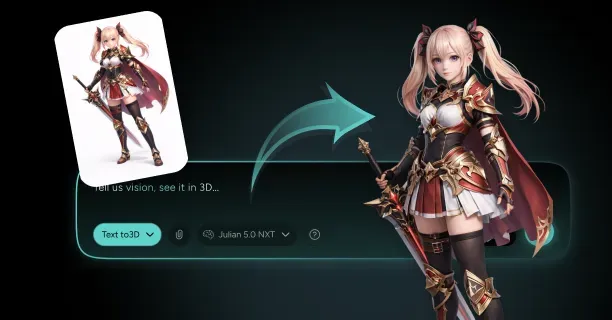
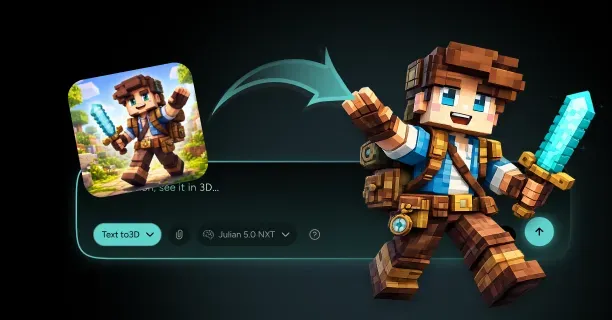
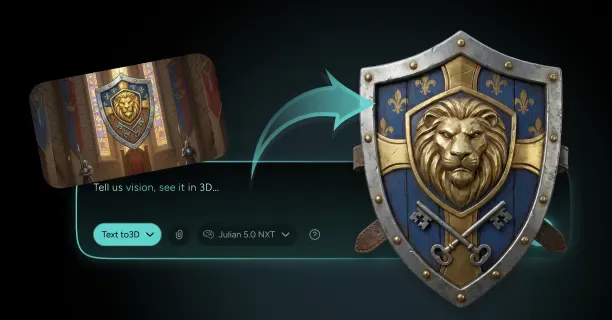
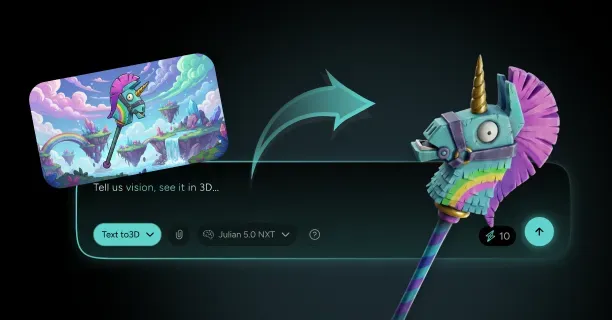

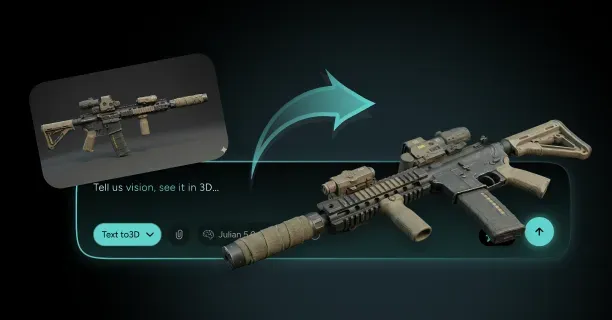

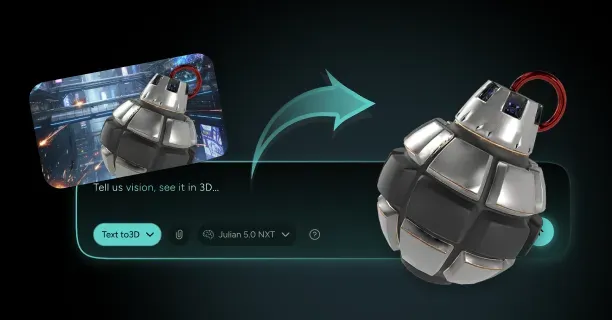
How Do You Generate Lightweight Sci-Fi Battle Royale 3D Props And Characters From Images?
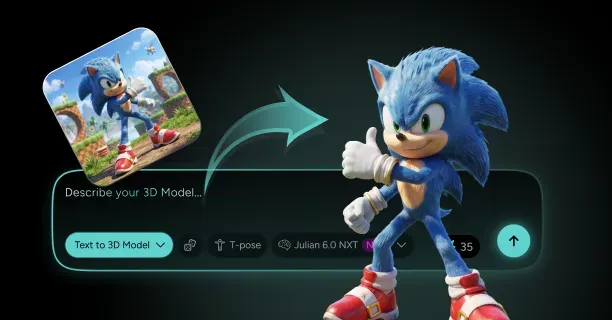
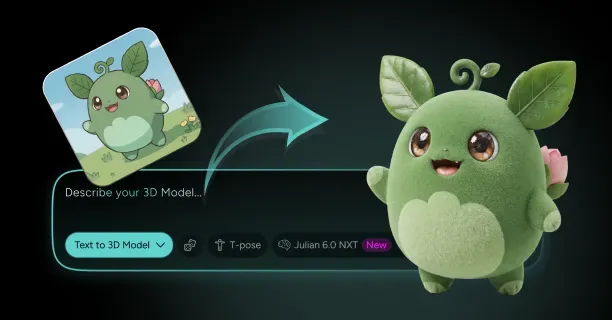
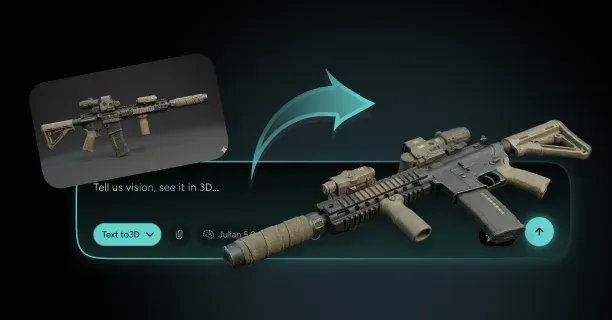
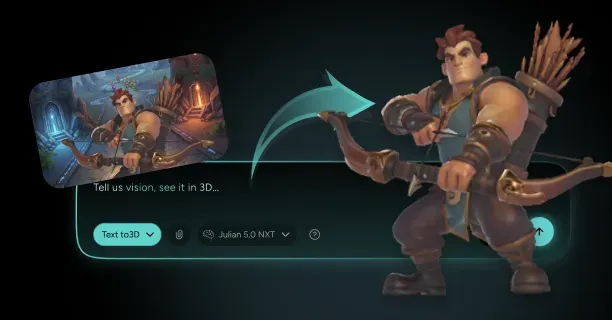
You generate lightweight sci-fi battle royale 3D props and characters from images by uploading reference artwork to AI-powered platforms that configure mesh density and texture parameters for real-time performance. Game developers transform 2D concept art: futuristic weapons, armored characters, environmental props into production-ready 3D assets that preserve visual quality while meeting strict polygon budgets needed for fast-paced multiplayer environments.
Battle royale games must optimize the trade-off between visual appeal and performance limits. Weapons must achieve instantaneous rendering when dropped, characters execute fluid animation during 100-player matches, and props dynamically populate vast maps without frame drops. Neural reconstruction techniques transform sci-fi concept images into game-ready models, automatically creating geometry, textures, and materials optimized for real-time rendering. Threedium’s Julian NXT technology performs conversion of futuristic aesthetic elements: glowing energy cores, metallic plating, holographic displays into lightweight meshes within memory limits of mobile gaming platforms (iOS, Android) and gaming console platforms (PlayStation, Xbox, Nintendo Switch).
Key Technologies for 3D Generation
Single-Image 3D Reconstruction infers complete 3D shapes from single 2D images by training neural networks on large-scale 3D object datasets containing millions of samples. TripoSR, an open-source model developed by Stability AI, an artificial intelligence research company, generates draft-quality 3D models from one image in under 0.5 seconds on an NVIDIA A100 data center GPU, enabling game developers to test multiple weapon designs or character variations within minutes. This rapid processing accelerates iteration cycles from days to minutes, enabling 3D artists to explore diverse sci-fi aesthetics without manual modeling overhead.
Large Reconstruction Models (LRM) enhance single-image generation through attention-based transformer neural network architectures that comprehend holistic spatial and semantic scene understanding. Large Reconstruction Models (LRM) analyze spatial relationships between object components with high accuracy. When a 3D artist inputs an image of a sci-fi character with complex accessories, LRM generates cohesive 3D structures where components connect logically, reducing manual adjustments before rigging and animation. Google Research’s LRM implementation demonstrates better processing of hidden regions and complex geometric relationships compared to earlier CNN-based convolutional neural network approaches.
Neural Radiance Fields (NeRF), a volumetric scene representation technique, perform optimally when multiple reference images exist. NeRF trains on continuous volumetric scene functions, reproducing photorealistic details like reflections and transparency. Training requires several hours to a day, but the resulting volumetric representation accurately captures intricate details such as scratched metal textures and glowing insets. Developers must execute mesh polygonization to transform implicit neural representations into polygonal meshes compatible with game engines like Epic Games’ Unreal Engine. NVIDIA’s Instant Neural Graphics Primitives (NGP) framework accelerates this process, enabling developers to control output polygon counts to meet performance budgets.
3D Gaussian Splatting encodes scenes with 3D Gaussians for real-time rendering, delivering framerates exceeding 100 frames per second at 1920×1080 pixel Full HD resolution according to “3D Gaussian Splatting for Real-Time Radiance Field Rendering” by Kerbl et al. (2023). 3D Gaussian Splatting processes complex scenes efficiently for preview and validation. Converting Gaussian splats into editable meshes necessitates surface reconstruction algorithms adapting polygonal meshes to Gaussian clouds, capturing overall form while requiring manual refinement for animation and texture mapping.
Photogrammetry reconstructs 3D models using multiple photographs captured from different angles, producing photorealistic assets with authentic material properties. Photogrammetry encounters difficulties with specular materials like chrome-plated metallic surfaces and transparent glass materials. Photographers must apply dulling sprays before photography, then recreate metallic appearances through post-reconstruction editing to achieve accurate sci-fi surface qualities.
Optimization Requirements
| Asset Type | Polygon Count | Texture Resolution | Usage |
|---|---|---|---|
| First-person weapon | 10,000-20,000 triangles | 2048×2048 pixels | Hero weapons |
| Third-person character | 8,000-15,000 triangles | 2048×2048 pixels | Main characters |
| Background props | Variable | 512×512 or 1024×1024 pixels | Environmental objects |
Polygon count optimization maintains optimal real-time performance in battle royale multiplayer games. A first-person weapon viewmodel comprises 10,000-20,000 triangles, while third-person character models comprise 8,000-15,000 triangles with additional level-of-detail (LOD) mesh optimization system variants. Texture resolution affects memory footprint: hero characters and weapons typically use 2048×2048 pixel textures, while background props use 512×512 or 1024×1024 pixel textures to minimize usage of video RAM (VRAM) during 100+ player concurrent multiplayer sessions.
Production Pipeline
Material setup establishes physically-based rendering (PBR), an industry-standard shading model, defining:
- Base color
- Metallic values
- Roughness
- Ambient occlusion
AI-assisted material generation accelerates workflow for sci-fi materials without real-world references. Rigging preparation establishes clean mesh topology with edge loops following deformation zones: elbows, knees, shoulders facilitating smooth character animation during combat sequences. UV unwrapping transforms 3D surface coordinates to 2D texture space, balancing texel density distribution for maximum visual quality per pixel.
Export configuration guarantees compatibility with target game engines. FBX format enables skeletal animation and embedded textures for Unity game engine by Unity Technologies and Unreal Engine, while glTF (GL Transmission Format) 3D asset format delivers web-based rendering support with PBR material definitions.
Workflow Optimization
- Batch Processing: Transform entire asset libraries simultaneously
- Quality Validation: Verify assets satisfy visual standards and performance benchmarks
- Asset Management: Implement standardized naming conventions and folder structures
Batch processing transforms entire asset libraries simultaneously, handling 50-100 props or character variations in parallel workflows. Quality validation verifies assets satisfy visual standards and performance benchmarks: polygon counts remain under budget, textures compress without artifacts, and materials render correctly under various lighting conditions.
Standardized naming conventions and folder structures facilitate efficient integration into game development pipelines. Developers categorize assets by:
- Category: weapons/characters/props
- Variant: common/rare/legendary
- LOD level: LOD0 highest detail/LOD1 medium detail/LOD2 lowest detail
This supports automated asset management systems. This AI-powered systematic approach democratizes high-quality game art production for sci-fi battle royale development, compressing production timelines from months to weeks while maintaining AAA (triple-A) industry-leading visual quality standards across diverse gaming hardware platforms including mobile, console, and PC.
What Inputs Help Keep Sci-Fi BR Asset Style Readable When Converting Images To 3D?
Inputs that help keep sci-fi BR asset style readable when converting images to 3D are high-resolution source imagery (minimum 2K resolution), consistent neutral lighting (5000K-6500K color temperature), multiple orthographic projection views (front, side, back perspectives), and clean isolated backgrounds (solid RGB backgrounds). These inputs collectively preserve aesthetic clarity and geometric precision throughout the photogrammetry conversion process used in game development pipelines.
High-resolution source imagery provides the intricate surface detail that 3D artists and photogrammetry algorithms require for accurate texture mapping and geometry reconstruction when creating sci-fi game environments. This detailed input enables precise material definition and structural accuracy essential for realistic asset rendering.
Game developers should establish 2048x2048 pixel resolution (2K resolution) as the minimum technical standard for secondary props and background characters in sci-fi battle royale games. This 2K resolution threshold provides texture artists with sufficient pixel density to extract critical surface details including:
- Panel lines
- Greebles (small decorative surface details)
- Material variations during the 3D asset creation process
Hero assets which comprise main player characters, signature weapons, and featured vehicles in battle royale games require 4096x4046 pixel resolution (4K resolution standard) to capture microscopic surface details including:
- Individual rivets
- Ventilation panels
- Material transition boundaries
These high-visibility assets demand maximum texture resolution because players frequently view them at close range during gameplay.
Photogrammetry algorithms and Neural Radiance Fields (NeRFs), advanced 3D reconstruction technologies, reconstruct precise surface geometry and texture information from high-resolution input images.
Simultaneously, generative AI tools such as Midjourney (AI image generation platform) and Stable Diffusion (open-source diffusion model) produce cleaner polygon mesh outputs with reduced artifacts when their neural networks are trained on 4K resolution reference images rather than lower-resolution alternatives.
Lower resolution source images (below 2K standard) force 3D artists to fabricate missing surface details through manual interpretation, which creates visual inconsistencies across asset collections within the same game. These inconsistencies break visual cohesion in multiplayer battle royale environments where players directly compare equipment appearances side-by-side during character selection, looting sequences, and competitive gameplay scenarios.
Consistent neutral lighting in source imagery prevents baked-in shadows and pre-rendered highlights that create visual conflicts with dynamic real-time lighting systems implemented in game engines such as Unreal Engine (Epic Games’ 3D creation platform) and Unity (cross-platform game development environment). This lighting consistency ensures proper material response across varying in-game illumination conditions.
3D asset creators should capture or generate source images under diffuse, even illumination conditions, specifically soft directional lighting emanating from multiple angles (typically 3-5 light sources positioned at 45-degree intervals). This multi-angle soft lighting reveals three-dimensional form and surface topology without creating hard shadow edges that would interfere with automated 3D reconstruction algorithms.
| Lighting Setup | Color Temperature | Background | Purpose |
|---|---|---|---|
| Multi-angle soft lighting | 5000K-6500K | Neutral gray (RGB 128,128,128) | Eliminate color casts |
| Diffuse directional | Daylight-balanced | Pure white (RGB 255,255,255) | Clean reference sheets |
| 3-5 light sources | 45-degree intervals | Solid color backdrops | Automated processing |
Traditional 3D asset production pipelines utilize neutral gray backgrounds (RGB 128,128,128) combined with 5000K-6500K color temperature lighting (daylight-balanced illumination) to produce clean reference sheets for modeling workflows. This controlled lighting setup eliminates color casts, unwanted color tinting from environmental light sources, that would contaminate albedo texture maps (the base color component in physically-based rendering materials).
This source lighting consistency ensures that 3D models’ physically-based rendering (PBR) materials, which simulate real-world material properties like metal reflectivity and surface roughness, respond correctly to dynamic environmental lighting systems in game engines. Assets maintain visual readability when transitioning between contrasting illumination zones such as:
- Bright outdoor battlefields (high-intensity lighting)
- Dark interior structures (low-intensity ambient lighting)
Common in battle royale map designs. AI-powered concepting workflows apply these same neutral lighting principles when generating concept art, producing images with flat diffuse lighting that algorithmically separates intrinsic geometry information (shape and form data) from extrinsic lighting information (shadows and highlights). This data separation enables more accurate 3D reconstruction by isolating the permanent structural features from temporary lighting effects.
Multiple orthographic projection views define an object’s complete three-dimensional form without introducing perspective distortion, the visual effect where parallel lines appear to converge, that distorts accurate proportions and dimensional relationships. Orthographic projection maintains consistent scale across all viewing distances, unlike perspective projection which creates foreshortening effects.
Technical artists should provide a minimum of three orthogonal views:
- Front elevation
- Side profile
- Back elevation
On standardized turnaround sheets (multi-view reference documents) to enable accurate 3D reconstruction of character body proportions and prop object dimensions. These perpendicular viewing angles provide complementary geometric information that eliminates reconstruction ambiguity.
Orthographic projection eliminates foreshortening, the perspective effect where objects appear smaller as distance increases, allowing 3D modelers working in industry-standard software such as:
- Blender (open-source 3D creation suite)
- ZBrush (digital sculpting application)
- Maya (Autodesk’s professional 3D animation software)
To align reference image planes with pixel-perfect accuracy during the modeling process.
Complex sci-fi character assets require additional supplementary views beyond the standard three orthogonal projections:
- Top-down views clarify helmet profile designs and shoulder armor spatial configurations
- Three-quarter perspective views (45-degree angle views) reveal how frontal chest plate armor geometrically transitions into dorsal back armor sections
These additional viewing angles resolve geometric ambiguities in overlapping armor components. Each additional orthographic view reduces geometric interpretation guesswork by 15-20 percent in total modeling time per asset, streamlining production schedules for large-scale asset libraries (collections containing 100-500+ game assets).
This efficiency improvement becomes critical when studios must deliver battle royale content updates containing 50-100 new cosmetic items per season.
Threedium’s proprietary AI reconstruction technology analyzes multiple orthographic views simultaneously using parallel processing algorithms, cross-referencing corresponding geometric features (edge alignments, surface contours, detail positions) between views to resolve dimensional ambiguities and maintain mathematically consistent proportions across all viewing angles. This multi-view correlation produces 3D models with 95%+ dimensional accuracy compared to source specifications.
Clean, simple backgrounds (solid-color backdrops without environmental clutter) enable precise subject isolation, the separation of the primary asset from surrounding context, for both manual 3D modeling workflows and automated AI processing pipelines. This background simplicity allows edge-detection algorithms to accurately identify asset boundaries with 98%+ precision.
3D asset photographers and concept artists should use solid color backgrounds, specifically:
- Neutral gray (RGB 128,128,128, 50% luminance)
- Pure white (RGB 255,255,255, 100% luminance)
That provide maximum contrast against asset silhouettes and edge details. This high-contrast separation allows automated background removal tools (such as Remove.bg, Photoshop’s Select Subject, or custom AI segmentation models) to generate accurate alpha masks (transparency channel data) with minimal edge artifacts.
This precise subject isolation proves crucial for batch-processing workflows that handle multiple weapon variants (different color schemes, attachment configurations) or character skins (cosmetic appearance variations) simultaneously. Clean isolation maintains industrial production speeds of 50-100 completed 3D assets per week, the output velocity required for active battle royale games releasing bi-weekly or monthly content updates with 20-50 new cosmetic items per release cycle.
Complex backgrounds containing environmental elements (trees, buildings, terrain features, atmospheric effects) introduce edge artifacts, pixel-level errors along asset boundaries, during automated masking processes. These artifacts require manual cleanup operations in image editing software, adding 10-15 minutes of corrective work per asset and reducing overall production efficiency by 20-25% when processing batches of 50+ assets.
Neutral backgrounds also prevent color spill, unwanted color bleeding from background hues onto asset edges, during texture baking processes (the transfer of high-resolution detail onto lower-resolution game meshes). This prevention preserves the pure albedo color values (unlit base color data without lighting influence) that physically-based rendering (PBR) workflows require for accurate material representation under dynamic game lighting conditions.
Source images must remain free from compression artifacts (blocky pixelation patterns, color banding) and digital noise (random pixel variations, sensor grain) to preserve high-frequency detail, fine-scale visual information including:
- Panel lines (recessed surface grooves)
- Rivets
- Surface textures
- Material transitions
Essential for accurate 3D reconstruction. Image degradation from compression or noise forces 3D artists to reinterpret or fabricate missing details.
3D asset production teams should use lossless image formats such as:
| Format | Color Support | Bit Depth | Use Case |
|---|---|---|---|
| PNG | 24-bit RGB or 32-bit RGBA | 8-bit per channel | General assets |
| TIFF | 16-bit per channel | High color depth | Hero assets |
| JPEG | Avoid | Lossy compression | Not recommended |
Instead of lossy JPEG format. JPEG’s discrete cosine transform (DCT) compression algorithm introduces visible artifacts including 8x8 pixel blocking patterns (grid-like squares) and color banding (posterization in gradients), which degrade source image quality and interfere with photogrammetry reconstruction accuracy.
Photogrammetry reconstruction algorithms misinterpret these compression artifacts as intentional surface details, legitimate geometric features that should be modeled, creating unwanted geometry bumps, surface irregularities, and mesh noise in the reconstructed 3D model. These algorithmic errors require manual correction by 3D artists using sculpting tools, adding 30-60 minutes of cleanup time per affected asset and degrading the efficiency advantages of automated reconstruction.
AI-generated concept images produced by Stable Diffusion (latent diffusion model for image synthesis) require rigorous quality control inspections at 200-300 percent magnification zoom levels to detect AI hallucination artifacts, distorted details such as:
- Warped text decals (illegible or nonsensical letterforms)
- Inconsistent rivet patterns (varying sizes or irregular spacing)
- Physically impossible geometry (non-Euclidean surfaces, paradoxical connections)
Detection of these artifacts indicates the need to regenerate the concept with adjusted prompts or different seed values.
Threedium’s automated quality assurance workflow includes intelligent artifact detection systems that flag problematic source images exceeding compression ratio thresholds of 10:1 (indicating excessive lossy compression) or falling below signal-to-noise ratio (SNR) thresholds of 35 decibels (indicating excessive image noise or grain).
Flagged images are routed to human artist review queues for manual quality assessment before entering the 3D reconstruction processing pipeline, preventing low-quality inputs from generating defective 3D models.
Neutral character poses, standardized body positions with relaxed limb placement, provide consistent anatomical reference points that are essential for skeletal rigging (the creation of bone structures for deformation) and animation processes (the application of movement to 3D characters). These standardized poses ensure that all character variants within a game share identical skeletal hierarchies and joint placement coordinates.
Character artists position 3D character models in standardized neutral poses:
- A-pose configuration (arms extended at 45-degree angles from torso, forming an ‘A’ silhouette)
- T-pose configuration (arms extended at 90-degree angles perpendicular to torso, forming a ‘T’ silhouette)
These straight-limbed poses allow skeletal riggers to place joint pivots (shoulder, elbow, wrist rotation points) at anatomically correct positions without mathematically compensating for bent limbs or twisted torso orientations that would introduce rigging errors.
These standardized neutral poses ensure that animation quality and movement behavior remain consistent across all character variants within the same class archetype. For example, all assault class characters (offensive-focused player avatars) share identical:
- Sprint cycle animations
- Weapon reload animation sequences
- Emote gesture performances
Regardless of cosmetic skin differences (color variations, armor styling, accessory attachments). This animation reusability reduces production costs by allowing one animation set to serve 20-50 character variants.
Dynamic action poses, while visually compelling for marketing, create rigging challenges that add 2-3 hours per character to technical setup time. Neutral poses also facilitate automated weight painting algorithms that distribute mesh deformation across joint influences with 95 percent accuracy, reducing manual cleanup.
Unambiguous perspective eliminates proportional misinterpretation that creates scale inconsistencies between modular assets. You capture reference images using telephoto focal lengths (85mm-200mm equivalent) or orthographic camera settings, minimizing barrel distortion and perspective convergence.
Wide-angle lenses (24mm-35mm) introduce size exaggeration in foreground elements, making weapon barrels appear 20-30 percent larger than their actual proportions relative to character hands. This distortion breaks visual consistency in first-person view models where players notice scale mismatches between different weapons. Orthographic rendering in 3D software eliminates all perspective effects, providing mathematically precise dimensional relationships necessary for attachment point standardization across modular weapon systems.
Color accuracy in source images preserves faction identity and rarity tier communication through consistent hue relationships. You include precise RGB values and Pantone references on technical sheets:
- Faction A uses RGB (45,85,135) blue primaries
- Faction B uses RGB (165,35,25) red primaries
Ensuring color consistency across different software environments and monitor calibrations.
Battle royale games communicate weapon rarity through color coding:
| Rarity Tier | Color | RGB Values |
|---|---|---|
| Common | Gray | RGB (180,180,180) |
| Rare | Blue | RGB (65,105,225) |
| Epic | Purple | RGB (138,43,226) |
| Legendary | Gold | RGB (255,215,0) |
Deviations of more than 10 percent in hue or saturation break player expectations and create confusion during rapid looting decisions. Material specifications accompany color data:
- Metallic surfaces require roughness values between 0.2-0.4
- Painted surfaces use roughness values between 0.6-0.8
Maintaining visual consistency across asset collections.
Detail hierarchy in concept art guides appropriate polygon budget allocation between primary features and secondary elements. You emphasize primary features (weapon silhouettes, character face masks, signature armor pieces) with bold line work (3-5 pixel width), while rendering secondary details (panel gaps, bolt heads, texture patterns) with lighter lines (1-2 pixel width).
This hierarchy helps technical artists distinguish between:
- Features requiring actual geometry (primary forms use 5,000-8,000 triangles)
- Features representable through normal maps (secondary details use 512x512 to 1024x1024 normal map resolution)
Uniform line weight across all details creates ambiguity, forcing artists to make subjective decisions that introduce inconsistencies across multi-artist teams. Clear hierarchy reduces modeling iteration cycles by 25-30 percent, allowing artists to achieve approval on first or second review passes.
Material callouts on turnaround sheets specify surface properties through standardized notation systems. You annotate materials using industry-standard descriptors:
- “Brushed aluminum, anodized blue, roughness 0.35”
- “Carbon fiber weave, 2x2 twill pattern, clearcoat gloss”
These callouts prevent visual ambiguity where artists might interpret a surface as painted metal versus anodized metal, creating different specular responses under game lighting. Sci-fi battle royale assets typically combine 4-6 distinct material types per prop:
- Hard metals
- Soft rubbers
- Transparent plastics
- Emissive displays
Each requiring specific shader parameters. Material reference libraries with photographed samples provide ground truth validation, ensuring artists match real-world physical properties that players recognize intuitively.
Annotation density on technical drawings provides dimensional accuracy necessary for modular weapon systems and standardized attachment points. You include measurements in consistent units (millimeters for props, centimeters for characters), coordinate specifications for pivot points, and assembly views showing how components connect.
Picatinny rail systems require 10.16mm slot spacing with ±0.1mm tolerance to accept standardized scope and grip attachments.
Inconsistent measurements force technical artists to manually adjust each attachment variant, multiplying production time by the number of possible combinations. Exploded assembly views clarify internal construction for weapons with moving parts:
- Bolt carriers
- Magazines
- Trigger assemblies
Ensuring animators understand mechanical relationships when creating reload sequences.
Reference consistency across image sets maintains visual coherence for AI tools generating variations within established style boundaries. You provide 8-12 examples from the same fictional universe when training generative models, establishing design rules through repetition:
- All faction weapons feature hexagonal panel patterns
- All character armor uses beveled edge transitions
- All vehicles display asymmetric vent placements
Threedium’s AI identifies these recurring patterns, generating new variants that maintain 85-90 percent stylistic similarity while introducing controlled variation in secondary details. Mixed reference sets combining realistic military hardware with fantastical alien technology confuse pattern recognition, producing outputs that lack cohesive aesthetic identity.
Style guides documenting these design rules ensure controlled variation within stylistic boundaries essential for creating recognizable asset families across 100-200 item collections:
- Panel angle constraints (30, 45, 60 degrees only)
- Color palette limitations (6 primary hues maximum)
- Surface detail density targets (3-5 greebles per 10cm²)