
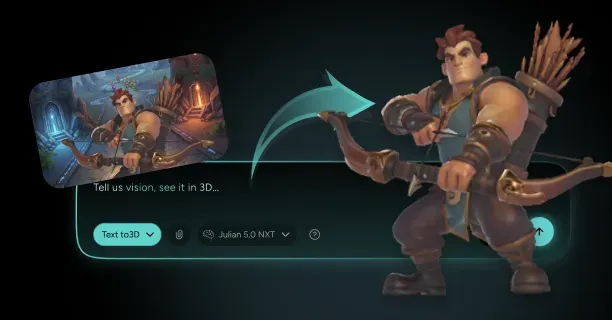
What Makes A MOBA-Style 3D Character Rig-Ready When Generated From An Image?
A MOBA-style 3D character becomes rig-ready when generated from an image through retopology workflow that transforms the AI-generated mesh into clean quad-based topology with proper edge flow, configures the character mesh into a neutral pose, constrains polygon count to 8,000-11,000 triangles, and creates non-overlapping UV coordinates for texturing. This retopology transformation guarantees through geometric optimization that the model deforms predictably during animation and satisfies real-time performance requirements for competitive multiplayer games like Dota 2, League of Legends, and Heroes of the Storm that require 60+ FPS performance.
AI-powered image-to-3D conversion technologies including neural radiance fields and diffusion models output through neural network inference dense, unstructured meshes containing thousands of triangles distributed algorithmically without consideration for animation requirements. AI-sculpt outputs from platforms like:
- Meshy (AI-powered 3D model generator founded 2023)
- Kaedim (image-to-3D conversion platform)
- Luma AI (neural radiance field technology provider)
These platforms reconstruct and preserve visual detail effectively but fail to generate the topology necessary for rigging. The generated geometry contains problematic n-gons (non-quad polygons with five or more vertices, problematic in game engines like Unity and Unreal Engine) and irregular triangle distributions that produce unpredictable mesh deformation when animators apply skeletal animation to the mesh. Converting this raw output into a rig-ready asset requires retopology, the manual or semi-automated process of reconstructing the model’s surface with clean, optimized geometry.
Clean quad-based topology constitutes the structural foundation of every rig-ready MOBA character because quad polygons deform and interpolate predictably when bones perform rotation transformations and translation transformations.
Edge flow (the continuous directional pattern of connected polygon edges in 3D topology, critical for character animation in software like Maya, Blender, and 3ds Max) must align with and trace the underlying muscle and bone structure to facilitate natural bending at joints. Character models require for optimal deformation:
- 3-5 concentric loops concentrically surrounding each major articulation point
- Strategic placement at shoulders, elbows, knees, and hips
- Alignment so the mesh deforms through compression and extension smoothly during animation
This prevents visual artifacts like: - Pinching (vertex clustering artifact where mesh geometry bunches unnaturally at joints during animation) - Collapsing geometry (topology failure where polygon faces fold inward or disappear during extreme deformation)
| Component | Requirement | Purpose |
|---|---|---|
| Triangle Count | 8,000-11,000 triangles | Optimize visual fidelity vs. performance |
| Face Topology | 2,000-3,000 triangles | Facial expressions and readability |
| Hand Models | 800-1,200 triangles per hand | Individual finger articulation |
| Joint Areas | High density edge loops | Smooth deformation |
Dota 2 Workshop Technical Requirements mandate that main hero models (LOD0, Level of Detail 0, the highest-resolution model version displayed when camera is closest to character) should contain 8,000-11,000 triangles to optimize the tradeoff between visual fidelity and real-time rendering performance. This triangle budget constrains and necessitates character artists to allocate polygons strategically, prioritizing density in areas that deform frequently while reducing resolution on rigid surfaces like armor plates and weapon bodies.
The retopology process reconstructs unstructured meshes into rig-ready models by manually or automatically strategically positioning edge loops that adhere to this budget while maintaining the character’s silhouette and visual features. Automated retopology tools expedite this workflow:
- Blender 3.x open-source 3D creation suite with Quad Remesh and Voxel Remesh tools
- 3DCoat digital sculpting software by Pilgway version 2023+
- TopoGun standalone retopology application by Pixelmachine version 3.x
These tools computationally process the high-polygon AI-generated mesh and generate quad-based topology solutions, though manual refinement remains necessary for optimal results.
A rig-ready model requires a neutral and symmetrical pose, standardized as:
- T-pose (T-shaped neutral pose with arms extended perpendicular to torso at 90 degrees, industry standard since early 3D animation)
- A-pose (A-shaped neutral pose with arms at 45-degree angles, preferred for characters with shoulder armor to prevent mesh intersection)
This neutral stance affords animators maximum joint range and eliminates pre-deformed geometry that obstructs: - Skinning (the process of binding mesh vertices to skeletal bones in rigging software) - Weight painting (assigning and adjusting bone influence values per vertex, typically performed in Maya, Blender, or 3ds Max)
Image-to-3D pipelines produce characters in action poses matching reference artwork, necessitating artists to repose the mesh into a neutral configuration before rigging. Artists accomplish this by precisely repositioning vertex positions while preserving topology integrity, ensuring left-right symmetry within a tolerance of 0.01 units (0.01 units in the software’s world space, typically representing 0.01 centimeters or 0.1 millimeters in Maya, Blender, or 3ds Max coordinate systems).
Symmetrical topology enables riggers to automatically transfer skinning weights from one side of the body to the other, decreasing rigging time by approximately 50 percent.
MOBA-style characters emphasize distinct silhouettes and top-down readability because players observe these models from an elevated isometric camera (elevated camera positioned 30-45 degrees above the battlefield, standard in Dota 2, League of Legends, and Heroes of the Storm) during gameplay. The topology must maintain the character’s recognizable outline features:
- Oversized weapons
- Flowing capes
- Distinctive headgear
These elements convey character identity at small screen sizes (80-150 pixels in height during typical MOBA gameplay at 1920x1080 resolution). Artists can validate that the retopologized mesh preserves these silhouette-defining elements by rendering orthographic views from above and cross-referencing them to the original concept art. Edge loops should encircle prominent costume elements and accessories, designating them as separate topology islands when they require independent deformation, such as a cape that animates separately from the torso.
Proper edge flow for MOBA characters accommodates both realistic anatomical deformation and stylized proportions characteristic of the genre. A character with exaggerated shoulder armor necessitates edge loops that support deformation of both:
- The organic shoulder joint beneath
- The rigid armor shell above
Artists implement this dual-layer topology by creating: - An inner layer aligned with anatomical muscle structure - An outer layer conforming to costume geometry - Bridging geometry (intermediate polygons connecting inner and outer mesh layers, typically using 2-3 edge loops to smoothly transition deformation)
The Dota 2 Workshop Technical Requirements restrict animation skeletons to 128 bones maximum (hard limit imposed by Source 2 engine skeletal animation system, including all helper bones, IK targets, and attachment points), necessitating riggers to optimize the rig hierarchy and ensuring the character topology accommodates this constraint by grouping related vertices that share bone influences.
UV unwrapping generates a 2D representation of the 3D model’s surface, projecting it so textures map accurately without distortion. For rig-ready MOBA characters, UV coordinates must remain non-overlapping because overlapping UVs create texture ambiguity during the baking process and prohibit unique texturing of different surface areas.
Artists generate UV islands by placing seams along topology edges that align with natural visual breaks including: - Clothing seams - Material transitions
- Areas behind ears
This minimizes visible texture stretching (UV distortion where texture pixels appear elongated due to uneven UV scaling). The Dota 2 Workshop Technical Requirements mandate 1024x1024 pixels as the maximum texture map size for a single hero’s body, necessitating artists to arrange UV islands efficiently within this resolution while maintaining texel density consistency (10-20 pixels/cm for MOBA characters) across the model surface.
Normal baking projects surface details from the dense, high-polygon AI-generated mesh to the low-polygon, rig-ready model through normal map textures. This normal mapping technique generates the illusion of high detail on optimized assets by storing surface angle variations as RGB color values:
| Color Channel | Axis | Purpose |
|---|---|---|
| Red | X axis | Normal vector X component |
| Green | Y axis | Normal vector Y component |
| Blue | Z axis | Normal vector Z component |
Artists execute normal baking in: - Substance 3D Painter by Adobe version 8.x+ industry-standard PBR texturing tool - Marmoset Toolbag 4.x real-time rendering and baking suite - Blender 3.x with Cycles or Eevee baking engine
The baking process depends on clean topology because surface normal interpolation across quads generates smoother gradients than across irregular triangles, minimizing visible faceting (angular shading artifacts appearing as distinct polygon edges in rendered output) in the final rendered character.
A game-ready MOBA character employs baked normal maps to replicate detail that would otherwise necessitate millions of polygons (2-5 million triangles typical in high-resolution sculpts, reduced to 8,000-11,000 triangles in game-ready models through normal mapping). The low-poly rig-ready mesh functions as the deformation cage that animators manipulate, while the normal map contributes visual richness during rendering.
This high-poly to low-poly baking workflow reconciles the divide between AI-generated visual fidelity and real-time performance requirements (60 FPS minimum frame rate on mid-range gaming hardware GTX 1060/RX 580 equivalent standard for competitive MOBA games).
Skinning attaches the vertices of the 3D mesh to the bones of its rig, with weights defining the amount of influence each bone has on each vertex. Clean topology with proper edge flow streamlines weight painting because vertices naturally organize into regions influenced by single joints. A shoulder joint with 4-5 concentric edge loops enables the creation of a smooth weight gradient:
- 100% clavicle influence at the torso
- Progressive transition (75/25, 50/50, 25/75)
- 100% upper arm influence at the bicep region
Poor topology with irregular edge flow necessitates manual weight adjustment for hundreds of individual vertices, extending rigging time and producing deformation errors including vertex popping, mesh tearing, and unnatural bending.
Neural Radiance Fields (NeRFs, AI technique published by Mildenhall et al. 2020) and Gaussian Splatting (3D representation method using oriented 3D Gaussian primitives, introduced by Kerbl et al. 2023) constitute emerging image-to-3D technologies that generate volumetric scene representations rather than traditional polygon meshes. The conversion process to polygon meshes uses:
- Marching cubes (isosurface extraction algorithm developed by Lorensen and Cline 1987)
- Surface reconstruction algorithms (Poisson surface reconstruction, ball-pivoting algorithm, and alpha shapes)
These methods output unstructured topology necessitating complete retopology.
Topo-aware AI models constitute the next evolution in image-to-3D pipelines, engineered to produce meshes with proper topology directly from images. These AI systems learn from professionally retopologized game characters (production-ready character models from AAA games and studios, typically including 1,000-10,000 examples), acquiring knowledge to position edge loops according to animation requirements.
Current topo-aware systems decrease manual retopology time by approximately 60-70 percent (reduction from typical 8-12 hours manual retopology to 2-4 hours of AI-assisted workflow with refinement), though they still necessitate artist refinement to satisfy MOBA-specific requirements like silhouette preservation and performance budgets.
The image-to-3D pipeline for MOBA characters mandates multiple technical validations before a model meets standards as rig-ready:
- Topology cleanliness validation using: - Maya’s Mesh > Cleanup tool - Blender’s 3D Print Toolbox - ZBrush’s Geometry > Modify Topology
- Pose neutrality validation through skeletal alignment checks
- Polygon count validation for LOD versions: - LOD0: 8,000-11,000 triangles (highest quality) - LOD1: 4,000-6,000 triangles (medium quality)
- LOD2: 1,000-2,000 triangles (distant viewing) - UV layout inspection verifying containment within 0-1 texture space
Edge loops for deformation are densely positioned around joints but also trace facial features for MOBA characters with expressive animations. Artists construct:
- 4-6 concentric loops around the mouth opening for phoneme shapes
- 3-4 radial loops around eyes for blink and emotion animations
The facial topology integrates these features through edge flow that aligns with anatomical muscle groups like the orbicularis oculi (circular muscle surrounding the eye socket) and zygomaticus major (muscle extending from cheekbone to mouth corner).
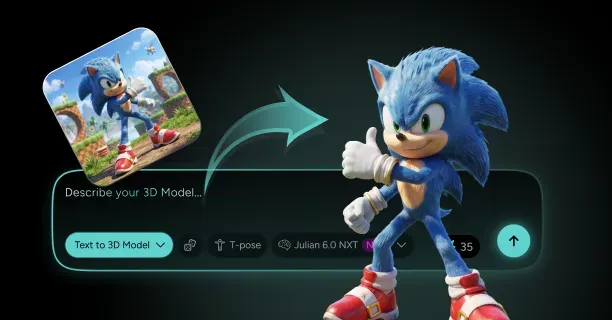
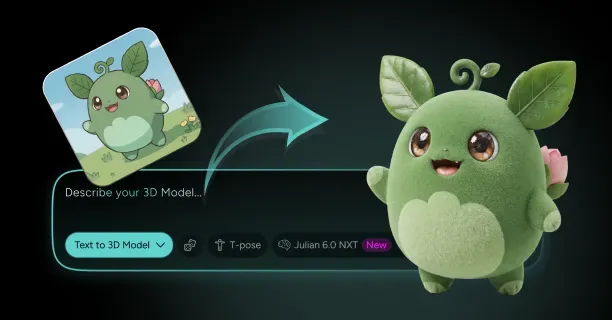
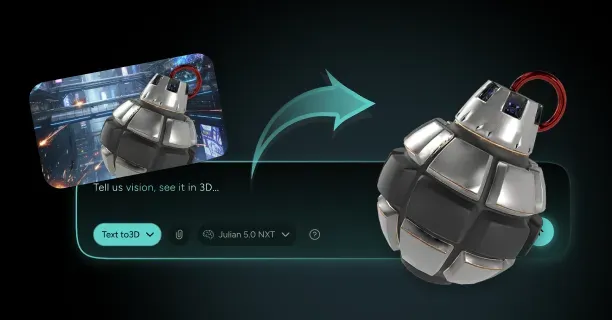
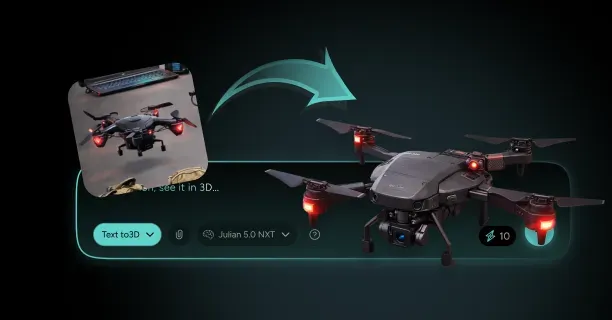
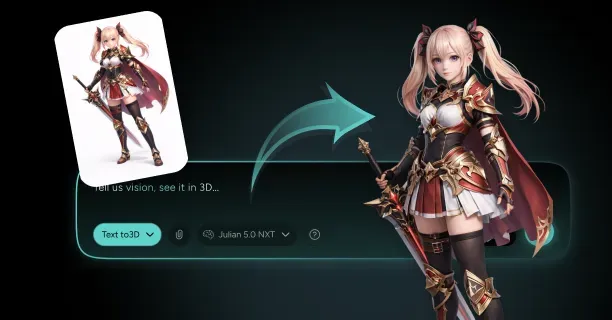
Threedium’s AI-powered platform produces MOBA-ready character topology from reference images by processing the source artwork’s silhouette, pose, and costume complexity, then executing retopology algorithms trained on professionally rigged game characters from AAA game studios.
Our Julian NXT technology generates clean quad-based meshes with edge loops strategically placed to enable optimal deformation, decreasing manual retopology time from 8-12 hours to 1-2 hours of refinement work. The system automatically:
- Converts action-posed reference images into neutral T-poses
- Creates non-overlapping UV layouts optimized for 1024x1024 texture resolution
- Satisfies Dota 2 and League of Legends technical specifications
Predictable mesh deformation requires consistent quad sizing within deformation zones, preserving edge lengths within 20 percent variation of neighboring edges. Artists attain this consistency during retopology by employing subdivision surface modeling techniques that naturally produce even quad distributions, then selectively eliminating edge loops in rigid areas to meet triangle budgets.
The final rig-ready model combines all technical requirements:
- Clean quad topology with proper edge flow aligned with anatomical and costume structure
- Neutral symmetrical pose appropriate for skeletal binding
- Optimized polygon count within MOBA performance budgets
- Non-overlapping UV coordinates for unique texturing
- Sufficient edge loop density at critical joints for clean deformation
Artists verify this integration by executing test animations (walk cycles, attack motions, and death sequences) and evaluating mesh deformation quality at extreme joint angles. Any pinching, collapsing, or unnatural stretching signals topology refinement needs, demanding additional edge loop adjustment or weight painting correction before the character is approved for production animation pipelines.
How Do You Preserve MOBA Silhouettes And VFX-Friendly Shapes When Converting Images To 3D?
To preserve MOBA silhouettes and VFX-friendly shapes when converting images to 3D, exaggerate distinct forms, maintain quad-based topology for effects attachment, and optimize geometry for the 45-to-60-degree top-down camera angle that determines player visibility in games like League of Legends and Dota 2.
MOBA character design prioritizes instant readability because players must identify character roles, threat levels, and ability states within milliseconds during fast-paced team fights. You translate 2D concept shape language into 3D by focusing on primary, secondary, and tertiary forms that communicate character function through visual hierarchy.
Riot Games’ character artists employ the “70/30 rule” when designing champions for League of Legends, allocating approximately 70% of visual interest and detail in the upper body: head, shoulders, torso, and weapon.
This approach maximizes visibility from the typical MOBA camera angle. You allocate the remaining 30% to the lower body, which appears compressed and less prominent from the game camera view.
The Conversion Process
The conversion process initiates with a silhouetting blockout phase where 3D artists construct simple geometric primitives:
- Cubes
- Spheres
- Cylinders
These establish the character’s most exaggerated and defining shapes before adding surface detail. Perform this initial blockout specifically from the game camera angle, positioned at 45 to 60 degrees relative to the ground plane, to verify core shapes read clearly from the player’s perspective.
| Company | Game | Technique | Key Principle |
|---|---|---|---|
| Valve Corporation | Dota 2 | Game-camera blockout | Test silhouettes continuously throughout production |
| Riot Games | League of Legends | 70/30 rule | Focus visual interest in upper body |
| Blizzard Entertainment | Heroes of the Storm | Exaggeration principle | Increase head size by 15-20% |
Valve Corporation’s character artists for Dota 2 employ the game-camera blockout approach, testing silhouettes continuously throughout production to ensure heroes remain instantly recognizable when reduced to pure black shapes against white backgrounds. Artists execute a silhouette test by rendering the character as a solid black shape from the in-game camera position and evaluating whether the outline alone communicates:
- Character identity
- Weapon type
- Stance
This evaluation occurs without relying on color or texture information.
Strategic Form Exaggeration
Strategic exaggeration of forms ensures subtle details from 2D concept art translate into readable 3D shapes under top-down perspective constraints and real-time rendering limitations. Key techniques include:
- Amplify shoulder width
- Enlarge head proportions
- Extend weapon silhouettes beyond realistic dimensions
These adjustments compensate for foreshortening effects created by the camera angle. Blizzard Entertainment’s Heroes of the Storm character pipeline documentation specifies this exaggeration principle, noting artists increase head size by 15% to 20% compared to realistic proportions and widen shoulders by similar margins to maintain character presence when viewed from above.
Apply form-carving techniques during high-poly sculpting in ZBrush or Blender, deliberately creating:
- Large, distinct planes
- Chiseled shapes that catch lighting effectively
- Avoiding small, noisy details that dissolve into visual clutter
High-Poly Sculpting Hierarchy
High-poly sculpting establishes primary and secondary forms through a hierarchical approach where you define the character’s largest, most essential shapes first before refining supporting details.
Form Hierarchy Structure:
- Primary forms (30-40% of production timeline) - Overall body mass - Limb proportions
- Major armor plates - Secondary forms (40-70% of production) - Muscle definition - Armor segmentation - Clothing folds
- Tertiary forms (70-100% phase) - Surface textures like fabric weave - Leather grain - Metal scratches (baked into normal maps)
Character artists adhere to strict polycount budgets between 10,000 and 20,000 triangles for modern MOBA player characters, balancing visual fidelity with performance demands of rendering multiple characters, minions, and particle effects simultaneously on screen.
VFX-Friendly Topology
Retopology generates an optimized low-poly mesh over the detailed sculpt, providing clean topology essential for animation deformation and VFX application. Key requirements include:
- Construct edge loops that follow natural muscle and joint flow
- Eliminate triangles in areas requiring deformation
- Maintain consistent polygon density appropriate to each body region’s animation complexity
- Create clear, uninterrupted surface areas for VFX attachment
Technical artists at Riot Games mandate VFX-anchor points: designated vertices, faces, or bones explicitly intended for effects attachment must reside on quad-based topology with minimal curvature.
This prevents particle clipping and ensures consistent emission directions across different animation poses.
VFX Integration Principles
VFX-friendly geometry ensures clear visual feedback for abilities by providing predictable surfaces for effects projection, emission, and interaction. Design considerations include:
- Flat or gently curved areas on weapons, hands, and ability-relevant body parts
- Simplified hand geometry with clean palm surfaces for spell-casting effects
- Flattened weapon blade faces for reliable projectile spawn locations
Avoid creating complex surface noise, excessive edge detail, or deep concavities in areas designated for VFX attachment because these geometric features cause particle systems to clip through mesh or emit in unpredictable directions.
Normal Map Optimization
Normal maps transfer surface detail without adding geometry, preserving the performance budget while maintaining visual richness that supports character silhouette. The baking process involves:
- Capture lighting information from millions of sculpted polygons
- Transfer to texture data for game engine interpretation
- Retain visual impact of detailed elements without increasing triangle count
Configure baking parameters to: - Emphasize details that enhance silhouette clarity - Suppress micro-details that create visual noise - Focus on sharp armor edges and pronounced muscle definition
Visual Hierarchy Implementation
Visual hierarchy directs player attention to important areas through deliberate manipulation of:
- Detail density
- Value contrast
- Shape complexity
| Priority Level | Focus Areas | Detail Allocation |
|---|---|---|
| Primary | Head and primary weapon | Highest detail, sharpest contrasts |
| Secondary | Upper body regions | Mid-tone values |
| Tertiary | Lower body elements | Desaturated, low-contrast |
Concentrate the highest detail in the character’s head and primary weapon because these elements communicate identity and current action state most effectively.
Noise Reduction Strategies
Reducing visual noise enhances main recognizable shapes by eliminating competing details that fragment silhouette or distract from character core identity. Execute a readability pass to:
- Identify and remove unnecessary surface detail
- Simplify overly complex armor patterns
- Merge small geometric elements into larger, more readable forms
This process includes:
- Consolidating multiple small armor plates into single unified shapes
- Simplifying fabric fold patterns to emphasize largest directional creases
- Eliminating decorative elements that don’t contribute to instant recognition
Camera Angle Optimization
The top-down camera angle dictates primary visual focus by determining which surfaces receive the most screen space. Key strategies include:
- Orient detail placement specifically for 45-to-60-degree viewing angle
- Flatten and widen elements that appear foreshortened from above
- Maintain persistent camera positioned at game angle during production
Maya and Blender workflows for MOBA characters include a persistent camera positioned at the game angle that artists reference continuously throughout modeling.
Shape Language Translation
Shape language translation from 2D concepts to 3D models requires identifying foundational geometric shapes underlying concept art and amplifying them in three dimensions. Analyze whether the concept employs:
- Circular shapes: Suggesting friendliness and defense
- Angular triangular forms: Communicating aggression and danger
- Stable rectangular shapes: Indicating strength and reliability
Dota 2’s hero design guidelines emphasize you must push these shape associations further in 3D than they appear in concept art because added dimension and real-time lighting can soften or obscure intended shape language.
Technical Implementation
Clean topology for effects means structuring polygon flow to provide VFX artists with:
- Reliable attachment points
- Emission surfaces
- Consistent deformation behavior across animation states
Requirements include:
- Align edge loops with natural seams where particle effects emit
- Maintain stable surface normals during animation
- Ensure consistent surface area and orientation across full animation range
Production Timeline and Testing
Top-down perspective readability demands designing characters to communicate essential information when viewed from above. Key practices include:
- Compress vertical proportions while expanding horizontal dimensions
- View models exclusively from game camera angle during final 30% of production
- Perform character readability tests in simplified game environments
Blizzard’s Heroes of the Storm art direction documents specify artists should make all refinement decisions based on game camera perspective rather than default front or side views.
Proportional Adjustments
Exaggerated proportions and features compensate for visual compression inherent in top-down perspectives:
- Enlarge hands beyond realistic scale for gesture readability
- Extend weapon lengths to ensure attack ranges appear visually accurate
- Increase head size to maintain facial expression visibility
League of Legends champion models demonstrate proportions that would appear cartoonish from eye level but read as heroic and dynamic from game camera position.
Baking Workflow
High-poly to low-poly baking preserves visual richness while maintaining geometric simplicity. Configure baking parameters to capture:
- Normal map information
- Ambient occlusion for depth enhancement
- Curvature maps for edge highlighting
Segment baking operations by material type or body region, processing hard-surface armor separately from organic flesh areas to apply appropriate parameters for each surface category.
Production Best Practices
Game camera angle optimization means designing, modeling, texturing, and testing every aspect specifically for the viewing angle players experience during gameplay. Recommended approach:
- Position camera at exact game angle and distance
- Spend 80% of modeling time in game camera view
- Validate every major decision from specific game perspective
Technical artists recommend making the game camera view your primary workspace throughout production, using traditional views only for technical precision.
AI-Powered Solutions
When creating MOBA-style 3D assets from images, Threedium’s AI system automatically analyzes the source image’s shape language and applies exaggeration algorithms calibrated for top-down visibility. Key features include:
- Automatic shape language analysis with exaggeration algorithms
- Retopology engine generating quad-based mesh layouts
- Designated VFX-anchor points for clean topology
- Production-ready assets with proper visual hierarchy
- Performance-optimized polygon counts between 10,000 and 20,000 triangles
Our system ensures client-converted characters maintain distinct silhouettes optimized for 45-to-60-degree camera angles, providing clean topology for animation and particle effects without manual edge-loop placement. You receive assets suitable for real-time game environments with concentrated detail in upper body regions.