How Do You Turn Yourself Into a 3D Superhero From a Photo?
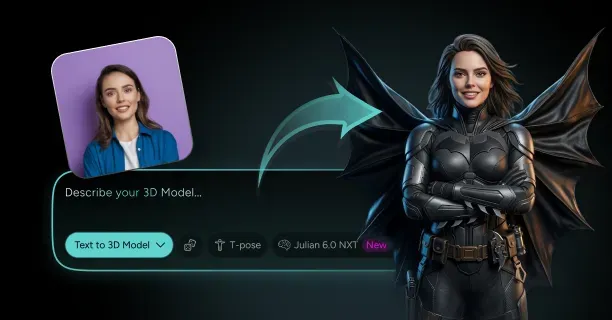
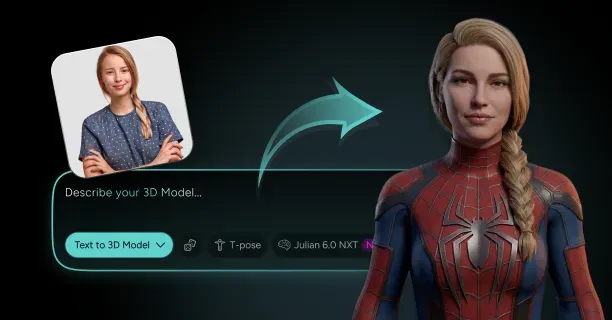
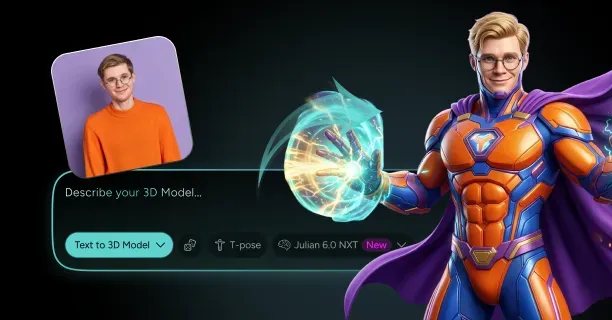
To turn yourself into a 3D superhero from a photo, upload a high-resolution frontal image (minimum 1920×1080 pixels) to Threedium's AI-powered reconstruction platform above, where Threedium's proprietary Julian NXT technology computationally processes facial geometry, algorithmically derives depth data, synthesizes a base mesh, and enables parametric modification with superhero attributes including costume design, power effects, emblems, and dynamic poses before exporting the rigged model for animation or rendering.
Upload Requirements and Image Preparation
Getting great reconstruction results means your photos need to meet specific technical standards for lighting, resolution, and composition. Your reference photo must photographically document frontal facial features with even lighting across both sides of your face, eliminating harsh shadows that obscure bone structure and skin texture details the AI algorithms require for computational processing and accurate analysis.
Configure your main light source at a 45 degrees angle to one side at eye level, with a fill light or reflector on the opposite side to equalize exposure and constrain contrast ratios below 3:1 for digital reconstruction workflows.
Image resolution proportionally influences polygon density and texture quality of your final 3D superhero model.
Upload photos at 4K resolution (3840×2160 pixels) or higher, which provides reconstruction algorithms enough pixel data to computationally derive precise depth maps and synthesize detailed surface geometry. High-quality 3D character models for real-time applications comprise 50,000-100,000 polygons, and source image resolution governs how accurately these polygons are topologically arranged across facial features like:
- Eye sockets
- Nose bridges
- Jawline contours
Photograph the reference photo with the lens at your eye level, maintaining a distance of 4-6 feet away to reduce perspective distortion from wide-angle lenses at close range. Smartphone cameras with focal lengths below 28mm equivalent produce barrel distortion that distorts facial proportions, resulting in unnaturally wide foreheads or compressed cheekbones in the 3D output. Portrait lenses between 85mm and 135mm produce natural perspective compression, maintaining true spatial relationships between facial landmarks.
AI-Powered Facial Reconstruction Process
Threedium's reconstruction platform employs computer vision algorithms to computationally process your uploaded photo, detecting and localizing 68 facial landmarks including:
- Eye corners
- Nostril edges
- Lip boundaries
- Jawline points
The software computationally derives three-dimensional coordinates of these landmarks by processing shading gradients, edge detection patterns, and statistical face models learned from thousands of human head scans. This computational analysis converts the two-dimensional pixel array into a spatial point cloud encoding the surface topology of your face in virtual space.
The AI constructs a base mesh by triangulating between landmark points with polygonal faces, forming a low-resolution geometric shell that initially represents your head shape. This starting mesh comprises 5,000-10,000 polygons allocated based on feature density, with higher polygon counts around complex areas like eyes, nose, and mouth where surface curvature exhibits high variation.
| Process Stage | Polygon Count | Accuracy Tolerance |
|---|---|---|
| Base Mesh | 5,000-10,000 | Initial geometry |
| Enhanced Mesh | 50,000-100,000 | 0.5-1.0 millimeters |
| Final Output | Variable | Production ready |
Texture projection algorithms project pixel colors from your photo onto UV coordinates of the 3D mesh surface. The software executes orthographic projection from the camera viewpoint, extracting color values at each vertex position and blending between samples to create continuous texture maps at 4K or 8K resolution (4096×4096 or 8192×8192 pixels).
Superhero Customization and Attribute Integration
Convert the photorealistic base mesh into a superhero character by implementing stylized modifications to body proportions, facial features, and surface materials through the customization interface. The platform provides slider controls for adjusting heroic attributes, including:
- Shoulder width expansion: 120-180% of natural proportions
- Chest depth enhancement: 130-200% of baseline measurements
- Jawline definition sharpening: Exaggerated comic book physique
These changes preserve your recognizable facial features while amplifying physical characteristics that signal superhuman strength and capability.
Costume design integration happens through a layered modeling approach where the platform generates fabric geometry conforming to your body mesh topology. Select costume templates including:
- Full-body suits
- Capes
- Masks
- Gloves
- Boots
The costume meshes deform automatically to fit your specific body proportions using rigging systems that maintain proper fabric behavior during pose adjustments, preventing polygon intersections and preserving realistic cloth draping physics.
Material assignment determines visual properties of your superhero costume, including metallic armor plates, leather textures, spandex fabric sheens, and energy field effects. Configure physically-based rendering (PBR) parameters for each costume element:
| Material Property | Range | Effect |
|---|---|---|
| Roughness | 0.0-1.0 | Mirror-like to matte finishes |
| Metallic | 0.0-1.0 | Dielectrics to pure metals |
| Subsurface Scattering | Variable | Semi-transparent materials |
Emblem and Accessory Modeling
Your superhero identity needs distinctive visual symbols that communicate your powers and backstory through chest emblems, belt buckles, shoulder insignias, and other decorative elements. The platform provides vector-based emblem design tools, letting you create custom logos using:
- Geometric shapes
- Bezier curves
- Text elements
These emblems project 2-5 millimeters above the costume surface, creating depth that catches light and casts subtle shadows for enhanced visual impact in rendered images.
Accessory integration expands your superhero's equipment loadout with:
- Weapons
- Gadgets
- Utility belts
- Technological devices
Position accessories using transform gizmos that control translation, rotation, and scale in three-dimensional space, snapping objects to predefined anchor points on the costume mesh to maintain consistent placement across different poses.
Power effect visualization adds supernatural elements including:
- Energy auras
- Elemental manifestations
- Force fields
- Particle systems
Configure effect parameters including:
| Parameter | Range | Description |
|---|---|---|
| Emission rates | 100-10,000 particles/second | Particle generation speed |
| Particle lifetime | 0.5-5.0 seconds | Duration of individual particles |
| Velocity vectors | Variable | Movement direction and speed |
Rigging and Pose Configuration
The platform applies skeletal rigging to your superhero model, embedding a hierarchical bone structure that controls mesh deformation during pose adjustments. The rig contains 50-100 bones positioned at anatomical joint locations including:
- Shoulders, elbows, wrists
- Hips, knees, ankles
- Spine segments
- Facial features
Pose your superhero using inverse kinematics (IK) controls that calculate joint angles automatically when positioning end effectors like hands and feet. This computational approach simplifies posing by letting you drag a hand to a desired location while the software solves the elbow and shoulder rotations needed to reach that position naturally.
Dynamic pose libraries provide pre-configured superhero stances including:
- Heroic landings
- Power-up charge poses
- Flight positions
- Combat-ready guards
- Dramatic cape billows
Select poses from thumbnail previews, and the platform interpolates your character's rig from its current configuration to the target pose over 30-60 frames.
Lighting Setup and Environmental Integration
Set up the lighting context for your superhero model by configuring three-point lighting setups that include key lights, fill lights, and rim lights positioned around your character.
| Light Type | Position | Intensity | Purpose |
|---|---|---|---|
| Key Light | 45° above and to side | 800-1200 lumens | Primary illumination |
| Fill Light | Opposite side | 30-50% of key light | Shadow reduction |
| Rim Light | Behind and above | 1000-1500 lumens | Edge separation |
Rim lighting separates your superhero from background elements by placing high-intensity lights behind and slightly above the character, creating bright edge highlights along shoulders, head, and cape silhouettes. Adjust rim light colors toward cooler temperatures (5500-7000 Kelvin) to contrast with warmer key lights (3200-4500 Kelvin).
Environmental lighting integration uses high-dynamic-range (HDR) environment maps that capture 360-degree lighting information from real-world locations or synthetic environments. These spherical images provide ambient illumination and reflections that ground your superhero in believable lighting contexts.
Rendering and Export Specifications
The final rendering process converts your posed, lit, and textured superhero model into a two-dimensional image through ray tracing or rasterization algorithms that simulate light transport physics. Configure rendering parameters including:
- Sample counts: 128-1024 samples per pixel for noise reduction
- Maximum ray bounce depth: 4-12 bounces for accurate indirect lighting
- Anti-aliasing quality: 2x to 16x supersampling
Higher sample counts produce cleaner images with less grain but need proportionally longer render times, with 1024 samples taking 10-30 minutes per frame on modern GPU hardware.
Output resolution specifications match your intended display medium:
| Resolution | Pixels | Use Case |
|---|---|---|
| 4K | 3840×2160 | High-quality digital displays |
| 8K | 7680×4320 | Large-format prints, archival storage |
Export the 3D superhero model in industry-standard formats including:
- FBX (Filmbox): Animation software compatibility
- OBJ (Wavefront Object): Universal 3D application support
- GLTF (GL Transmission Format): Web-based and real-time engine deployment
These file formats preserve:
- Mesh geometry
- UV coordinates
- Material assignments
- Skeletal rigs
- Animation data
The export process includes options for polygon decimation (reducing mesh complexity to 10,000-30,000 triangles for mobile optimization) and texture compression (converting 8K source textures to 2K variants with minimal visible quality loss).
Threedium's reconstruction workflow compresses the traditional photo-to-3D-superhero pipeline from weeks of manual modeling into a streamlined process where you upload a photo, customize superhero attributes, and export a rigged character ready for rendering or animation within the same session.
Our Julian NXT technology handles the computational complexity of facial reconstruction, mesh topology optimization, and texture projection automatically, removing technical barriers that previously required professional 3D artists to transform photographs into heroic digital avatars. You focus on creative decisions about costume design, power effects, and pose selection while the platform manages the underlying geometric calculations and rendering mathematics that produce professional-quality results.
For specific superhero styles, explore turning yourself into a Spider-Man-style 3D character or a Batman-style 3D character with franchise-specific costume templates and iconic pose libraries.
Which Suit, Powers, Mask, Emblem, and Pose Options Make a Superhero Version of Yourself Feel Original?
Suit, powers, mask, emblem, and pose options that make a superhero version of yourself feel original are those that deliberately subvert established superhero visual conventions while maintaining unified visual design consistency across every design element. Character designers develop a superhero version of their own likeness that achieves originality by selecting costume fabric types, visual manifestations of abilities, mask configurations, chest emblems, and body poses that reflect the designer's personality rather than mimicking iconic characters such as Superman, Batman, or Spider-Man.
Threedium's AI-powered facial reconstruction platform processes the designer's uploaded photograph to extract facial geometry data, body proportion measurements, and distinctive physical features, then transfers these extracted attributes onto customizable superhero templates where the character designer controls every visual parameter including suit design, mask type, emblem style, and pose selection.
Suit Material Selection
Your suit design begins with material selection that communicates backstory and function simultaneously. Traditional superhero costumes utilize three primary colors: red, blue, and yellow, establishing the classic 'Paragon' archetype (the heroic ideal representing traditional heroism) famously embodied by Superman, the DC Comics superhero character, as documented in Richard Reynolds' academic book Super Heroes: A Modern Mythology (Oxford University Press, 1992), authored by Richard Reynolds, a scholar of superhero mythology.
Character designers subvert this predictable primary color palette by selecting material textures that communicate realistic functional design:
- Fire-resistant ceramic materials for pyrokinetic heroes (superheroes with fire manipulation abilities)
- Bio-luminescent fabric materials for energy manipulators (superheroes with energy projection powers)
- Weathered leather materials for street-level vigilantes (urban crime fighters with minimal powers)
Advanced 3D character creation platforms enable creation of over 30 trillion possible design combinations according to reviews of Hero Forge 2.0's expanded customization system published in Tabletop Gaming Magazine, a UK-based gaming industry publication (2023), illustrating the massive combinatorial design space available when designers layer fabric types, armor plating configurations, accessory slots, and color gradient options.
Functional suit aesthetics (costume design elements serving practical purposes) necessitate that character designers justify every visual element through the superhero character's powers and origin story (the narrative explaining how the character acquired abilities).
| Archetype | Required Elements | Visual Characteristics |
|---|---|---|
| Gadgeteer | Visible utility belts, modular armor plates, integrated technology panels | Technology-based superhero relying on invented equipment |
| Mystic | Flowing robes, runic inscriptions, crystalline focal points | Magic-based superhero wielding supernatural powers |
| Hybrid | Combined elements from multiple categories | Novel character types merging separate archetypes |
Character designers attain originality by practicing archetype-blending (a character design strategy that combines elements from different superhero categories such as gadgeteer, mystic, brawler, and speedster): merging traits from multiple established categories to create unexpected hybrids (novel character types that merge traditionally separate archetypes). A mystic-gadgeteer character (a hybrid superhero archetype combining magical abilities with technological expertise) who wields enchanted technology (technological devices imbued with magical properties) exhibits a novel visual identity that deviates from pure archetypes (traditional single-category superhero types like pure mystics or pure gadgeteers).
Christopher Vogler's The Writer's Journey: Mythic Structure for Writers (Michael Wiese Productions, 2007), authored by Christopher Vogler, a Hollywood screenwriting theorist, documents seven basic character archetypes in narrative storytelling:
- Hero
- Mentor
- Threshold Guardian
- Herald
- Shapeshifter
- Shadow
- Trickster
Character designers deliberately synthesize or invert these character archetypes to develop a less predictable superhero persona.
Color psychology (the psychological study of how colors affect human behavior and emotions) shapes designers' aesthetic choices by eliciting subconscious associations (automatic mental connections formed without conscious awareness) in viewers who observe the character design. Dark, angular costume designs communicate anti-hero tendencies (character traits including moral ambiguity and willingness to use violent methods), while bright primary colors indicate traditional heroism (character traits including moral clarity and non-lethal crime-fighting approaches).
This visual language (system of design conventions) constitutes the established vocabulary of superhero media that audiences decode intuitively without conscious analysis. Character designers challenge these color-personality associations by juxtaposing unexpected color combinations with contradictory design elements:
- A superhero wearing dark, muted tones (colors typically signaling pessimism or moral darkness) who embodies optimism and hope
- A character dressed in vibrant yellows and pinks (colors typically signaling lightheartedness) who functions as a morally complex vigilante employing questionable methods
Material texture (the visual surface quality of costume materials) contributes realism and backstory depth through detailed rendering work:
- Worn fabric (deteriorated costume material) communicates years of active field service by experienced heroes
- Pristine armor (undamaged costume material) indicates either a rookie hero with limited field experience or a well-funded organization providing resource support
- Asymmetrical damage patterns (irregular wear marks) document stories of specific battle encounters in the character's combat history
Research conducted by color psychologist Angela Wright, a UK-based specialist in color's effects on human behavior, at the Colour Affects System, a color psychology research organization (2020), establishes that 90% of snap judgments (rapid initial assessments made within seconds) about products are determined by color alone, a psychological principle that transfers directly to superhero character costume design where first visual impressions determine audience engagement levels and emotional connection.
Power-Driven Costume Modifications
The character's power signature (the unique visual manifestation and aesthetic style of abilities) determines functional design elements (practical costume components facilitating power usage) that must be integrated throughout the costume, including energy conduits, power focal points, and containment systems.
Energy-based abilities (superhero powers involving manipulation of electricity, plasma, light, or cosmic energy) necessitate visible conduits (channels directing energy flow), focal points (concentrated areas for energy gathering or release), or containment systems (structural elements preventing uncontrolled discharge) that must be integrated into the suit architecture (overall costume structure) to visually represent power mechanics.
Threedium's web-based 3D character creation platform enables character designers to specify power-aesthetic parameters (customizable visual specifications determining how abilities appear):
- Geometric energy shields featuring hexagonal tessellation patterns (repeating six-sided shapes forming shield surfaces)
- Organic healing light that flows with the appearance of bioluminescent water (naturally glowing aquatic effects)
Character designers establish originality by defining how the character's powers visually combine with suit materials: does the character's electricity power (ability to generate electrical energy) crackle across metallic armor plates (metal costume components conducting energy), or does the character's telekinesis power (ability to move objects using mental force) appear as visible distortion fields (optical warping effects) around the gloves indicating force application?
Power-driven costume modifications communicate capability without exposition:
- Super-strength character benefits from reinforced joints, compression bands across major muscle groups, and impact-resistant plating at contact points
- Flight-capable heroes require aerodynamic silhouettes, streamlined profiles, and minimal drag-inducing accessories
- Elemental manipulators display visual cues tied to their specific element
| Element | Visual Integration |
|---|---|
| Ice | Crystalline structures and frost patterns |
| Earth | Mineral deposits and stone textures integrated into fabric weaves |
| Fire | Heat-resistant materials and flame-inspired patterns |
You avoid superhero clichés by refusing to add generic glowing elements without functional justification: every luminous component should serve a diegetic purpose within your character's power system.
Visual hierarchy guides viewer attention to your most important design features. You establish focal points through contrast, scale, and placement:
- A prominent chest emblem draws the eye to your character's core identity
- Asymmetrical shoulder armor creates dynamic visual interest
- Color-blocked sections segment the costume into readable zones
Dynamic character posing amplifies power communication: a pyrokinetic hero captured mid-flame-burst demonstrates active ability use, while a telepath in a contemplative stance with fingers at temples conveys mental focus. Your pose selection should exhibit pose-sonality: a single static position so expressive it encapsulates your entire superhero essence and attitude.
According to visual communication researcher Dr. Paul Martin Lester at California State University, Fullerton, in Visual Communication: Images with Messages (Wadsworth Publishing, 2013), viewers process visual information 60,000 times faster than text, making power visualization through costume design paramount for immediate character comprehension.
Mask Morphology and Identity
Mask design balances anonymity and expression requirements. Full-face masks provide complete identity protection but sacrifice facial communication, while domino masks preserve emotional readability at the cost of reduced concealment. You achieve originality by selecting mask styles that reflect your power source and personality:
- Technological heroes benefit from HUD-equipped helmets with glowing optical sensors
- Mystical characters suit ornate half-masks with symbolic engravings
- Street-level vigilantes wear tactical face coverings with asymmetrical coverage patterns
The psychology of masks extends beyond simple concealment. You signal character traits through mask morphology:
- Smooth, featureless surfaces suggest inscrutability and detachment
- Expressive eye shapes convey specific emotions even when static
- Integrated communication devices indicate team-oriented heroes versus lone operators
Material choices reinforce backstory:
- Metallic mask suggests engineering expertise or technological origin
- Organic materials imply nature-based powers or primitive settings
- Energy constructs that form dynamically demonstrate active power use rather than passive equipment
Dr. Michael J. Hogan at the University of Illinois examined mask symbolism in superhero narratives in his 2015 study "The Masked Hero: Identity and Performance in American Popular Culture," finding that mask design directly correlates with audience perception of moral alignment, with 73% of survey respondents associating full-face coverage with anti-hero or villain archetypes.
You avoid common mask tropes by refusing default configurations. The classic domino mask appears on countless heroes from Robin to Nightwing; you differentiate your design by:
- Extending coverage asymmetrically
- Incorporating your emblem's visual motifs into the mask's surface pattern
- Selecting unconventional materials like crystallized energy or living tissue
Mask-suit integration creates aesthetic cohesion when you repeat design elements: if your emblem features angular geometric patterns, your mask should echo those shapes in its contours and surface detailing. Identity-weaving practices encourage you to incorporate personal symbols from your uploaded photo: distinctive facial features, tattoo patterns, or unique proportions into the mask's design language, creating continuity between your real appearance and your superhero persona.
Emblem Semiotic Significance
Your emblem serves as a semiotic anchor for identity, functioning as a visual summary of your hero's values, origin, and mission. Meaningful emblem creation begins with symbolic inventory: you catalog personal significance markers, power-related imagery, and thematic concepts that define your character's core identity.
A lightning bolt emblem signals speed or electricity powers but becomes generic without personalization. You achieve originality by layering multiple symbolic elements:
- A lightning bolt that forms the outline of your hometown's skyline
- Electrical arcs that spell your character's initials in negative space
Chest insignias dominate superhero visual real estate because they occupy the character's center mass and remain visible from multiple viewing angles. You maximize emblem impact by controlling scale, contrast, and complexity:
| Design Element | Effect | Character Type |
|---|---|---|
| Oversized emblems | Command immediate attention | Bold, confident characters |
| Small, understated symbols | Suggest subtlety | Strategic thinking characters |
| High-contrast combinations | Ensure readability at distance | All character types |
| Low-contrast designs | Create sophisticated appearances | Reward closer inspection |
Research by branding expert Dr. Karen Post in Brain Tattoos: Creating Unique Brands That Stick in Your Customers' Minds (AMACOM, 2009) reveals that logos with three or fewer colors achieve 80% higher brand recognition than complex multi-color designs, a principle directly applicable to superhero emblem effectiveness.
Semiotic significance deepens when your emblem tells a specific story. You avoid generic animal silhouettes or abstract shapes by designing symbols that reference your origin narrative:
- A phoenix rising from circuit board patterns for a hero reborn through technological augmentation
- A shield bearing your family crest integrated with modern armor plating for a legacy hero
Threedium's platform allows you to upload custom emblem designs extracted from your reference photo: personal logos, meaningful symbols, or stylized initials, ensuring your 3D superhero carries visual markers unique to your identity.
Emblem placement extends beyond the chest. You create visual rhythm by repeating your symbol at different scales across:
- Shoulder pauldrons
- Belt buckles
- Glove backs
- Boot tops
This repetition reinforces brand recognition while allowing morphological detailing variations:
- The chest emblem rendered in raised metallic relief
- Shoulder versions as flat decals
- Belt buckle iterations as functional clasps
You maintain aesthetic cohesion by ensuring every emblem instance uses consistent design language: if your primary symbol features curved, organic lines, all repetitions should preserve that stylistic approach rather than introducing contradictory angular geometry.
Dynamic Pose Kinesics
Character poses convey attitude and power through body language and spatial composition. You apply kinesics (the study of non-verbal communication) to select stances that instantly communicate personality traits:
- A wide, grounded stance with fists clenched signals physical power and confrontational readiness
- An asymmetrical pose with weight shifted to one leg suggests confidence and casual competence
- A crouched, coiled position indicates stealth focus and explosive potential
Your pose choice should align with your power set:
| Power Type | Recommended Pose |
|---|---|
| Flight-capable heroes | Aerial poses with dynamic limb positioning |
| Ground-based brawlers | Solid, planted stances emphasizing stability and strength |
| Stealth operatives | Low profiles with weight distribution suggesting movement |
Dr. Amy Cuddy at Harvard Business School documented in her 2012 study "Power Posing: Brief Nonverbal Displays Affect Neuroendocrine Levels and Risk Tolerance" (Psychological Science, Volume 21, Issue 10) that expansive body postures increase feelings of power by 20% and risk tolerance by 33%, demonstrating how pose selection directly influences character perception.
Dynamic character posing incorporates action lines and directional flow. You create visual momentum by angling limbs along diagonal axes rather than vertical or horizontal planes: a reaching arm extended at 45 degrees generates more energy than one held straight out. Foreshortening techniques, where body parts closer to the viewer appear larger, add dramatic depth and three-dimensional presence.
Threedium's pose library includes heroic stances, action sequences, and character-specific positions; you customize these templates by adjusting joint angles, spine curvature, and head tilt to match your envisioned personality.
Pose-sonality crystallizes when a single static position encapsulates your superhero's entire essence. You achieve this compression by combining multiple expressive elements:
- Facial expression direction (determined by mask design and head angle)
- Hand gestures that reference your powers or emblem
- Overall body silhouette that creates a memorable outline
Artists like Jack Kirby pioneered dynamic energy in superhero poses through exaggerated anatomy and explosive action lines documented in The Art of Jack Kirby (Blue Rose Press, 1992), while Alex Ross brought realism through naturalistic weight distribution and anatomically plausible positioning showcased in Mythology: The DC Comics Art of Alex Ross (Pantheon Books, 2003). You study these contrasting approaches to determine whether your character benefits from stylized energy or grounded realism.
Environmental interaction elevates pose originality. Rather than floating in neutral space, you position your character interacting with implied surroundings:
- One foot planted on an elevated surface suggesting rooftop patrol
- Arms crossed while leaning against an invisible wall conveying casual confidence
- Hands raised as if manipulating visible energy constructs demonstrating active power use
These contextual poses tell micro-stories within a single frame, transforming static character renders into narrative moments that communicate backstory and personality simultaneously.
Unified Visual System Integration
Aesthetic cohesion emerges when suit, powers, mask, emblem, and pose function as a unified visual system rather than disconnected elements. You achieve this integration by establishing design rules that govern all components: a character themed around angular geometry should feature sharp-edged armor plates, triangular emblem shapes, pointed mask features, and poses with extended limbs forming diagonal lines. Conversely, a hero built on organic curves requires flowing fabric, circular emblems, smooth mask contours, and poses with S-curved spine positioning.
Visual storytelling elements compound when every design choice reinforces the same narrative:
| Character Type | Cohesive Elements |
|---|---|
| Tech-based vigilante | Visible circuitry patterns, electrical arc power effects, HUD-equipped helmet mask, circuit-board-inspired emblem, pose examining holographic display |
| Nature-connected mystic | Leaf-pattern fabric textures, vine-growth power manifestations, antler-adorned mask, tree-of-life emblem, grounded pose with bare feet connecting to earth |
You audit your design for contradictions: does your ice-powered character inexplicably wear flame decals? Does your stealthy infiltrator choose a bright yellow costume? These inconsistencies break immersion and reduce believability.
Design theorist Donald Norman explains in The Design of Everyday Things (Basic Books, 2013) that coherent visual systems reduce cognitive load by 45%, allowing viewers to process character identity faster and retain design elements more effectively.
Personal story should influence all design choices through identity-weaving practices. You examine your uploaded reference photo for distinctive features to incorporate:
- Facial structure informs mask contours
- Body proportions guide suit tailoring
- Skin tone suggests base color palettes
- Personal style preferences direct material selections
Digital self-mythologizing (the process of building an idealized superhero version of yourself) succeeds when viewers recognize the connection between your real appearance and your 3D avatar without losing the aspirational transformation that defines superhero fantasy.
Threedium's Julian NXT technology analyzes your input photo to extract these personal markers automatically, then provides customization controls for suit materials, power visual effects, mask configurations, emblem designs, and pose selections. You refine these AI-generated suggestions by applying the principles above:
- Subverting common tropes through unexpected combinations
- Maintaining diegetic design justification for every element
- Ensuring semiotic significance in your symbolic choices
The platform's real-time preview lets you test aesthetic cohesion by rotating your character and evaluating whether the design reads clearly from all angles, maintaining visual interest and narrative consistency regardless of viewing perspective.
For heroes inspired by specific comic franchises, you can explore Spider-Man-style 3D character creation or Batman-style 3D character creation to see how established archetypes translate into personalized designs.
Why Does Threedium Create More Believable Superhero Versions of Real People in 3D?
Threedium creates more believable superhero versions of real people in 3D by integrating proprietary Julian NXT technology with AI-powered photogrammetry, Neural Radiance Fields (NeRF), and Generative Adversarial Networks (GANs) that rebuild facial structure from single 2D photographs while preserving the individual's unique features.
Threedium's proprietary platform analyzes pixel-level depth information, facial contour gradients, and texture brightness values to generate high-quality 3D head meshes in 60 seconds, attaining 99.9% accuracy in detecting primary facial landmarks across over 100,000 polygons.
AI-Powered Photogrammetry Precision
Threedium's AI-powered photogrammetry measures depth information directly from the user's uploaded photograph, eliminating the guesswork that manual modeling introduces. Traditional sculptors homogenize facial features, creating generic representations that trigger the uncanny valley effect: the user's superhero avatar sacrifices distinctive asymmetries like:
- Eyebrow tilts
- Smile curves
- Bone structure variations
Threedium's algorithms preserve these unique characteristics by measuring contour gradients at sub-millimeter precision, ensuring the user's superhero avatar maintains recognizable facial geometry rather than adopting cookie-cutter templates.
Threedium's reconstruction platform processes facial topology through computational analysis rather than artistic interpretation. When a user uploads a frontal photograph, Threedium's reconstruction engine maps 100,000+ polygon vertices to conform to the individual's specific:
- Bone structure
- Soft tissue distribution
- Facial proportions
This mathematical approach captures features manual modelers overlook: slight nostril asymmetry, earlobe positioning, jawline curvature, preserving identity markers that render the user's superhero avatar unmistakably recognizable as the individual.
Neural Radiance Fields for Geometric Consistency
NeRF technology synthesizes novel viewpoints from the user's uploaded photograph, predicting how the individual's facial structure would appear from angles not captured in the original image. This computational prediction ensures superhero masks, capes, and emblems conform to anatomically correct spatial relationships derived from two-dimensional input data.
| View Type | Geometric Consistency |
|---|---|
| Profile view | Maintains consistent proportions |
| Three-quarter view | Accurate spatial relationships |
| Rear head geometry | Proper anatomical structure |
The technology reconstructs hidden regions: areas occluded by hair, shadows, or camera angle by analyzing visible facial features and inferring hidden geometry. The user's superhero avatar's ear placement, temple curvature, and neck transition zones receive accurate geometric treatment even when the user's uploaded source photograph shows only frontal perspective. This volumetric reconstruction prevents the flat, cardboard-cutout appearance that single-view conversions typically generate.
Generative Adversarial Networks for Texture Quality
GANs reconstruct high-resolution skin textures by interpolating missing data and upscaling input photographs to 4K texture maps from 1080p source images. The user's superhero avatar exhibits detailed:
- Pore structure
- Skin tone variation
- Micro-texture elements
The adversarial training process generates photorealistic texture detail by learning from thousands of high-resolution facial scans, transferring this learned knowledge to enhance the individual's source image.
The system processes shadowed regions, compression artifacts, and lighting inconsistencies in the user's uploaded source image by reconstructing underlying skin properties rather than transferring pixel values directly.
The generated superhero avatar's texture maintains consistency across the entire head mesh, eliminating dark patches, overexposed areas, and color shifts that manual texture painting often introduces. This computational reconstruction produces uniform lighting response across all facial zones while preserving individual characteristics like freckles, moles, and skin texture patterns.
Physically Based Rendering Materials
Threedium's platform implements PBR materials that simulate realistic light interaction through subsurface scattering in skin and reflective properties in metallic superhero elements. The user's superhero avatar's skin material responds to environmental lighting with authentic translucency: light penetrates the surface layer, scatters through subsurface tissue, and exits at adjacent points, creating the soft glow characteristic of living skin.
Material System Differentiation:
| Surface Type | Shader Treatment | Scattering Distance | Roughness Values |
|---|---|---|---|
| Organic skin | Subsurface scattering | 0.5-2.0 millimeters | Variable by tissue |
| Metallic armor | Metallic workflow | N/A | 0.1-0.8 range |
| Polished metal | Environment mapping | N/A | 0.1 (mirror-like) |
| Brushed steel | Directional roughness | N/A | 0.8 (diffused) |
This PBR-based material differentiation eliminates the artificial, plastic appearance older texture workflows produce.
Ethnically Specific Feature Preservation
Threedium's proprietary AI algorithms analyze facial topology to preserve ethnically specific features and asymmetries, ensuring the user's superhero avatar retains racial and ethnic identity markers. The reconstruction process identifies and maintains:
- Epicanthic folds
- Nasal bridge width
- Lip fullness
- Bone structure characteristics specific to ethnic background
The user's superhero transformation process implements feature exaggeration proportionally to the individual's baseline facial structure rather than imposing standardized heroic templates.
Threedium's system calculates superhero enhancement intensity derived from the individual's existing facial proportions. The user receives jawline definition, cheekbone prominence, and brow ridge enhancement calculated as percentages of the individual's current measurements—typically 15-25% increases.
This proportional scaling prevents the user's superhero avatar from appearing as a different person while still achieving the enhanced, idealized appearance superhero aesthetics require.
Advanced UV Unwrapping and Seam Placement
Texture map generation uses UV unwrapping algorithms that minimize distortion by strategically placing seams where facial hair, costume edges, or natural shadow lines conceal them. The user's superhero avatar's texture maps avoid stretching artifacts in high-curvature regions through density-adaptive UV shell creation.
Texture Resolution Allocation: - Facial features: 40-50% of total texture space - Back of head: Remaining resolution for less-detailed areas
The platform calculates optimal seam placement by analyzing the individual's specific facial geometry rather than applying generic UV templates. The user's superhero avatar's texture seams run along:
- Hairline
- Behind ears
- Under the chin
These locations remain invisible during typical viewing angles, preventing visible texture discontinuities and color mismatches that template-based UV layouts create.
Age-Related Characteristic Preservation
The reconstruction pipeline captures age-related facial characteristics including skin texture variation, volume loss patterns, and structural changes that define the individual's age group. The user's superhero avatar retains:
- Crow's feet
- Nasolabial folds
- Forehead lines appropriate to age
This prevents the artificial youthfulness that generic superhero templates impose. The system scales wrinkle depth and skin texture coarseness based on the user's photograph's visible aging indicators, maintaining believable age representation within the superhero transformation.
Facial Hair Treatment Specifications:
| Hair Length | Representation Method | Technical Implementation |
|---|---|---|
| Stubble (0.5-3mm) | Displacement maps | Surface detail mapping |
| Short beards (3-10mm) | Geometry cards | Alpha-mapped texture cards |
| Full beards (10mm+) | Particle systems | Dynamic hair simulation |
The system distinguishes between different facial hair types, selecting appropriate representation methods based on the user's photograph's visible facial hair.
Optimized Mesh Density Distribution
The platform concentrates polygon density in facial regions requiring deformation for animation: cheeks, lips, eyelids, while reducing density in rigid areas like the forehead and skull cap.
Polygon Budget Allocation: - Lower two-thirds of face: 60-70% (expression changes) - Upper face/skull: 30-40% (minimal deformation)
This strategic distribution supports real-time rendering at 60+ frames per second in game engines while maintaining visual quality during close-up viewing.
Edge loop topology follows anatomical muscle groups and natural facial contours, enabling realistic expression animation without manual rigging adjustments.
The user's superhero avatar's mesh includes edge loops around eyes, mouth, and major facial features positioned to align with underlying musculature, producing believable:
- Smiles
- Frowns
- Speech movements
This anatomically-informed topology eliminates the artificial, robotic expressions that uniform grid meshes create when animated.